
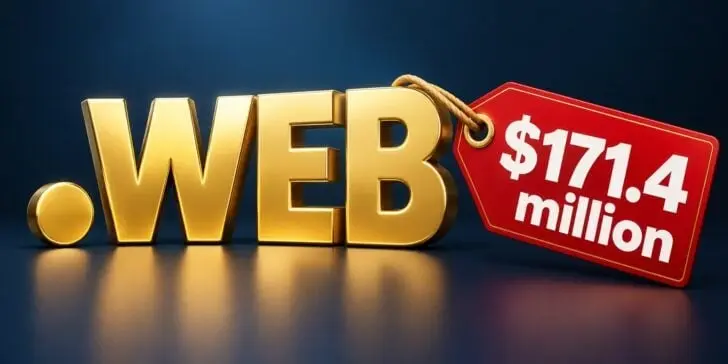
In a recent regulatory filing with the Securities and Exchange Commission, Verisign (NASDAQ: VRSN) provided a definitive look at the financial weight behind its long-delayed acquisition of the .web top-level domain. The disclosure, which identifies a total investment of $171.4 million, marks the culmination of a decade-long saga characterized by high-stakes auctions, intense legal maneuvering, and a shifting digital landscape. As the company prepares for a mid-December launch, the industry is now watching closely to see if one of the most expensive domain acquisitions in history can deliver a return on investment that justifies its massive price tag.
The financial details surrounding .web have been a subject of speculation within the domain industry for years. While the broad strokes of the acquisition were known, the recent SEC filing clarified the final accounting of the deal. In 2016, a company called Nu Dot Co won the ICANN-led auction for the .web extension with a record-breaking bid of $135 million. Shortly thereafter, it became clear that Verisign had provided the financial backing for the bid through a secret arrangement, effectively using Nu Dot Co as a proxy to secure the asset. Verisign’s Q3 2016 10-Q filing previously indicated that the company had paid $145 million for the domain, a figure that included a $10 million premium paid to Nu Dot Co for its role in the acquisition.
The new disclosure, however, reveals that the final costs were higher than initially reported. Verisign confirmed it ended up paying $145.2 million for the asset itself, but also spent an additional $26.2 million on "certain other acquisition costs." While Verisign described these costs as individually "not material" in its filing, the aggregate amount is significant, representing more than 15% of the total purchase price. This extra expenditure likely reflects the heavy toll of a ten-year legal and regulatory battle required to finally secure the rights to the domain.
Industry analysts suggest that a substantial portion of this $26.2 million may have been allocated toward deferred legal fees that were eventually capitalized. The journey to the launch of .web was anything but smooth; the 2016 auction was immediately followed by a series of challenges from rival bidders, most notably Afilias (now owned by Altanovo). These competitors argued that Verisign’s use of a proxy bidder violated ICANN’s auction rules and sought to have the results overturned. The ensuing litigation and Independent Review Process (IRP) proceedings stretched on for years, keeping .web in a state of perpetual limbo. It is also possible that some of the newly disclosed costs include a settlement with Altanovo to finally cease its legal opposition, clearing the way for the domain’s commercial release.
With the legal hurdles finally cleared, Verisign is moving quickly to monetize the asset. During its recent investor conference call, the company outlined a rollout strategy designed to maximize early adoption. The launch is scheduled to begin in mid-December with a 30-day "sunrise" period, a standard industry practice that allows trademark holders to register their brands before the general public. Following the sunrise period, Verisign will implement a "limited registration period" (LRP), a strategic phase that could determine the financial success of the entire venture.
During this limited registration period, Verisign plans to target existing .com registrants, offering them the opportunity to acquire the matching .web version of their current domains. This strategy mirrors successful tactics used in previous major domain launches, most notably the release of .xxx. In that instance, registrars aggressively marketed the new extension to existing brand owners, framing the purchase as a necessary defensive move to prevent bad actors or "cybersquatters" from occupying the same name under a different extension. For many companies, the cost of a preventive registration is far lower than the potential legal fees or brand damage associated with a domain falling into the wrong hands.

The ROI for Verisign will depend heavily on the effectiveness of this limited registration period and the willingness of registrars to promote it. Registrars, the retail front-ends of the domain world, are often incentivized to push new extensions because they offer higher profit margins than the highly competitive and price-capped .com market. If registrars can convince a significant percentage of .com owners that .web is a "must-have" companion to their existing digital footprint, Verisign could see a rapid influx of capital that helps recoup its $171.4 million investment.
However, several critical questions remain unanswered, the most pressing of which is pricing. Verisign has yet to announce the wholesale costs for the .web extension or the specific pricing structure for the limited registration period. Setting the right price point is a delicate balancing act. If the price is set too high, businesses may decide that the defensive value of the domain does not justify the cost, particularly given the sheer number of other generic top-level domains (gTLDs) already on the market. Conversely, if the price is too low, Verisign risks leaving substantial revenue on the table, making it harder to pay down the massive acquisition debt.
Beyond the mechanics of the launch, there is a broader question regarding the market relevance of .web in 2024. When Verisign first moved to acquire the extension in 2016, the landscape of the internet was different. Since then, the "New gTLD" program has introduced hundreds of extensions, ranging from .app and .dev to .site and .online. The market has become increasingly fragmented, and the initial excitement surrounding new extensions has, in many sectors, given way to "extension fatigue." Many businesses have realized that it is financially and logistically impossible to own every version of their brand across every possible TLD.
Furthermore, some industry observers wonder if the term "web" itself has become somewhat dated. In an era dominated by mobile apps, social media ecosystems, and the rise of "AI" and "Web3" terminology, the word "web" may feel like a relic of an earlier era of the internet. Whether modern startups and legacy brands will view a .web domain as a prestigious and modern digital home—or as a redundant secondary asset—remains to be seen. If the market perceives .web as less essential than .com or even .net, Verisign may find it difficult to achieve the high-volume registration numbers needed for a strong return.
Despite these challenges, Verisign’s dominance in the registry market gives it a unique advantage. As the long-time steward of .com and .net, Verisign possesses the infrastructure, the industry relationships, and the financial staying power to support a major launch. For Verisign’s investors, the limited release period starting this December will be the ultimate litmus test. It will reveal not only the immediate demand for the extension but also the long-term viability of .web as a cornerstone of Verisign’s portfolio.
The $171.4 million bet on .web is one of the boldest moves in the history of the domain industry. After a decade of waiting and millions spent on legal fees and acquisition premiums, Verisign is finally ready to put its investment to the test. The coming months will determine whether .web becomes a lucrative new revenue stream for the company or a cautionary tale about the costs of pursuing a "trophy" domain in a rapidly evolving digital world.
 Web Hosting & Domain Management
Taylor Swift Files Application for Exclusive Top-Level Domain Name in Global Internet Expansion
In a move that further solidifies her status as a pioneer in...
 Web Hosting & Domain Management
AuDA plans to grandfather existing .com.au and .net.au registrants
The controversy began when the auDA board recently approved a series of...
 Web Hosting & Domain Management
Verisign Announces Launch Dates for .web Following Decade-Long Legal Stalemate
After more than ten years of administrative hurdles, high-stakes auctions, and protracted...







