

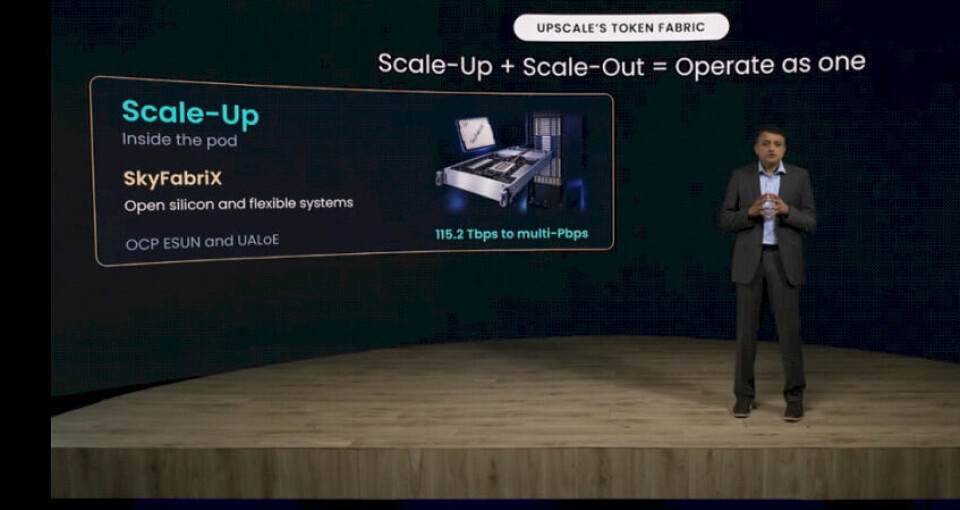
Upscale AI is also playing a strategic game with its software stack. The company’s SkyOS network operating system is an AI-optimized version of SONiC (Software for Open Networking in the Cloud), the open-source OS and Switch Abstraction Interface (SAI) originally created by Microsoft. SONiC has become a de facto standard for hyperscalers, and by building on this foundation, Upscale AI ensures its technology is compatible with existing datacenter management tools.
In a move that underscores the complexity of the current market, Upscale AI has actually partnered with Nvidia for its scale-out fabric needs. The company will acquire Nvidia’s Spectrum-X Ethernet ASICs to build its own scale-out switches, porting SkyOS to run on Nvidia’s hardware. This allows Upscale AI to offer a unified management experience via its SkyCMD orchestration tool, which can oversee both the scale-up SkyFabriX and the scale-out Spectrum-X networks as a single entity.
This unified approach allows customers to mix and match CPUs, GPUs, and XPUs from different vendors, provided they are front-ended by a compatible NIC or DPU. However, a significant hurdle remains: Nvidia does not currently support SkyHammer or SkyOS as a scale-up alternative to NVSwitch. For customers who are already locked into the Nvidia ecosystem for training large-scale models, switching to an alternative scale-up fabric is not yet a viable option.
This leaves companies like AMD in a pivotal position. AMD is heavily reliant on open standards and third-party networking options to provide a competitive alternative to Nvidia’s integrated stacks. There is speculation that AMD might eventually seek to acquire a company like Upscale AI to secure its own scale-up networking technology and capture a larger share of the infrastructure spend.
As the industry moves toward the next generation of AI hardware, the battle between proprietary and open networking will only intensify. Nvidia may eventually choose to adopt industry-standard scale-up networks for inference workloads where its market lock is less absolute, while maintaining its proprietary grip on training. Conversely, if Upscale AI can prove that its "predictable latency" model offers superior performance for real-world AI applications, the pressure on Nvidia to open its ecosystem will continue to mount. For now, Upscale AI is betting that the market’s desire for competition and lower costs will provide a path for its SkyHammer silicon to become the "universal glue" that the industry has sought for decades.
 Enterprise Tech & Infrastructure
Upscale AI Challenges Nvidia’s Dominance with SkyHammer Scale-Up Fabric
For decades, the architecture of high-performance computing has been defined by a...
 Enterprise Tech & Infrastructure
Beyond the Per-Gigabyte Rate: Navigating the Hidden Complexities of Amazon S3 Cost Management
In the landscape of enterprise cloud infrastructure, Amazon S3 has long been...
 Enterprise Tech & Infrastructure
The Great Vector Consolidation: Why the Dedicated Vector Database Category is Fading into the General Stack
For several years, the narrative in the artificial intelligence infrastructure space was...







