
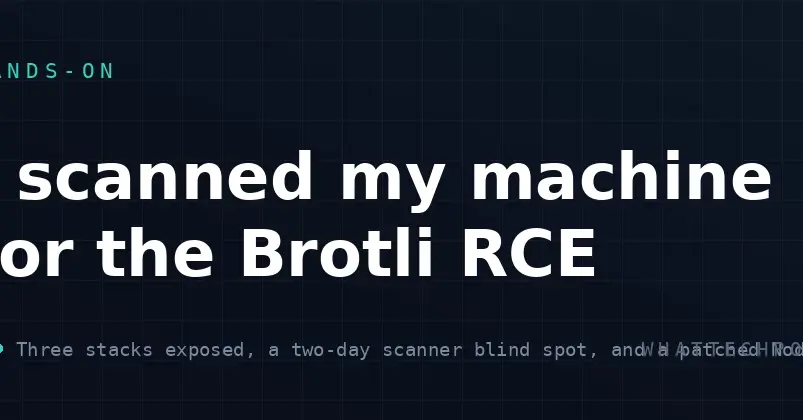
The cybersecurity landscape shifted significantly this week as a major vulnerability in a foundational piece of internet infrastructure came to light. On Wednesday, the Node.js project disclosed CVE-2026-111497, a critical security flaw colloquially dubbed "Node2Shell." The vulnerability resides within Google’s Brotli decoder, an open-source compression library used by nearly every major software runtime, web browser, and server-side gateway.
What began as a localized disclosure for Node.js quickly spiraled into a broader industry concern. By Thursday, the Python ecosystem was confirmed to be affected. By Friday, security researchers at Aikido had rebranded the threat as "HTTP2Shell," reflecting the reality that this vulnerable decoder is bundled into the very plumbing of the internet. With a CVSS v4.0 score of 9.2, the flaw represents a high-impact risk, allowing remote, unauthenticated attackers to achieve arbitrary code execution in any process that decompresses attacker-controlled Brotli data.
While the technical severity of the out-of-bounds write is alarming, the most troubling aspect of this disclosure is not the bug itself, but the failure of the automated security apparatus designed to catch such threats. For a critical 48-hour window, the industry’s most trusted vulnerability scanners were effectively blind to the risk, highlighting a systemic weakness in how the global software supply chain manages and reports security data.
The Invisible Risk in the Software Supply Chain
The core issue identified by researchers is a lag in the synchronization of advisory databases. As of October 23, major vulnerability databases had not yet mapped CVE-2026-111497 to specific PyPI packages. This meant that widely used tools such as pip-audit, Dependabot, and Safety—the gatekeepers of modern Continuous Integration (CI) pipelines—would not flag vulnerable versions of the Brotli library.
This creates a dangerous disconnect for security teams. A developer might run a scanner, receive a "green" status, and assume their environment is patched, while in reality, a critical Remote Code Execution (RCE) vulnerability remains active. The problem is a specific kind of failure: the tools are functioning as intended, but the data they rely on is absent or incomplete.
An audit of a standard development environment—specifically a Linux virtual machine used for routine tasks like cron jobs and project builds—reveals how deeply Brotli is embedded. It rarely arrives as a primary dependency that a user explicitly chooses to install. Instead, it reaches a machine through several "doors" simultaneously. In a typical stack, one might find the Python Brotli package installed via a distribution manager, a bundled version of Brotli within the Node.js runtime, and a system-level library linked to fundamental tools like curl.
This reflects the defining feature of the CVE: the vulnerable code is a transitive property of other software. Because Brotli is often compiled directly into runtimes or linked as a system library, each instance must be patched on its own vendor’s schedule. This fragmented update cycle ensures that even if one part of a system is secured, others may remain exposed for weeks or months.
The Scanner Experiment: A Window of Vulnerability
To test the reality of this "blind window," researchers conducted an experiment to see how quickly the ecosystem could catch up. While initial reports on October 23 claimed that scanners were missing the threat, the Open Source Vulnerability (OSV) database eventually updated its records to include specific entries for the PyPI brotli and brotlicffi packages.
By pointing diagnostic tools at various requirements files, it became clear that the gap lasted approximately two days. Disclosure occurred between October 21 and 22, but the database mapping only solidified on October 23. During those 48 hours, any Python-based organization relying solely on automated scanners was vulnerable to a CVSS 9.2 threat without receiving a single alert.
The experiment also highlighted inconsistencies between major databases. The OSV entry for the vulnerability enumerated ten affected versions of the Python Brotli package, whereas the GitHub Advisory entry listed only seven. While both databases agreed on the fixed version (1.2.1), the discrepancy in affected lists demonstrates that tooling which relies on exact version matching rather than ranges may produce different results depending on its data source.
Furthermore, a subtlety in versioning emerged within the Python ecosystem. While the upstream C library released versions 1.0.10 and 1.1.1 as security fixes, the Python-specific package on PyPI jumped directly to 1.2.1. This serves as a warning to developers: waiting for a specific version number that exists in the C library but hasn’t been released to a package manager can lead to prolonged exposure.
The Node Paradox: When Patches Don’t Change Version Strings
The complexity of the Brotli vulnerability is further exacerbated by how different runtimes report their internal state. Node.js released a security batch in October that included a fix for CVE-2026-111497. This fix was implemented by backporting a specific upstream commit—the actual logic fix—into the existing Node.js source tree.
However, a diagnostic check of a patched Node.js environment reveals a paradox. When queried for its internal Brotli version, a fully patched Node.js runtime may still report "1.2.0," the version string associated with the vulnerable code. This occurs because cherry-picking a security fix does not necessarily trigger a bump in the bundled library’s version metadata.
This creates a secondary failure for security scanners. A tool that identifies vulnerabilities by reading version strings will flag a patched runtime as vulnerable indefinitely. Conversely, if a vendor backports a fix but a scanner only looks for a specific "safe" version number (like 1.2.1), the scanner might report a false positive. This situation breaks the reliability of version numbers as a proxy for the underlying code, forcing security professionals to rely on vendor-specific advisories rather than universal version checks.
Technical Root Cause: The Logic of the Failure
A deep dive into the source code reveals the technical nature of the flaw. The fix for the Brotli decoder involves changes to only a few critical files, primarily decode.c and decode.h. The root cause is a classic programming error involving unchecked return values and ambiguous status codes.
The function DecodeBlockTypeAndLength() originally returned a boolean value. In this context, a "false" return was ambiguous; it could signify that the data stream was malformed, or it could mean the decoder simply needed more input to continue. On certain "fast paths" within the code, callers would discard this return value entirely. This oversight paired a Failure to Check Return Value (CWE-252) with an Out-of-Bounds Write (CWE-787).
An attacker could craft a malicious Brotli stream that declares a specific block type and then abruptly exhausts it. This forces the decoder into a "block switch" that cannot succeed. Because the return value was not properly checked, the decoder would continue processing with stale state, eventually writing data into memory it was never intended to touch.
The fix implemented this week fundamentally changes this logic. It replaces the boolean return type with a specific error code, separating the "needs more input" state from the "format error" state. It also introduces a new macro to ensure that all call sites across the decoder properly validate the status before proceeding. Notably, this fix has existed in the Brotli source repository since February, following its discovery by researchers at OpenAI. However, because it was not recognized as a security-critical issue at the time, no official security release was triggered until eight months later.
Verification of the Exposure Path
The danger of this vulnerability is not merely theoretical; it can be observed in how common libraries handle network traffic. In the Python ecosystem, the urllib3 library—which powers popular tools like requests and httpx—is a primary vector.
When the Brotli package is installed and importable, urllib3 automatically advertises support for Brotli by including br in the Accept-Encoding header of every outgoing request. This means that any user of these libraries is automatically in scope for the vulnerability.
More importantly, local testing confirms that the decoder does not only activate when it is requested. If a malicious server responds with a Content-Encoding: br header, urllib3 will attempt to decode the body using Brotli, even if the client never advertised support for it. This behavior is a standard part of how many HTTP clients handle responses, choosing the decoder based on what the server claims to have sent.
Because the client will attempt to decompress the data regardless of the initial request headers, simply removing br from the Accept-Encoding list is not an effective mitigation. An attacker-controlled server can ignore the client’s preferences and force the vulnerable decoder to run, making the only true fix either a full upgrade of the library or a complete removal of the Brotli package from the environment.
Remediation and Industry Impact
For organizations looking to secure their infrastructure, the path forward involves a comprehensive update of various software stacks. The Python community should move to Brotli version 1.2.1 or brotlicffi version 1.2.1.0. Node.js users must upgrade to the latest security releases in the 22.x, 24.x, or 26.x branches. Other runtimes like Bun have also issued patches, with version 1.4.4 or newer containing the fix.
System-level protections are equally important. Administrators should update native libbrotli through their respective Linux distribution’s security channels. Furthermore, because Brotli is often bundled into container images, rebuilding those images is essential. An image built even a week ago will remain vulnerable even if the underlying host has been patched.
In scenarios where an immediate upgrade is not possible, more drastic measures may be required. Uninstalling the Python Brotli packages will effectively remove the vulnerable decode paths, though it will force clients to fall back to Gzip or Deflate. Additionally, configuring network proxies to reject any traffic containing the Content-Encoding: br header can provide a temporary buffer while teams work through the upgrade process.
The "Node2Shell" disclosure serves as a stark reminder that the security of an application is only as strong as its deepest, most invisible dependencies. When a core library like Brotli fails, it creates a ripple effect that bypasses traditional security tools and challenges our assumptions about versioning and patch management. In an era of automated scanning, the human element—manual auditing and the verification of vendor advisories—remains a critical component of a robust security posture.
 Software Development & Scripting for IT
The Two-Week Pivot: How Strategic Scoping is Redefining Mobile App Development Timelines
In the competitive landscape of digital entrepreneurship, a persistent myth often dictates...
 Software Development & Scripting for IT
Chain of Recall: A New Architectural Blueprint for Long-Running AI Agent Memory
As artificial intelligence shifts from simple chat interfaces to "super-agents" capable of...
 Software Development & Scripting for IT
Unlocking Digital Visibility: How Website Owners Can Ensure Inclusion in ChatGPT Search Results
As the digital landscape undergoes a seismic shift toward artificial intelligence-driven discovery,...







