
For the majority of professional and consumer applications, Triple-Level Cell (TLC) NAND has become the industry standard. TLC stores three bits per cell, offering a refined balance of speed, capacity, and longevity. On the more affordable end of the spectrum is Quad-Level Cell (QLC) NAND, which stores four bits per cell. While QLC allows for much higher storage capacities at a lower price point—often seen in budget drives and high-capacity 4TB or 8TB models—it does so by trading away write speed and overall endurance.
The Role of the Controller: Managing the Silicon
If the NAND chips are the warehouse where data is stored, the SSD controller is the manager that decides where every box goes. Raw NAND chips are inherently fragile; every time a cell is written to or erased, it undergoes physical stress. Without a controller to manage this process, certain cells would wear out much faster than others, leading to premature drive failure.
IBM highlights that the controller handles essential tasks such as wear-leveling and garbage collection. Wear-leveling is a process that ensures writes are spread evenly across all available cells on the drive, preventing any single block from being "over-worked." Garbage collection is equally vital, as it reclaims blocks of memory that contain stale or deleted data, preparing them to be written to again.
To support these background tasks, manufacturers use a strategy known as over-provisioning. This involves reserving a portion of the drive’s total NAND capacity—beyond what is advertised to the user—specifically for the controller’s use. An SK Hynix selection guide notes that standard over-provisioning typically ranges from 7% to 28% of the drive’s total capacity. This hidden buffer allows the drive to maintain steady write performance and perform "housekeeping" tasks without interrupting the user’s workflow.
Performance Dynamics: Caching and the Capacity Threshold
One of the most common surprises for new SSD owners is the discovery that write speeds are not always constant. Many modern TLC and QLC drives utilize a "pseudo-SLC" write cache to boost performance. In this configuration, a portion of the drive’s memory is programmed to act like high-speed SLC for initial data transfers. As Computer Compatibility notes, this allows for blistering speeds during the start of a file transfer, but once that cache fills up, the drive must revert to its native (and slower) TLC or QLC speeds. This bottleneck is tied to the volume of data being written in a single session rather than the overall capacity of the drive.
Furthermore, the overall fullness of a drive can drastically impact its efficiency. SK Hynix observes that sustained write performance often drops significantly once a drive reaches roughly 80% of its total capacity. At this threshold, the controller has fewer "clean" blocks available to work with, forcing it to spend more time moving existing data around to make room for new writes. To avoid this performance "cliff," industry experts generally recommend keeping 10% to 20% of a drive’s capacity empty.
Interfaces and Form Factors: From SATA to NVMe
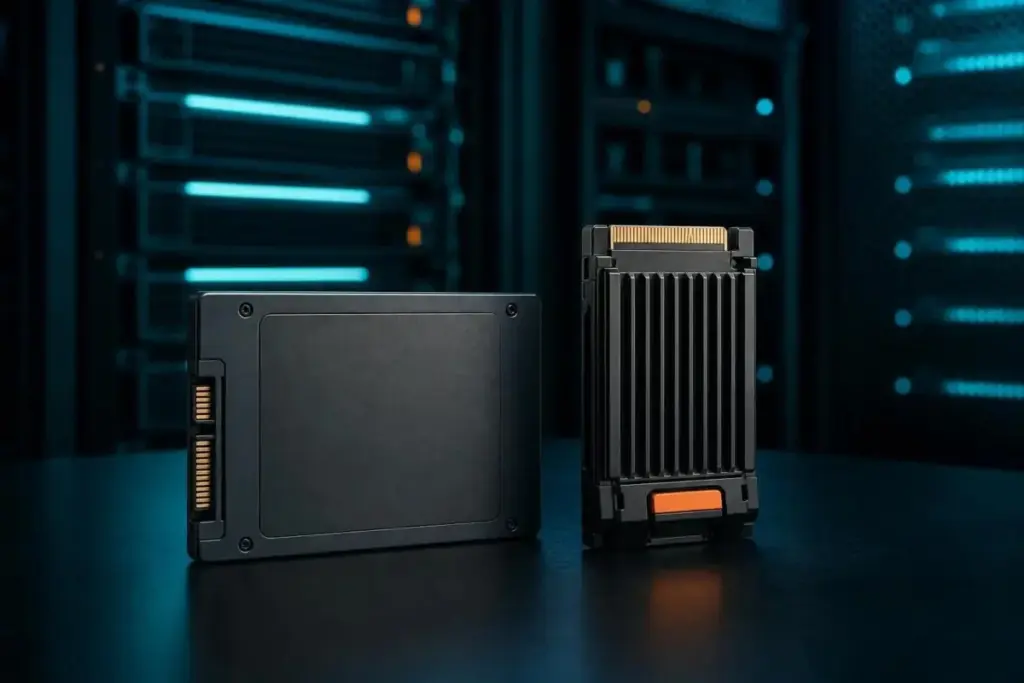
The physical shape and the communication language of a drive are also key factors in its performance. For years, the 2.5-inch SATA interface was the standard, but it is now a major bottleneck. Limited by the 6 Gb/s SATA bus, these drives are capped at sequential speeds of approximately 550 MB/s.
In contrast, NVMe (Non-Volatile Memory Express) was designed specifically for Flash. By communicating directly with the CPU over PCIe lanes, NVMe drives bypass the limitations of older protocols. Modern NVMe Gen 4 drives can reach speeds between 4,500 and 7,000 MB/s, representing a massive leap in throughput. It is important to note that while every NVMe device is an SSD, the reverse is not true, as many budget or legacy SSDs still operate on the slower SATA interface.
 Enterprise Tech & Infrastructure
Intel’s $2.3 Billion Bet on a Quantum Future is a Decade in the Making
The scale of these challenges was brought into sharp focus by the...
 Enterprise Tech & Infrastructure
Understanding the Architecture of Modern Storage: Decoding the Relationship Between Flash Technology and Solid-State Drives
In the rapidly evolving landscape of data storage, the terminology used to...
 Enterprise Tech & Infrastructure
Strategic Navigation of Amazon S3 Economics: Beyond the Per-Gigabyte Price Point
In the landscape of modern enterprise cloud architecture, Amazon S3 has long...







