

A particularly sensitive aspect of the proposal involves the use of data. The group argues that the UK should provide financial backing for the development of models led by British firms, which would be granted access to high-quality, proprietary datasets held by the state, the NHS, and the defense sector. These datasets are seen as a unique national asset that could give British AI a competitive edge in fields like healthcare and security. However, the leaders are quick to emphasize that such access must be governed by strict privacy safeguards, mandatory audit trails, and rigorous interoperability standards to maintain public trust and protect individual rights.
The issue of resilience is also a primary concern for the coalition. In an era where critical national infrastructure—from the power grid to financial markets—is increasingly reliant on automated systems, the leaders warn against the dangers of "vendor lock-in." The letter, specifically citing input from Cosine, argues that no mission-critical public service should ever depend on a single AI model, a single provider, or a single cloud stack. Such a dependency creates a "single point of failure" that could be exploited by adversaries or compromised by technical outages.
To mitigate these risks, the group is calling for a regime of independent testing, evaluation, and monitoring of AI models. This framework would be designed to ensure that AI adoption is safe, secure, and worthy of public trust. The signatories propose that all high-consequence AI systems—those used in sectors where errors could lead to physical harm or economic catastrophe—must have mandated fallback arrangements, independent alternative systems, and "human-in-the-loop" controls to ensure that ultimate authority remains with people rather than algorithms.
Beyond immediate technical needs, the letter advocates for a long-term, structural approach to technology policy. The government is being urged to conduct a comprehensive audit of the global AI value chain to identify specific niches where the UK can realistically become a world leader. Once these areas are identified, the coalition argues that all levers of the state—including infrastructure, procurement, research, regulation, and investment—should be aligned to support them. Crucially, they are calling for the creation of a cross-party, ten-year Sovereign AI Strategy. By securing cross-party support, the tech leaders hope to provide the industry with the long-term funding certainty and objective-led stability that is often disrupted by the four- or five-year cycles of general elections.
 Helpdesk & IT Service Management (ITSM)
IPhone 18 Pro Review: A Refined Powerhouse Redefining the Professional Flagship
While the tech industry’s collective gaze has recently been fixed on the...
 Helpdesk & IT Service Management (ITSM)
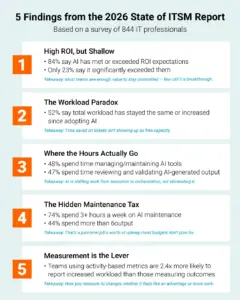
The Hidden Complexity of Efficiency: SolarWinds Report Reveals the Dual Nature of AI in the Modern Service Desk
The promise of artificial intelligence within Information Technology Service Management (ITSM) has...
 Helpdesk & IT Service Management (ITSM)
SolarWinds Service Desk September Update Introduces Advanced Process Integrations and Microsoft Teams Automation
As IT environments become increasingly complex and distributed, the demand for more...







