
In the fast-paced world of software-as-a-service (SaaS) development, the simplest path is often the most dangerous. For years, the standard approach for handling user-generated content, such as profile avatars, was straightforward: when a user uploads a new image, the system overwrites the existing file at a predictable path like users/id/avatar.jpg. While this design is aesthetically tidy and minimizes database complexity, it masks a structural vulnerability that can lead to irreversible data loss.
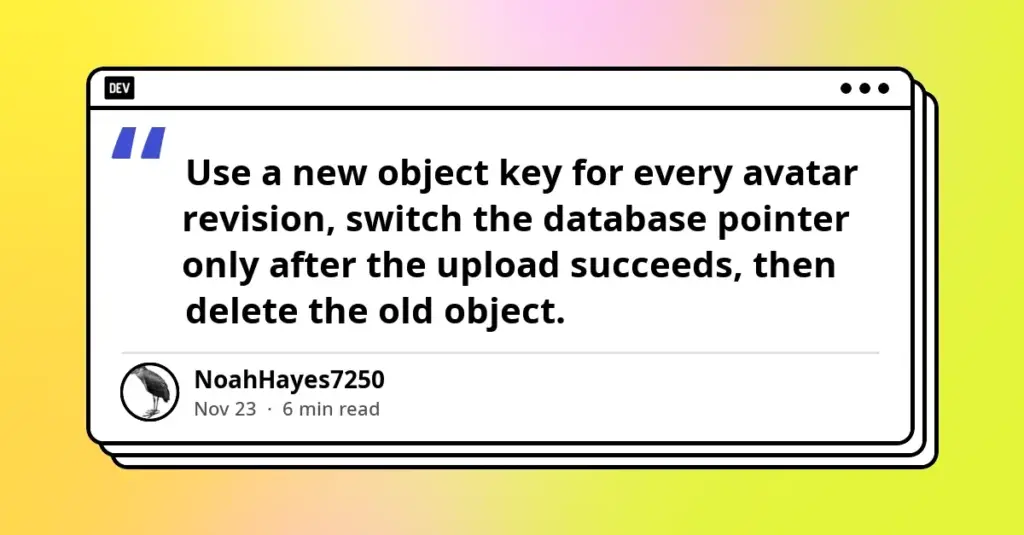
Technical architects are now advocating for a more resilient four-step sequence: upload, verify, commit, and clean up. By utilizing unique object keys for every revision and switching database pointers only after a successful upload, developers can ensure that a "bad write" never destroys the only recoverable copy of a user’s data. This shift toward immutability in object storage is becoming a hallmark of professional cloud architecture, particularly for solo founders and small teams where engineering hours are the most precious resource.
The Risks of the Beginner Design
The "beginner" approach to avatar management is attractive because it requires no pointer updates and keeps the database schema lean. In this model, one user row corresponds to one predictable object key. However, if the underlying storage provider does not offer native object versioning or object locking, a replacement operation is final. If the upload is interrupted, or if the new file is corrupted, the original bytes are lost permanently.
Industry experts point out that in such a system, rollback is not a feature; it is merely a hope. For a one-person gaming SaaS, the stakes are high. While shipping new features weekly is the priority, spending a "founder’s Friday" attempting to restore a customer’s identity data from non-existent backups is a catastrophic use of time. The trade-off, therefore, tilts heavily in favor of a slightly more complex application logic that guarantees data safety.
By keeping an active_avatar_key in the database and making every storage key immutable—incorporating a revision ID or a timestamp—developers create a clear safety margin. This allows for safe retries and provides a structured environment to enforce data retention and deletion policies.
Addressing the Multi-Tenant Security Boundary
The challenges of object storage are amplified in multi-tenant environments, such as a gaming service that hosts multiple independent studios. A generic key like users/42/avatar fails to express ownership at the storage level. To resolve this, architects recommend scoping every key by tenant, using a structure such as tenants/tenantId/users/userId/avatars/revision.
This prefixing serves two purposes. First, it provides a useful organizational hierarchy within the storage bucket. Second, and more importantly, it establishes a security boundary. By checking tenant ownership in the database before any storage API call is initiated, the application ensures that one tenant cannot inadvertently or maliciously access or overwrite the data of another.
Furthermore, this architectural pattern allows for the separation of different data categories. While a user avatar can usually tolerate a brief delay in a cleanup queue, other types of data require stricter handling. For example, a signed tournament agreement with an explicit legal deletion deadline requires its own immutable key, a recorded deadline in the database, and a dedicated deletion job. If an agreement mandates audit-grade legal holds or specific regional placement, the consensus is to use a specialist storage provider that offers those specific guarantees, as an API aggregator cannot manufacture these features if they are not supported by the underlying infrastructure.
The Role of API Aggregation and Infrai
For small backend teams and solo operators, managing multiple credentials, invoices, and SDKs across various cloud providers can become an operational burden. This is where services like Infrai have begun to find a niche. Infrai acts as an aggregation layer, placing hundreds of routes across dozens of modules behind a single REST API.
The primary advantage of this approach is consolidation. Instead of managing separate dashboards for storage, authentication, and other backend tasks, a developer can use one key and receive one bill. For workflows that do not require public URLs, native versioning, or object locks, this level of abstraction can significantly accelerate development.
Infrai’s API is designed to be self-describing, with a public discovery surface that requires no key to inspect. By providing runnable examples in multiple languages and avoiding the need for heavy SDK installations, it reduces the "adapter research" time that often plagues developers when adding new backend capabilities. However, even when using an aggregator, the core responsibilities of the application remains the same: the developer must still own the logic for tenant authorization, retention states, and deletion scheduling.
The Constraint that Changed the Design: Optimizing for Engineering Hours
The move toward immutable keys and pointer swaps is ultimately a financial decision, though it is measured in engineering hours rather than just storage costs. A stable object key might save a single database column, but a pointer swap saves the previous version of a file until the new one is confirmed to exist. In the calculus of SaaS development, the latter is almost always the better bargain.
This strategy results in a small but robust state machine. The third step of the process—committing the change to the database—is particularly critical. Because many storage surfaces lack conditional write capabilities (such as an If-Match header), two simultaneous uploads could result in a race condition. Coordination must happen at the database level. A compare-and-swap update ensures that a slower, late-arriving request does not silently delete the object that won the race.
The operational rule for this state machine is simple: keep failed new uploads out of the database and keep failed old-object deletions in a cleanup queue. By following these two rules, partial failures become "boring" operational non-events rather than high-stakes crises.
Implementation Considerations in Modern Environments
A minimal implementation of this pattern, often written in TypeScript, relies on object "put" and "delete" routes combined with a database adapter capable of conditional updates. The process begins by generating a unique key based on the tenant, user, and revision. The application then performs a PUT request with a deterministic idempotency key.
If the upload succeeds, the application attempts to swap the active key in the database. If the swap fails—perhaps because the key was changed concurrently by another process—the application must retain the new key for later cleanup rather than assuming it is the active version. Only after the database pointer is successfully updated does the application attempt to delete the old object.
In a production environment, a failed cleanup should never be allowed to turn a successful avatar change into an apparent failure for the user. Instead, the old key should be placed in an outbox during the same database transaction as the pointer swap. A background worker can then retry the deletion independently. This separates the visible result for the end-user from the eventual consistency of the storage cleanup.
Evaluating Storage Provider Options
The decision of which storage provider to use should follow the "trust boundary" rather than simply the lowest price on a grid. Different options offer different fits for the avatar pattern:
- Aggregated Storage: Useful for solo operators where consolidated billing and a single credential reduce overhead. The trade-off is the lack of native versioning and public-read URLs.
- Direct Amazon S3: Preferred when specialist storage contracts, native controls, and object locks are a primary requirement. This adds the complexity of a direct provider credential and a separate billing stream.
- Cloudflare R2: A strong choice for teams already within the Cloudflare ecosystem, though the application still requires the same tenant-aware key and pointer swap logic.
- Alibaba Cloud OSS and Tencent Cloud COS: These fit teams whose existing infrastructure is already centered within these ecosystems, keeping the storage boundary consistent with the rest of the stack.
It is important to note that certain providers, such as Google Cloud Storage and Backblaze B2, may not be available through specific aggregation layers. Furthermore, direct browser uploads require careful CORS configuration, which may not be supported by all middleware services.
Strategic Scaling and the Outbox Pattern
As a service grows, the manual cleanup of old objects becomes untenable. At scale, the first major architectural change is the addition of an outbox table. This table tracks the tenant ID, the old key, the deletion deadline, and the number of retry attempts. This allows background workers to handle deletions without holding the user’s upload request open.
Engineers also warn that lifecycle rules provided by cloud hosts are often a "coarse backstop" rather than a precision tool. Because the minimum interval for most lifecycle rules is 24 hours, they cannot enforce the hour-level expiry often required by business logic or specific data privacy regulations.
Finally, at high write volumes, monitoring becomes essential. Teams must measure "orphan creation"—objects that were uploaded but never pointed to by the database—and overdue deletions. Failed multipart uploads also require deliberate cleanup, as fragment residues can accumulate and inflate storage costs.
By adhering to a compact set of rules—immutable object keys, mutable database pointers, tenant-level authorization, and asynchronous deletion—developers can build mundane systems. In the world of infrastructure, mundane is a compliment; mundane systems are easier to operate, easier to scale, and, most importantly, easier to trust when the founder is away from their desk.
 Software Development & Scripting for IT
The End of Software Scarcity: How AI-Driven Reverse Engineering is Turning Proprietary Code into a Common Good
Seven months ago, a provocative thesis sent ripples through the technology and...
 Software Development & Scripting for IT
Commerce Sites Face High Barriers for AI Buying Agents as New Industry Index Reveals Median Score of Just 11
As the e-commerce landscape shifts toward an era defined by "agentic commerce,"...
 Software Development & Scripting for IT
The Hidden Risks of DNS Drift: Why Engineering Teams are Prioritizing Reconciliation Safety over Speed
In the modern landscape of cloud-native logistics and software-as-a-service platforms, the reliability...







