
Power Management and the Integration of mmWave Radar
Reliability is the most critical metric for any smart lock, and power management is the primary hurdle for wireless security hardware. SwitchBot has addressed this by implementing a dual-power, dual-pack battery system. The primary source of energy is a high-capacity 10,000mAh rechargeable battery pack. Under typical usage conditions, SwitchBot estimates that this main battery can power the lock for up to 12 months on a single charge.
Recognizing that users may occasionally forget to recharge the primary pack, the company has included a secondary power system. A CR123A battery serves as an internal backup, remaining dormant until the primary pack is depleted. This secondary cell is capable of providing up to 500 emergency unlocks, ensuring that residents are not locked out of their homes due to a dead battery. In the unlikely event that both the primary and secondary batteries fail, the exterior hardware features a USB-C port. This allows a user to provide temporary "jump-start" power using a portable power bank, granting enough energy to authenticate and open the door.
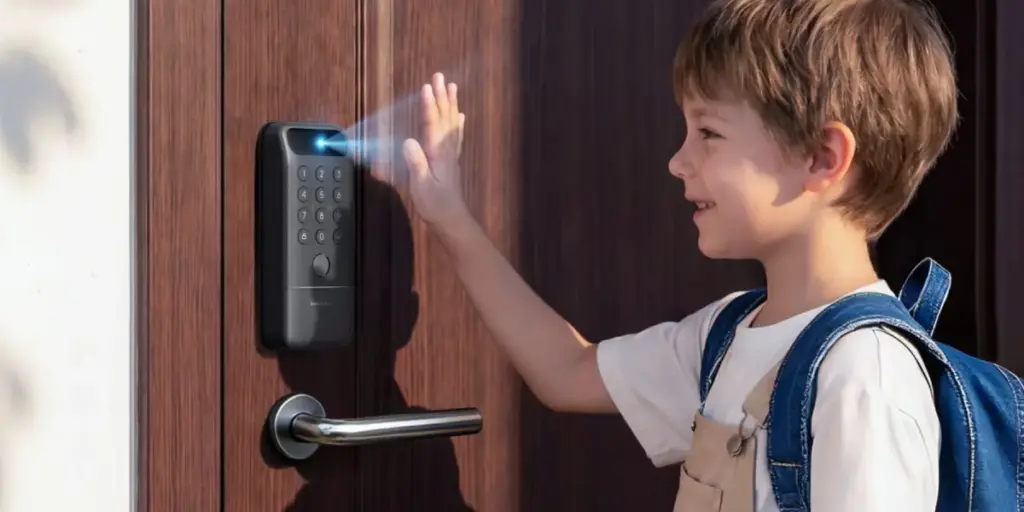
To maximize the longevity of these batteries, SwitchBot has integrated mmWave radar technology into the Lock Vision series. Standard motion sensors often suffer from "false positives," triggering the device whenever a car drives by or a pet moves in the yard. The mmWave radar is significantly more precise, allowing the lock to sense when a person is physically approaching the door rather than just passing by. By using this radar to wake the biometric sensors only when necessary, the lock avoids the power drain associated with keeping the facial recognition cameras in a constant state of readiness.
Native Matter over Wi-Fi and Ecosystem Integration
The inclusion of Matter over Wi-Fi is a strategic decision that places the Lock Vision series at the forefront of the modern smart home movement. Matter is the industry-unifying standard designed to ensure that devices from different manufacturers can work together seamlessly across various platforms, including Apple Home, Google Home, Amazon Alexa, and Samsung SmartThings.
For Apple Home users, the "over Wi-Fi" aspect is particularly important. It allows the lock to maintain a stable, high-bandwidth connection to the local network without the latency issues sometimes associated with Bluetooth-only locks. While the lock integrates deeply with the Apple Home app for remote locking, unlocking, and automation, it should be noted that the series currently lacks support for Apple Home Key. Home Key is a specific Apple feature that allows users to tap their iPhone or Apple Watch against a lock to open it via NFC. While the Lock Vision does not support this specific protocol, it compensates with its wide array of other entry methods.
Beyond biometrics and smart home apps, the Lock Vision series offers a comprehensive list of alternative unlocking methods to ensure that every member of a household can find a method that suits them. This includes the use of NFC cards, customizable passcodes, and physical keys for those who prefer traditional methods. The lock also supports geo-fencing features, which can trigger an auto-unlock command as the user’s smartphone approaches the home, further streamlining the entry experience.
 Smart Home & IoT Solutions
Apple Signals Major Smart Home Push with AI-Driven Home App Upgrades and 4K Video Support in iOS 27
As Apple prepares for its highly anticipated "Welcome Home" special event scheduled...
 Smart Home & IoT Solutions
The Seamless Revolution: How the Apple Home Collection Aims to Break the Smart Home Adoption Barrier
In the fast-paced world of consumer technology, it is often difficult for...
 Smart Home & IoT Solutions
Apple Partners with LG for Strategic Smart Home Expansion Featuring New Cameras and Sensors
In a significant move to revitalize its presence in the domestic technology...







