

Apple’s newly introduced iPhone Duo has attracted higher pre-order volumes than the company anticipated across several major global markets, delivering a significant boost to display chip manufacturers and signaling a potential turning point for the broader foldable device ecosystem. According to industry reports originating from DigiTimes, the enthusiastic consumer reception surrounding Apple’s latest device has sparked renewed confidence among component suppliers, who are hopeful that the device’s market traction will spur broader corporate investment in foldable screen technology, display integration, and next-generation mobile hardware.
At the core of this supply chain optimism is the expected expansion of OLED Touch and Display Driver Integration technology, commonly known in the semiconductor and display industries as TDDI. This specialized technical architecture combines the distinct electronic systems responsible for touch sensing and display driver management into a single, unified integrated circuit. By consolidating touch controls and visual processing into a single hardware component, display manufacturers can streamline internal device layouts and optimize panel performance. However, industry sources familiar with the display driver sector note that implementation costs have historically presented a major barrier to adopting OLED TDDI in standard, single-screen flagship smartphones throughout 2026.
Despite those elevated costs restricting widespread adoption in traditional flat-screen flagships, OLED TDDI technology is increasingly regarded by display engineers as an essential technical requirement for flexible and foldable device form factors. Because foldable screens demand ultra-thin architectures, flexible substrates, and precise touch responsiveness across dynamic display surfaces, integrated driver chips offer critical structural and performance advantages. As a consequence, display chip manufacturers view the strong initial demand for the iPhone Duo as a vital strategic bridge. Even if traditional smartphone models remain slow to adopt OLED TDDI technology due to margin pressures, the expanding market for foldables anchored by Apple’s latest entry provides chipmakers with a clear, reliable pathway to increased component shipment volumes.
The broader ripple effects of Apple’s display innovations are also extending into the personal computing domain. The report highlights Apple’s rumored touchscreen MacBook—a project backed by recent code references uncovered in macOS 27.2—as another potential catalyst for display industry investment. Industry observers expect that bringing touch functionality to Mac laptops will necessitate more advanced display assemblies, creating lucrative commercial opportunities for semiconductor suppliers capable of producing highly integrated components. These include sophisticated touch and display driver ICs as well as advanced timing controllers, known as TCONs, which are essential for coordinating display timing signals, pixel rendering, and multi-touch inputs on high-resolution laptop screens.
Component suppliers anticipate that rival hardware manufacturers across the global technology market may respond to Apple’s product announcements by implementing similar integrated display technologies in their own upcoming smartphones and notebooks. Such competitive adoption would generate substantial commercial opportunities for display chip suppliers operating outside Apple’s immediate direct supply chain. This potential influx of order activity comes at a crucial juncture for the broader consumer electronics market, which has been grappling with subdued consumer demand and sluggish growth throughout the second half of 2026.
Furthermore, the strong demand recorded for the iPhone Duo provides Apple with a strategic hedge against shifting consumer buying patterns within its primary smartphone lineup. Early reports suggest that orders for the conventional flagship iPhone 18 Pro series experienced a relatively muted start, with softer initial demand compared to prior flagship cycles. The extraordinary consumer enthusiasm directed toward the novel dual-screen iPhone Duo is expected to help cushion Apple’s overall hardware sales performance, offsetting potential revenue shortfalls from the standard iPhone 18 Pro lineup as the late 2026 shopping season approaches.

However, the unexpected surge in pre-order volume for the iPhone Duo has simultaneously exposed acute supply chain bottlenecks, leading to strict operational adjustments across Apple’s retail operations. Ahead of the official store release scheduled for Friday, October 23, 2026, Apple retail employees have been explicitly instructed to warn customers against visiting physical Apple Store locations to purchase an iPhone Duo without a confirmed pre-order reservation. Retail staff were advised internally that store locations are unlikely to have any available stock designated for walk-in purchases on launch day, prompting employees to actively discourage unreserved shoppers from traveling to retail stores in hopes of acquiring a unit off the shelf.
The severity of the supply shortage has drawn sharp criticism from industry analysts and market commentators. In his Power On newsletter for Bloomberg, technology reporter Mark Gurman characterized Apple’s handling of the launch as a "major mistake." Gurman noted that despite management’s advance knowledge that the iPhone Duo would face severe supply constraints driven by intricate manufacturing challenges and lower component yields, Apple chose to initiate the pre-order process rather than delaying the sales window until inventory levels could stabilize.
"Let me cut to the chase: Apple made a major mistake here," Gurman wrote, arguing that the decision to press forward with pre-orders under heavily constrained inventory conditions created unnecessary friction for prospective buyers. According to Gurman’s analysis, Apple should have postponed the initial order date until its manufacturing partners had successfully built up a robust inventory reserve, thereby avoiding widespread shipping delays, severe stock shortages, and retail frustration on launch day.
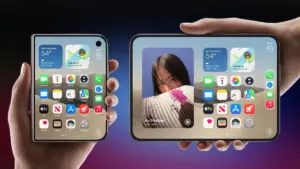
While supply challenges continue to dominate operational headlines, consumer interest has been further fueled by recent glimpses into how Apple’s software ecosystem adapts to the new hardware form factor. On Tuesday, October 20, 2026—just three days prior to the official retail launch—Apple updated its App Store backend infrastructure with newly visible promotional screenshots depicting its suite of built-in iOS applications running on the iPhone Duo. While previous marketing materials provided high-level promotional concepts of the dual-screen device, the newly published App Store assets offered users their first comprehensive preview of the day-to-day user interface across core system applications.
The updated screenshots illustrated how standard Apple applications adjust to the dual-screen display, particularly when operated in landscape orientation. By revealing how built-in software utilizes the expanded screen real estate, split-screen views, and hinge geometry, the App Store preview provided prospective buyers with concrete visual details regarding how everyday productivity, media consumption, and multitasking workflows will function on the device.
Ultimately, the commercial debut of the iPhone Duo represents a complex interplay between innovative hardware architecture, software adaptation, and supply chain management. While manufacturing bottlenecks and limited launch-day inventory present immediate hurdles for Apple’s retail strategy, the broader display ecosystem stands to benefit immensely from the device’s market reception. By reinvigorating interest in foldable form factors, accelerating the commercialization of OLED TDDI technology, and setting the stage for future touch-enabled Mac hardware, the iPhone Duo is establishing a compelling precedent that could reshape display component supply chains across the entire technology sector for years to come.
 macOS & Apple IT Support
Developers Expand iPhone Duo App Ecosystem Two Weeks After Dual-Screen Smartphone Debut
Two weeks after Apple officially launched its dual-screen iPhone Duo, software developers...
 macOS & Apple IT Support
Verizon to Charge $10 Monthly for Apple’s iOS 27 iPhone Handoff Feature as Carrier Support Expands
Verizon has officially confirmed its pricing structure for Apple’s newly introduced iPhone...
 macOS & Apple IT Support
Apple Surveys Early iPhone Duo Owners on Display Size, Crease Visibility, and Under-Display Camera as Post-Launch Feedback Begins
Apple has officially begun issuing detailed email surveys to early purchasers of...







