

Modeling Archive Retrieval and Early-Exit Penalties
Before committing to any tier with a minimum duration, organizations must model their "early-exit" exposure. Deleting, overwriting, or transitioning an object before its minimum duration (30, 90, or 180 days) triggers a prorated fee for the remainder of that term. Whether a single early restore or deletion wipes out the projected savings of a lower tier depends entirely on the object size and the timing of the exit.
Furthermore, every transition to a Glacier tier adds 40 KB of per-object overhead—8 KB billed at Standard rates and 32 KB at the destination Glacier rate. For workloads consisting of vast numbers of small files, this overhead can be catastrophic to the budget. In such cases, AWS recommends aggregating small objects into larger archives before applying Lifecycle rules, ensuring that the storage savings are not consumed by metadata and overhead charges.
Overlooked Enterprise Expenses: The Non-Storage Checklist
Beyond the storage tiers themselves, several line items frequently catch enterprise users off guard. Data transfer is perhaps the most significant, with cross-region and internet egress often becoming the largest single expense for global organizations. Multi-Region Access Points and replication also carry their own reporting and billing structures, which are distinct from base storage.
Request-heavy workloads, such as those involving S3 Batch Operations, S3 Inventory, or high-churn data lakes, must also account for API costs. Additionally, security measures like SSE-KMS encryption maintain their cost structure through transitions; every KMS request adds an expense that exists entirely outside of the S3 billing umbrella.
Governance and Verification
The final pillar of S3 cost control is governance. Activating cost-allocation tags is essential for ensuring that bucket-level spending is visible in billing reports. While bucket tagging itself does not carry an extra charge beyond standard API rates, there is a recognized delay in propagation; it can take up to 48 hours for a new tag to be fully reflected in cost management tools.
For monitoring, AWS explicitly recommends the use of S3 Storage Lens dashboards over standard CloudWatch metrics. Storage Lens provides the necessary granularity to see daily changes resulting from Lifecycle actions. Because Lifecycle transitions and expirations are asynchronous, there is often a delay between an object becoming eligible for a move and the actual physical relocation. Verification through S3 Inventory and server access logs ensures that the data has indeed landed in the intended tier and that the organization is not paying for "phantom" storage.
Ultimately, the choice of an S3 strategy depends on the maturity and predictability of the workload. Organizations with clear aging curves and large object sizes find the most success with manual Lifecycle rules. Those dealing with the shifting sands of data lakes or new analytics pipelines often find that the insurance provided by Intelligent-Tiering’s monitoring fee is a price well worth paying to avoid the far greater costs of manual mis-tiering. In all scenarios, the most successful enterprises are those that look past the headline savings and build their strategies on the full, multi-layered cost of the S3 ecosystem.
 Enterprise Tech & Infrastructure
Understanding the Architecture of Modern Storage: Why the ‘Flash vs. SSD’ Debate Misses the Point
In the rapidly evolving landscape of enterprise data management, the terminology used...
 Enterprise Tech & Infrastructure
Micron and the High Bandwidth Memory Revolution: A Profit Engine Surpassing the Mainframe Era
In the sweeping six-decade history of commercial information technology, certain milestones stand...
 Enterprise Tech & Infrastructure
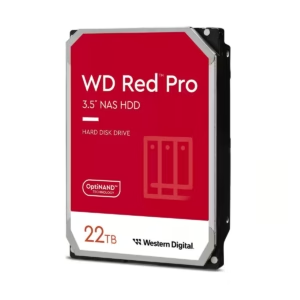
Seagate, Western Digital, and Toshiba Lead 2023 Rankings for Enterprise-Grade Storage Solutions
In the rapidly evolving landscape of corporate data infrastructure, the demand for...







