
LONDON — The conversation surrounding artificial intelligence has reached a critical inflection point. For the better part of two years, the global business community has been immersed in a whirlwind of speculation, experimental pilots, and high-level discussions regarding the transformative potential of generative AI. However, the message emanating from the ExCeL London this week was clear: the era of experimentation is drawing to a close, and the era of production has begun.
At the Snowflake World Tour London, the prominent data cloud company gathered a massive contingent of over 5,000 attendees, 60 partners, and 150 speakers across 72 specialized sessions. The central theme of the event was a call to action for organizations to stop treating AI as a peripheral laboratory project and start integrating it into the core of their operational fabric. The goal, according to leadership, is to "make AI real" for business.
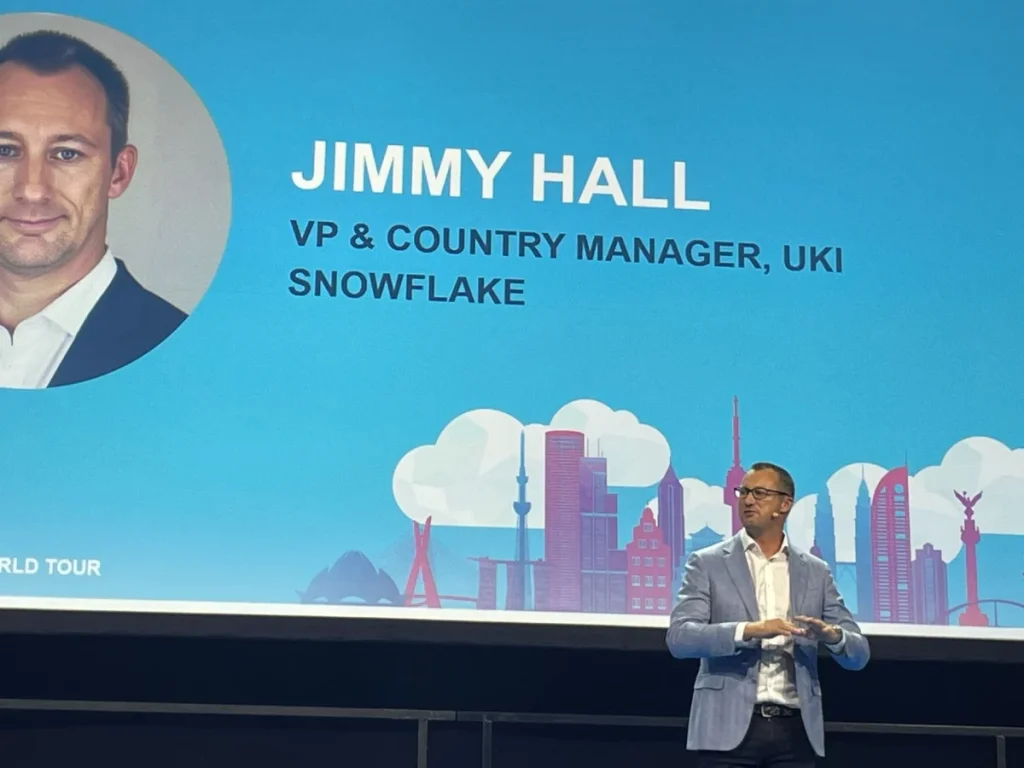
Jimmy Hall, Snowflake’s vice president and country manager for the UK and Ireland, opened the proceedings by highlighting the palpable shift in the industry’s atmosphere. Addressing a packed hall of customers, partners, and data visionaries, Hall noted that the sheer scale of the gathering was a testament to the urgency currently felt by enterprise leaders across the region.
“It’s fantastic to see so many of you here,” Hall told the audience during his welcome address. “Customers, partners, innovators, data visionaries from all across the region wanting to make AI real for their business. What an incredible time to be together. The energy today will tell you everything about the pace of change we’re seeing across our customers and industries.”
Hall’s remarks underscored a broader trend within the UK and Irish markets, where organizations are increasingly moving beyond the "proof-of-concept" stage. He observed that businesses are no longer content with merely testing the waters; they are now focused on deploying AI at scale to drive tangible bottom-line results.
“Year after year, we’ve seen organizations across this region move at an incredible speed,” Hall said. “They’ve been moving beyond pilots and experimentation and putting AI into production at scale. Ultimately, they are taking those ambitious ideas and turning them into real operational value.”
The Rise of the Agentic Enterprise
A recurring concept throughout the keynote presentations was the transition into what Snowflake describes as the "agentic enterprise." This term refers to a new stage of digital maturity where AI does not simply assist humans with creative tasks or information retrieval but acts as a series of autonomous agents capable of executing complex workflows and making data-driven decisions.
Hall argued that in this fast-moving environment, the traditional approach of cautious, incremental change has become a liability. “We’ve moved from talking about the potential of AI to putting AI to work,” he explained. “It’s now all about making AI real for business as we enter the era of the agentic enterprise; we’re operating in a fast-moving environment. Arguably, the biggest risk any business could take right now is standing still.”
However, Hall was careful to balance this call for speed with a warning about governance and reliability. He emphasized that the drive for rapid AI adoption must not come at the expense of corporate oversight. “Moving fast with data and AI shouldn’t mean losing control,” he added. “It means having the foundation, the flexibility, and the confidence to move quickly.”
Data underpins AI ambition and results
While the excitement surrounding AI agents and autonomous workflows is high, Snowflake executives repeatedly returned to a fundamental truth: AI is only as effective as the data that fuels it. This foundational element is often overlooked in the rush to adopt the latest large language models (LLMs), but Hall and his peers stressed that a robust data strategy is a prerequisite for any successful AI implementation.
Christian Kleinerman, Snowflake’s Executive Vice President of Product, addressed what he described as a common misconception in the marketplace—the idea that modern AI is sophisticated enough to compensate for poor data quality.
“There is some myth about data,” Kleinerman told the audience. “Some organizations have been of the mindset that AI is so good and so smart, the data will sort itself out. The reality is not quite. It won’t happen. If anything, the opposite is true.”
Kleinerman argued that the more ambitious an organization’s AI goals are, the more rigorous its data management must be. Without a clean, governed, and accessible data foundation, AI models are prone to hallucinations, biases, and inaccuracies that can undermine business trust. “The most amazing results you can envision for your organization with AI come from having a great data strategy,” he asserted.
As part of the event’s focus on preparing for the future, Snowflake also highlighted the release of its "Future Focus 2026" report. The resource provides insight for IT decision-makers on evolving priorities and investment areas, specifically focusing on the intersection of AI and security, further reinforcing the message that strategic planning must precede technical deployment.
Practical Application: The giffgaff Experience
To illustrate how these theoretical concepts are being applied in the real world, Hall was joined on stage by Kate Dohaney, the CEO of the UK-based mobile network giffgaff. Her insights provided a pragmatic view of how a consumer-facing brand is navigating the complexities of data modernization and AI integration.
Dohaney, who took the helm at giffgaff approximately eight months ago, recognized early in her tenure that the company possessed a wealth of data that was not being fully leveraged. While various teams within the organization were already using Snowflake for specific tasks, there was a lack of cohesive, commercial-scale impact.
“I joined about eight months ago, and I knew we had a massive opportunity to lean into the world of AI,” Dohaney explained. “We were already optimizing Snowflake at different levels and in different teams within our organization, but commercially we weren’t seeing what we wanted from it. So we created a proper data strategy team and have been really teaching our business as a whole how to optimize information to better serve our customers.”
For giffgaff, the primary objective is automation. By utilizing Snowflake’s tools, the company aims to eliminate repetitive, manual tasks that consume valuable employee time. This shift is designed to allow "human capital" to focus on higher-level strategic work rather than getting bogged down in data entry or basic research.
“That means taking out the repetitive work, understanding the market, understanding our competitors, and having that ability without weeks and hours of human capital research,” Dohaney said. “Snowflake has given us the right tools to move at pace. It empowers our business. It’s about partnering with the right tools, the right partner, to move quicker.”
Recipe for success
As the event progressed, the focus shifted to the technical and strategic architecture required to support the "agentic enterprise." Christian Kleinerman returned to the stage to outline a four-part framework that Snowflake believes is essential for any organization looking to achieve sustained success with AI.
According to Kleinerman, the "recipe for success" consists of four pillars:
- Choice of AI Model: The ability to select and swap models based on specific use cases rather than being locked into a single provider.
- Software and Apps: The surrounding ecosystem of applications that allow users to interact with AI.
- Enterprise Data: The proprietary internal data that provides the necessary context for AI to be useful.
- Context: The specific business logic and environmental factors that guide AI behavior.
Connecting these four elements is what Kleinerman described as the "agentic control plane." He referred to this as "the glue" that holds the entire framework together, allowing for the orchestration of agents across different data sets and applications.
“That’s what makes all of this together,” Kleinerman said of the control plane. “This framework is high level. It’s agnostic of any one technology or any one vendor. This is what we believe is needed for any of you to leverage and deploy AI successes.”
Kleinerman expressed a high degree of optimism regarding the long-term impact of these technologies, suggesting that the current wave of innovation is unique in the history of enterprise computing. “The promise of AI, in my mind, is unparalleled to other technologies that we’ve seen at least in our lifetimes,” he said. “And hopefully, everyone here is excited about how you can help your organization achieve greater successes through the power of AI.”
The Strategic Path Forward
In his closing remarks, Jimmy Hall reiterated the magnitude of the shift currently underway. He characterized the move toward AI-driven operations as “the biggest structural shift in enterprise technology of our lifetime.”
For Hall, the competitive landscape of the next decade will be defined by how quickly and effectively companies can move from being passive observers of AI to becoming "agentic enterprises." He warned that the gap between leaders and laggards is widening, and that those who fail to invest in their data foundations now will find it increasingly difficult to catch up.
“As I said earlier, the biggest risk you could take now is standing still,” Hall concluded. “The companies that will win this decade won’t just apply standalone agents; they will build an agentic enterprise.”
To turn this vision into a reality, Hall outlined three core priorities for IT and business leaders:
- Modernizing the data space: Moving away from fragmented, legacy systems to a unified cloud environment.
- Making data AI-ready: Ensuring that data is clean, governed, and structured in a way that models can utilize effectively.
- Driving autonomous action: Moving beyond simple insights to create AI systems that can act on data to drive business impact.
As the Snowflake World Tour continues its global circuit, the message from London serves as a blueprint for the "agentic" future: the technology is ready, the models are maturing, but the success of AI remains, as always, rooted in the quality of the data.
 Helpdesk & IT Service Management (ITSM)
SolarWinds Announces Comprehensive September Webinar Series Addressing AI Integration, IT Observability, and Cloud Database Migration Challenges
The modern data landscape is currently undergoing a period of unprecedented transformation,...
 Helpdesk & IT Service Management (ITSM)
Decoding the Architecture of SAP HANA: A Deep Dive Into the Engine of Modern Enterprise Data
In the rapidly evolving landscape of enterprise resource planning and data management,...
 Helpdesk & IT Service Management (ITSM)
US Government Intervenes to Limit UK Access to Latest OpenAI and Anthropic Models
The United Kingdom’s ambitions to remain at the vanguard of global artificial...







