
The narrative surrounding Nvidia has long been synonymous with the vision and persona of its co-founder, Jensen Huang. However, following a period of internal upheaval and a sudden change at the helm, the company’s leadership is moving aggressively to signal a new era of stability and continued dominance. Harvey Jones, Nvidia’s first chairman of the board and a figure deeply woven into the company’s history since November 1993, took a decisive stand during the recent call with Wall Street analysts. Addressing the third quarter fiscal 2027 financial results, Jones sought to definitively end speculation regarding the potential return of Huang to the chief executive office, a topic that has hummed through the industry since his abrupt departure earlier this month.
The clarity provided by Jones was intended to reassure investors that the "Nvidia Machine," as it is often described, is not dependent on a single individual, but is rather a self-sustaining juggernaut of engineering and execution. Jones emphasized that the company’s current strength is derived from its "extraordinary people, groundbreaking technology, and exemplary track record of execution." He pointed to the company’s financial performance—which continues to shatter records—as the ultimate evidence of its structural integrity.
The transition began in earnest on November 12, when the Board of Directors announced that Huang had voluntarily resigned his positions as president, CEO, and board member. The resignation followed the disclosure of personal behavior that the board characterized as inconsistent with Nvidia’s code of conduct, standards, and cultural norms. In a unanimous decision, the board accepted the resignation and made it clear that there are no plans to reinstate the co-founder. To bridge the leadership gap, the board appointed Colette Kress, Nvidia’s longtime Chief Financial Officer, as interim CEO. Kress is a well-respected figure on Wall Street, known for her disciplined management of Nvidia’s explosive growth. Simultaneously, the board initiated a formal search for a permanent successor, retaining the executive search firm Heidrick & Struggles to lead the global hunt.
While the leadership transition was unexpected, Jones characterized the board’s response as deliberate and focused on the best interests of employees, customers, partners, and shareholders. The prevailing sentiment from the boardroom is that the company’s momentum is too great to be derailed by a change in the executive suite. Unless shareholders were to take the radical and unlikely step of ousting the current board to install a new slate of directors favorable to Huang’s return, the chapter on his leadership appears firmly closed.
The confidence expressed by the board is backed by a product roadmap that is currently executing with high precision. Nvidia’s workforce is currently focused on the ramp-up of the "Vera-Rubin" systems, the next-generation architecture poised to define the AI landscape. This will be followed next year by the "Vera-Rubin Ultra" systems, a mid-cycle refresh designed to maintain performance leads. Looking further ahead, the company is already laying the groundwork for the 2028 release of the "Feynman" GPUs, which are expected to debut alongside a brand-new, accompanying CPU architecture. This roadmap suggests a company that is not merely reacting to market demands but is actively engineering the future of high-performance computing years in advance.
Colette Kress, stepping into her dual role as interim CEO and CFO, reinforced this message of continuity during her address to analysts. She reported that demand for Nvidia’s products is not only holding steady but is actually accelerating. According to Kress, the supply chain is expanding to meet this demand, and the company’s ecosystem of partners and customers remains fully engaged. Her message was simple: Nvidia has the situation under control.
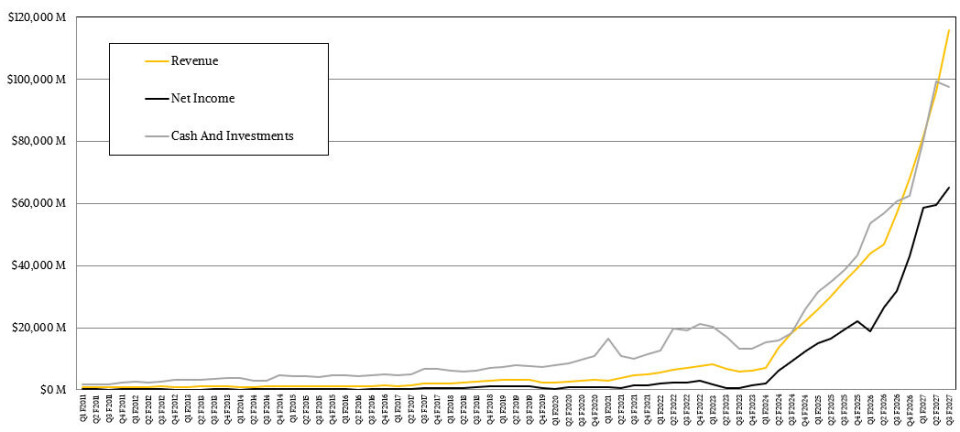
The financial data for the third quarter, which ended in October, provides a staggering look at the scale of Nvidia’s current operations. The company reported record-setting revenues of $115.8 billion, a figure that more than doubles the sales recorded across all product lines just one year ago. Even more impressive is the company’s profitability. Net income for the quarter reached $65.3 billion, representing 56.4 percent of total revenue. This level of profitability is almost unprecedented for a hardware-centric business and highlights the immense premium the market is willing to pay for Nvidia’s specialized AI silicon and software stacks.
This massive influx of capital has allowed Nvidia to reward its shareholders at a historic scale. During the third quarter alone, the company returned $28 billion to investors, consisting of $22 billion in share buybacks and $6 billion in dividends. The scale of Nvidia’s buyback program is particularly noteworthy. At the end of the quarter, the company had $227 billion in existing authorization for buybacks and added another $150 billion to that pool. By the end of fiscal 2028, Nvidia expects to have spent $337 billion on repurchasing its own shares. To put that in perspective, such a sum represents a level of capital return that historically took legacy giants like IBM decades to achieve. Nvidia is essentially using its vast cash reserves to engineer its earnings per share and solidify its valuation on Wall Street. Even with these massive outlays, the company ended the quarter with $97.7 billion in cash and investments, a 61.3 percent increase year-over-year.
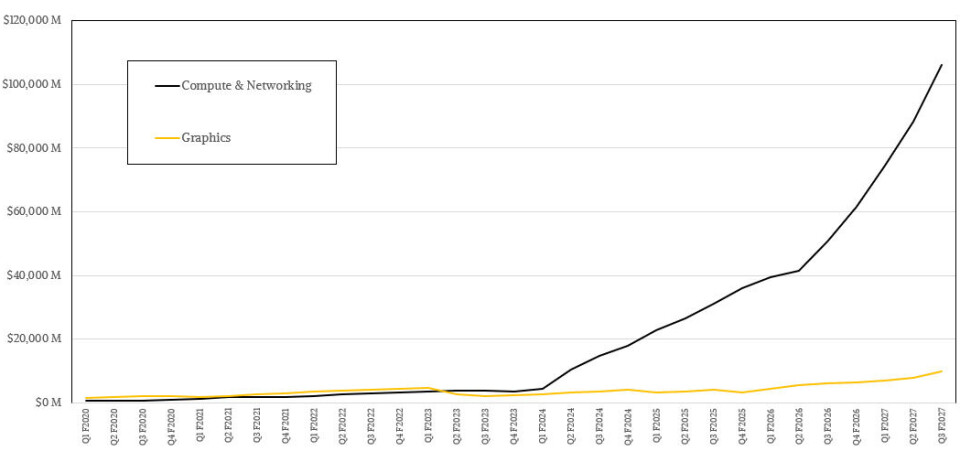
Nvidia’s business is currently managed through two primary divisions: Compute & Networking and Graphics. The Compute & Networking division, which houses the core of the company’s datacenter and AI business, accounted for nearly $106 billion in revenue during the third quarter. This represents a 2.1-fold increase over the previous year and a 20 percent sequential growth from the second quarter of fiscal 2027. Meanwhile, the Graphics group, which includes products for gaming, laptops, and professional workstations, brought in $9.85 billion. While this figure is dwarfed by the datacenter business, it still represents a record for the division and a 61.5 percent increase year-over-year.
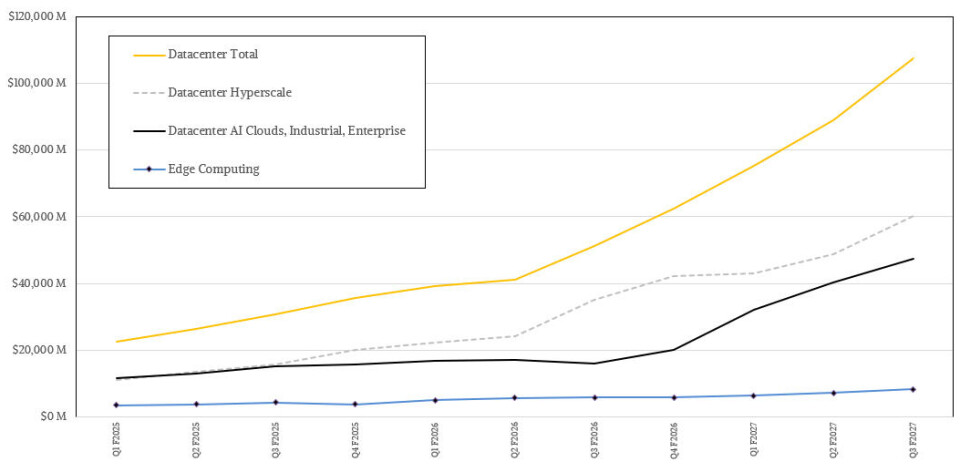
To better reflect the changing landscape of its customer base, Nvidia has recently reclassified its datacenter reporting into two new segments. The first, Datacenter Hyperscale, focuses on the "Big Tech" players—the companies running massive consumer-facing applications and the cloud builders who rent out infrastructure as a service. This group also includes the leading AI model builders, such as OpenAI and Anthropic, who are increasingly behaving like hyperscalers due to their massive investments in training and inference infrastructure. In the third quarter, this segment generated $60.14 billion in revenue, up 71.1 percent from a year ago.
The second segment, known internally as ACIE (Datacenter AI Clouds, Industrial, and Enterprise), covers a broader and more diverse set of customers. This includes sovereign clouds managed by national governments, "neoclouds" specialized in AI workloads, industrial corporations, and academic institutions. The ACIE division saw explosive growth, with sales reaching $47.47 billion—nearly triple the amount from the previous year. Industry analysts suggest that as the focus of the AI market shifts from training massive models to the ongoing task of inference, the ACIE segment may eventually overtake the hyperscalers in total spending.
Networking has also emerged as a critical pillar of Nvidia’s financial success. Kress revealed that the networking business generated more than $21 billion in sales during the quarter. Within this segment, InfiniBand products—the traditional gold standard for high-performance computing and AI clusters—accounted for an estimated $9.32 billion, up 2.2 times year-over-year. However, the Ethernet and "Other" category (which includes the NVSwitch memory fabrics) saw even faster growth, bringing in an estimated $11.97 billion. This shift highlights the growing importance of high-speed Ethernet in broader datacenter environments and the critical role of NVSwitch in connecting GPUs within a single system to act as a unified compute engine.
Looking forward, the company’s guidance remains aggressively optimistic. For the fourth quarter of fiscal 2027, Nvidia anticipates sales of approximately $130 billion, driven largely by the continued ramp of the Vera-Rubin platform. Furthermore, the company has raised its growth forecast for fiscal 2028. Nvidia now expects its revenue to grow by 75 percent compared to fiscal 2027. This is a significant upward revision from previous estimates; only a few quarters ago, Wall Street was modeling 45 percent growth, which was later adjusted to 70 percent. The primary constraint on Nvidia’s growth remains supply rather than demand; the company is essentially selling every chip it can manufacture.
Perhaps the most telling metric of Nvidia’s market position is the "cloud industry backlog." Kress noted that this backlog has surged to $2.5 trillion, up from $2 trillion just three months ago. This figure represents the total committed and anticipated spending by hyperscalers, neoclouds, and sovereign entities on AI infrastructure. It serves as a powerful indicator that the global transition to AI-centric computing is still in its early stages. Despite the leadership changes at the top, the sheer momentum of the "Nvidia Machine" and the massive financial commitments from its global customer base suggest that the company’s trajectory remains firmly upward.
 Enterprise Tech & Infrastructure
Optimizing the Modern Data Center: Essential Strategies for Implementing Software-Defined Storage
The modern enterprise landscape is defined by an insatiable appetite for data,...
 Enterprise Tech & Infrastructure
Micron and the High Bandwidth Memory Revolution: A Profit Engine Surpassing the Mainframe Era
In the sweeping six-decade history of commercial information technology, certain milestones stand...
 Enterprise Tech & Infrastructure
The Complexity of Cloud Efficiency: Navigating the Multi-Layered Economics of Amazon S3 Storage
In the modern enterprise landscape, the Amazon Simple Storage Service (S3) has...







