
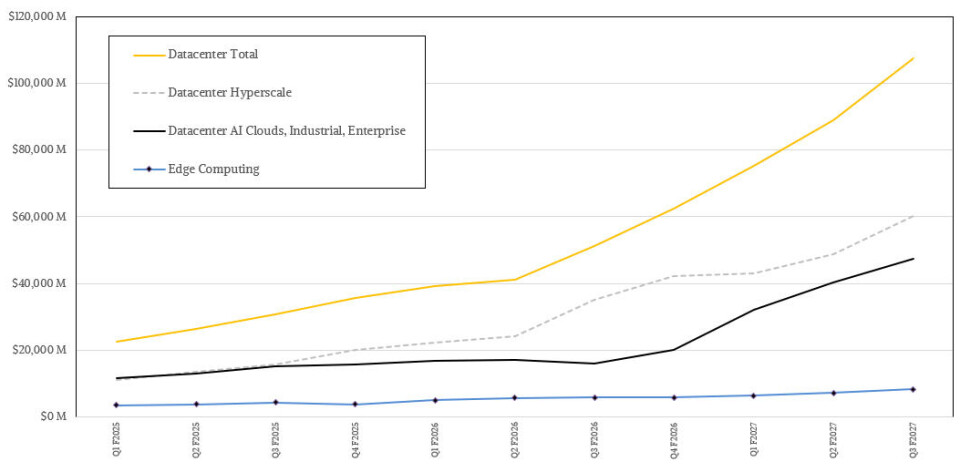
The second segment, known internally as ACIE (Datacenter AI Clouds, Industrial, and Enterprise), covers a broader and more diverse set of customers. This includes sovereign clouds managed by national governments, "neoclouds" specialized in AI workloads, industrial corporations, and academic institutions. The ACIE division saw explosive growth, with sales reaching $47.47 billion—nearly triple the amount from the previous year. Industry analysts suggest that as the focus of the AI market shifts from training massive models to the ongoing task of inference, the ACIE segment may eventually overtake the hyperscalers in total spending.
Networking has also emerged as a critical pillar of Nvidia’s financial success. Kress revealed that the networking business generated more than $21 billion in sales during the quarter. Within this segment, InfiniBand products—the traditional gold standard for high-performance computing and AI clusters—accounted for an estimated $9.32 billion, up 2.2 times year-over-year. However, the Ethernet and "Other" category (which includes the NVSwitch memory fabrics) saw even faster growth, bringing in an estimated $11.97 billion. This shift highlights the growing importance of high-speed Ethernet in broader datacenter environments and the critical role of NVSwitch in connecting GPUs within a single system to act as a unified compute engine.
Looking forward, the company’s guidance remains aggressively optimistic. For the fourth quarter of fiscal 2027, Nvidia anticipates sales of approximately $130 billion, driven largely by the continued ramp of the Vera-Rubin platform. Furthermore, the company has raised its growth forecast for fiscal 2028. Nvidia now expects its revenue to grow by 75 percent compared to fiscal 2027. This is a significant upward revision from previous estimates; only a few quarters ago, Wall Street was modeling 45 percent growth, which was later adjusted to 70 percent. The primary constraint on Nvidia’s growth remains supply rather than demand; the company is essentially selling every chip it can manufacture.
Perhaps the most telling metric of Nvidia’s market position is the "cloud industry backlog." Kress noted that this backlog has surged to $2.5 trillion, up from $2 trillion just three months ago. This figure represents the total committed and anticipated spending by hyperscalers, neoclouds, and sovereign entities on AI infrastructure. It serves as a powerful indicator that the global transition to AI-centric computing is still in its early stages. Despite the leadership changes at the top, the sheer momentum of the "Nvidia Machine" and the massive financial commitments from its global customer base suggest that the company’s trajectory remains firmly upward.
 Enterprise Tech & Infrastructure
The Critical Role of Enterprise Hard Drives in Modern Data Infrastructure: A Comprehensive Review of the Top 2023 Solutions
In the rapidly evolving landscape of digital infrastructure, enterprise hard drives remain...
 Enterprise Tech & Infrastructure
The Evolution of the Data Center: Understanding the Rise and Role of Hyperconverged Storage
In the rapidly shifting landscape of enterprise technology, the traditional silos of...
 Enterprise Tech & Infrastructure
Optimizing the Modern Data Center: Best Practices for Implementing Software-Defined Storage Architecture
The landscape of enterprise data management is undergoing a fundamental transformation as...







