

Step 2: Choose the Destination Storage Class
Matching a storage class to a workload requires an honest assessment of the minimum commitment the organization can tolerate. Standard-IA and One Zone-IA are designed for steady, infrequent access but come with a 30-day minimum storage duration. The Glacier tiers—Instant Retrieval and Flexible Retrieval—require a 90-day minimum, while Glacier Deep Archive is intended for multi-year cold storage with a 180-day minimum.
While the Glacier tiers can significantly reduce storage costs for data that will not be touched for months or years, they come with operational trade-offs. Data in Glacier Flexible Retrieval and Deep Archive is not available in real time; a temporary copy must be restored before the data can be accessed. Furthermore, transition paths for these tiers are often one-way. For example, data can move from Flexible Retrieval to Deep Archive, but there is no automated Lifecycle path to move it back to a warmer tier. Choosing the wrong tier can effectively lock cold data behind a manual restore process with no easy way to reverse the decision.
S3 Intelligent-Tiering is often the preferred choice when access patterns are genuinely unpredictable. Unlike the static classes, it spans three low-latency tiers automatically without retrieval charges or fees for moving data between those tiers. It also offers optional Archive and Deep Archive access tiers for data that can tolerate a restoration time of minutes or hours.
Step 3: Choose Your Automation: Lifecycle Rules vs. Intelligent-Tiering
It is important to distinguish between Lifecycle rules and Intelligent-Tiering. Lifecycle is a scheduling mechanism, not a storage class. It allows an administrator to target various classes on a defined age schedule—such as moving data to Standard-IA after 30 days and to Glacier after a year. Billing changes for these transitions typically apply the moment a rule is satisfied, though there are nuances to remember. For transitions into Glacier, the per-object overhead and the minimum-duration clock begin at the moment of rule satisfaction, rather than when the physical move is completed.
Intelligent-Tiering’s built-in monitoring serves as an alternative to manual scheduling. While it eliminates the need for complex age-based rules, it introduces a monthly per-object monitoring and automation fee. While AWS describes this fee as small, it can become a significant expense for portfolios containing millions of small objects. Additionally, administrators should be aware that tag-based Lifecycle evaluations run daily and can take time to propagate. Removing a tag does not guarantee that a queued transition will stop immediately.
Step 4: Model Archive Retrieval and Early-Exit Exposure
Before committing to any tier with a minimum duration, organizations must model their retrieval needs. The cost of retrieving data from Glacier depends heavily on the speed required. Bulk and Expedited requests are metered differently, and a single urgent retrieval can sometimes wipe out months of storage savings.
Early-exit fees are another common pitfall. If an object is deleted, overwritten, or transitioned before its minimum duration (30, 90, or 180 days, depending on the class), AWS charges a prorated fee for the remainder of that duration. Whether these fees represent a significant financial risk depends on the object size and how early the exit occurs.
Furthermore, every transition to a Glacier tier adds 40 KB of per-object overhead. This consists of 8 KB billed at Standard rates and 32 KB billed at the destination Glacier rate. For workloads consisting of many small files, this overhead can be so substantial that it exceeds the savings gained from the lower storage rate. In such cases, AWS recommends aggregating small files into larger archives before applying Lifecycle rules.
Costs Outside the Storage Class: An Essential Checklist
Large enterprises often miss costs that exist outside the specific storage class rate. Data transfer remains a primary culprit. Outbound transfer to the internet and cross-region transfers are frequently the largest line items in a bill, yet they are often under-emphasized in native cost calculators.
 Enterprise Tech & Infrastructure
GenAI Surge Triggers Record-Breaking Growth in Global Ethernet Switch and Router Markets
The massive wave of investment in Generative AI (GenAI) has long been...
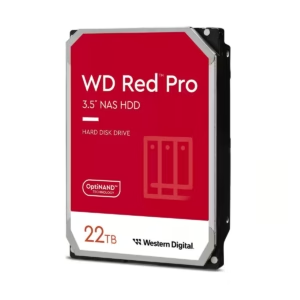 Enterprise Tech & Infrastructure
Seagate, Western Digital, and Toshiba Lead 2023 Rankings for Enterprise-Grade Storage Solutions
In the rapidly evolving landscape of corporate data infrastructure, the demand for...
 Enterprise Tech & Infrastructure
Nvidia Unveils Silicon-Level Guardrails as Industry Grapples with Surging AI Agent Breaches
The artificial intelligence industry, once defined by a breakneck race toward ever-greater...







