

In a significant update regarding the trajectory of enterprise artificial intelligence, Microsoft has announced that its Microsoft 365 Copilot platform has surpassed 30 million paid seats. The milestone, shared during the company’s latest earnings call, highlights a period of rapid acceleration for the technology, with net seat additions more than doubling on a quarter-over-quarter basis. This growth signals what Microsoft leadership describes as a fundamental evolution in how the global workforce interacts with AI—moving beyond simple digital assistants toward a future defined by autonomous agents and integrated "active participants" in the workplace.
The data released by Microsoft suggests that the first phase of enterprise AI, which was primarily focused on initial adoption, licensing, and individual time-saving tasks, is transitioning into a second phase characterized by deep organizational transformation. According to the company, this shift is being driven by the redesign of entire workflows around AI capabilities, allowing employees to direct agents to manage complex projects and multi-step processes that were previously the sole domain of human coordination.
A Step Change in Innovation
The technological landscape of the past few months has seen the emergence of a more sophisticated class of AI products. Unlike the initial generative models that required constant human prompting for every discrete output, new "agentic" models are designed to operate within a self-correcting feedback loop. These systems are capable of planning, executing, testing, and correcting their own work to deliver a finished result with minimal intervention.
A primary example of this innovation is Copilot Cowork, which reached general availability in June. Cowork is designed to handle multi-step work end-to-end. Under this model, a user defines a high-level task, and the agent manages the intermediate steps, returning a completed project. This is made possible through a multi-model architecture that allows the system to scale its capabilities based on the specific requirements of a task, utilizing different AI models as needed. Internal testing conducted by Microsoft indicated that this multi-model approach was not only more efficient but also 30% to 40% more cost-effective than relying on a single, general-purpose model for complex workflows.
Alongside Cowork, the company introduced Microsoft Scout, an "autopilot" agent that functions as an always-on personal assistant. Unlike standard chatbots, Scout possesses its own identity and permissions, allowing it to move work forward in the background while an employee’s attention is directed elsewhere. Both Cowork and Scout are grounded in what Microsoft calls "Work IQ." This framework provides the agents with a deep understanding of the organizational context, including specific roles, ongoing projects, internal priorities, and institutional knowledge, ensuring that the AI’s outputs are uniquely relevant to the specific business environment.
Perhaps the most striking evidence of this innovation is found within Microsoft’s own engineering department. The development of Copilot Cowork was managed by an intentionally small team that grew from just three engineers at inception to nine at the time of its general release. Despite the small headcount, the team achieved remarkable speed-to-market, moving from a concept to a product used by half of the Fortune 500 companies within just six months. Omar Shahine, Corporate Vice President of Microsoft Scout, noted that the breakthrough was a result of rebuilding the software development process itself around agents.
"In the past, I spent a lot of time helping teams scale: aligning large groups, coordinating work, and making sure everything moved forward together," Shahine explained. "Now it’s more about creating the conditions for expert teams to move quickly, experiment safely, and continuously capture what they learn."

Depth and Breadth of Use
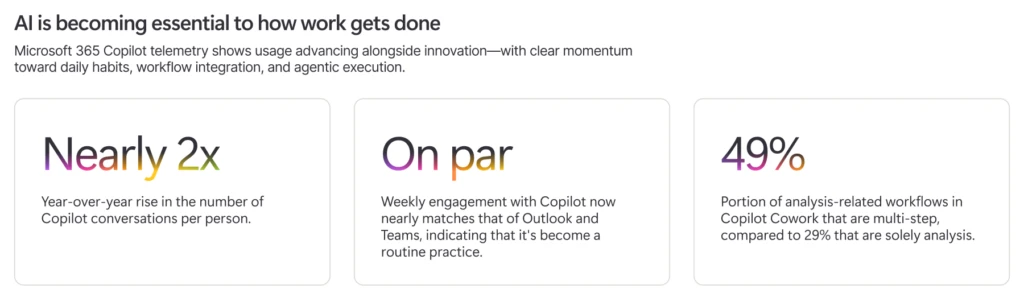
As the underlying technology matures, the way organizations utilize Copilot is becoming both deeper and more expansive. Internal telemetry from Microsoft 365 indicates that the number of conversations per user has nearly doubled over the past year. Furthermore, the number of users engaging with multiple Copilot features simultaneously has seen triple-digit growth. Currently, average weekly engagement with Copilot has reached parity with foundational workplace tools like Microsoft Outlook and Teams, suggesting that AI has successfully integrated into the daily routine of the modern information worker.
The nature of these interactions is also changing. Microsoft reported a significant rise in requests that span multiple complex steps, such as analyzing a raw data set and then drafting a contextualized email to explain the findings. When these multi-step workflows are factored in, analysis-related work now accounts for 49% of all tasks performed by the AI, a sharp increase from the 29% observed when analysis was treated as a standalone, one-off request.
While early adopters were concentrated in the banking, software, and manufacturing sectors, the adoption of AI agents is now spreading into more traditional industries. Automotive and healthcare have emerged as some of the fastest-growing sectors for agent adoption. This momentum is further reflected in the scale of deployment; the number of Microsoft customers with more than 50,000 seats has increased more than sevenfold year-over-year. Additionally, the time required for an organization to reach "high usage"—defined as more than 80% monthly active usage across the user base—has plummeted from several months to just a few days.
What AI Makes Possible
The true value of this technological shift is increasingly measured not just by speed, but by the expansion of organizational capability. Companies that have successfully integrated AI are moving beyond "efficiency for efficiency’s sake" to redefine the parameters of their work.
Microsoft’s own Cloud Supply Chain team recently implemented a "lean before agents" strategy, mapping and simplifying six end-to-end workflows before deploying over 70 purpose-built agents to handle planning, sourcing, and fulfillment. This methodical approach resulted in a 75% reduction in cycle time. The core lesson, according to the team, was the importance of fixing broken processes before layering automation on top of them.
In the manufacturing sector, Eaton is utilizing an AI-powered quality agent to assist experts in root cause analysis. By reviewing thousands of reports on manufacturing quality issues, the agent can quickly surface trends and supplier insights that might have taken human investigators weeks to identify. This has accelerated analysis and allowed for earlier risk identification while keeping human experts at the center of the final decision-making process.
In the healthcare space, Premera Blue Cross has empowered its employees to build their own AI agents using Copilot Studio. By providing staff with the tools to automate repetitive manual work within clear safety guardrails, the organization has seen the creation of over 900 agents. One specific agent designed for document processing reduced a manual workflow that previously took 45 minutes down to just three minutes, allowing employees to focus more time on member care.
Other organizations are using AI to perform tasks that were previously considered impossible to quantify or manage manually. At Levi Strauss & Co., a finance agent analyzed 1,100 standard operating procedures and cataloged 18,000 individual tasks in a single day. Lisa Sterling, Vice President of Finance at Levi’s, noted that the agent provided a detailed view of the company’s internal workings that would have otherwise remained hidden. Similarly, the global consulting firm EY has piloted an Autonomous Sourcing Agent (ASA) that automates low-risk procurement transactions, including negotiations with multiple suppliers simultaneously, ensuring that human judgment is reserved for high-stakes escalations.
Specialization at Scale
The organizations currently deriving the most value from AI are those that have moved away from a general-purpose deployment strategy in favor of role-specific specialization. By tailoring AI to the specific patterns of a job function, these companies are creating specialized expertise at scale.
S&P Global, for instance, developed a Copilot agent within Microsoft Teams to give customers faster access to market research and commodity insights. The solution resulted in a 95% increase in the speed of data extraction and a 98% increase in the speed of comparative analysis, allowing market participants to make informed decisions more rapidly.
Microsoft’s own sales organization has seen similar success by mapping distinct seller "personas" to dedicated agents, such as "Researcher," "Analyst," and "Deal Agent." By delegating administrative and coordination tasks to these agents, Microsoft sellers were able to double their time spent on customer-facing activities, increasing it from 25% to 50%. This shift contributed to a 9.4% increase in revenue per head and 20% faster deal closures.
At the marketing firm Kantar, a system of approximately 10 agents is being used to handle HR queries. Since its implementation, the share of HR queries handled without human intervention has risen from zero to 40%, with a year-end target of 95%. Tasks that once took days, such as issuing employment verification letters, are now completed in 120 seconds.
What’s Next
As the technology continues to advance, the metrics used to define success in the AI era are evolving. Microsoft suggests that the focus is shifting away from simple seat counts and toward the depth of use, the governance of autonomous agents, and the total redesign of workflows.
The emergence of the "Frontier Firm"—an organization where technology, operating models, and human agency evolve in tandem—represents the next horizon for the global economy. In this environment, the durable advantage will belong to those who can successfully integrate AI not just as a tool for individuals, but as a core component of organizational capability. As routine activities are increasingly handled by autonomous systems, the value of human insight, nuanced decision-making, and strategic creativity is expected to become more central to the future of work.
 Productivity Software & Office Suites
Microsoft Launches Copilot Cowork Globally, Bringing Agentic AI to the Fortune 500
Microsoft has officially announced the general availability of Copilot Cowork, marking a...
 Productivity Software & Office Suites
Microsoft Outlines Strategic Roadmap for Enterprise AI Integration, Prioritizing Platform Flexibility and New Economic Models
In a landscape characterized by rapid technological breakthroughs and a constant stream...
 Productivity Software & Office Suites
Microsoft Reimagines Copilot as a Proactive AI Ecosystem for the Enterprise
Microsoft has announced a comprehensive overhaul of its Copilot platform, signaling a...







