
Powered by the same underlying technology as GitHub Copilot, the Code feature allows anyone to describe a desired application, automation, or dashboard in natural language. Copilot then determines the best technical approach and builds the solution within a secure, sandboxed environment. These solutions can range from persistent desktop widgets for quick data reference to cloud-hosted internal apps that can be shared across a team.
This democratization of coding is supported by "Microsoft Copilot Managed Runtime," a new hosting infrastructure that allows these custom-built solutions to run safely within an organization’s Microsoft 365 environment. While the creation process is designed to be simple for the end user, the infrastructure remains under the governance of IT departments. This foundation is also being opened to third-party and professional developers, providing a unified platform for both "low-code" and "pro-code" innovations. To ensure these solutions are relevant, they are grounded in "Microsoft IQ," which provides the necessary business context and automatically syncs plugins.
Autopilot: The Rise of the Persistent Digital Teammate
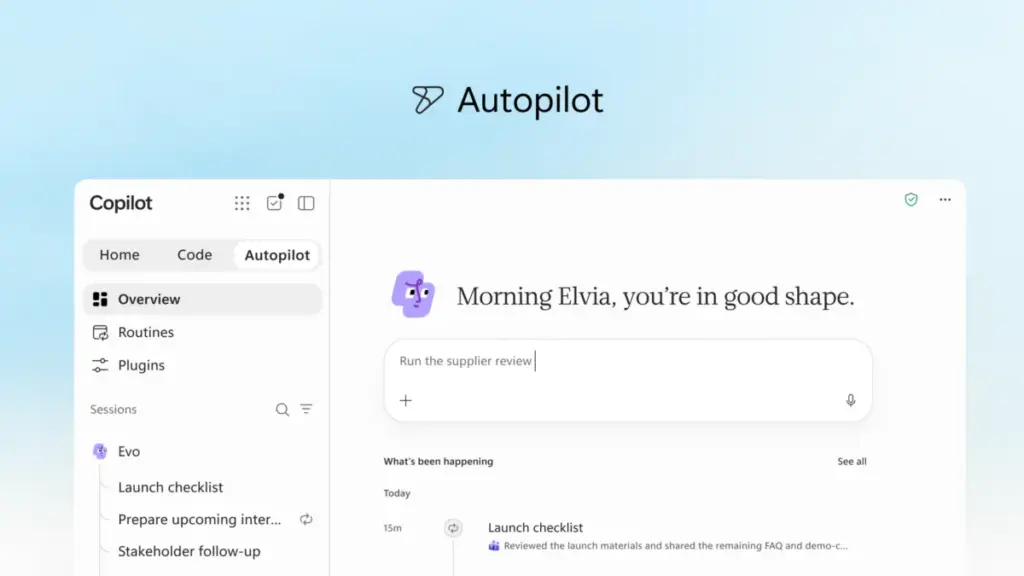
In a move toward true agentic AI, Microsoft has introduced "Autopilot," a rebranding and expansion of the capability previously known as Scout. Unlike traditional AI assistants that wait for a user’s prompt, Autopilot is designed to be a persistent, proactive digital teammate. Users can assign Autopilot a specific name, role, and objective, after which it operates independently within the user’s tenant.
Autopilot is capable of managing long-running, recurring processes without constant human monitoring. For example, it can oversee a full supplier review process by building a schedule, managing preparatory work, attending meetings, and reaching out to stakeholders for updates. Because it is cloud-hosted, Autopilot continues to work even when the user is offline or focused on other tasks.

Operating with its own identity, memory, and workspace, Autopilot is integrated into the tools where teams already communicate, such as Microsoft Teams and Outlook. This allows users to @mention the agent just as they would a human colleague. Despite its autonomy, Autopilot is built with rigorous governance and audit trails, ensuring that users remain in control of the boundaries and objectives set for their digital agents.
Deepening Integration with Business Context
For AI to be effective in an enterprise setting, it must have access to the specific data and workflows that drive the business. Microsoft is addressing this through "Microsoft IQ," a unified intelligence platform that connects the various layers of the Microsoft stack into a real-time view for Copilot.
The company is now expanding the business context available to the platform. "Fabric IQ" is bringing trusted data from more than 20 million semantic models in Power BI into Copilot, grounding Chat and Cowork in enterprise-grade analytics. Additionally, Copilot is being integrated with data from Dynamics 365 and the Power Platform. This means that a salesperson drafting a proposal can now have Copilot automatically incorporate deal history or customer support tickets directly into the document, eliminating the need for distracting lookups in separate CRM systems.
 Productivity Software & Office Suites
Microsoft Expands Copilot Ecosystem with Natural Language App Building to Democratize Enterprise Software Development
The landscape of software development is undergoing a fundamental transformation, driven by...
 Productivity Software & Office Suites
Microsoft Unveils the "New Copilot": A Strategic Shift Toward Proactive AI Agents and Integrated Productivity
In a significant move to redefine the landscape of digital labor, Microsoft...
 Productivity Software & Office Suites
Microsoft Reimagines Copilot as a Central Hub for AI-Driven Enterprise Productivity
In a significant move to redefine the landscape of modern work, Microsoft...







