
Managing AI Spend with FinOps
As AI usage scales, the challenge of managing costs becomes a primary concern for leadership. Microsoft is addressing this through a dual-pronged approach to pricing and a new suite of "FinOps for AI" capabilities.
For "everyday AI" tasks like drafting and summarization, Microsoft utilizes a User Subscription License (USL), which provides a fixed-cost model. At the center of this is "Auto," a system that evaluates the accuracy, speed, and cost of each request to route it to the most appropriate AI model.

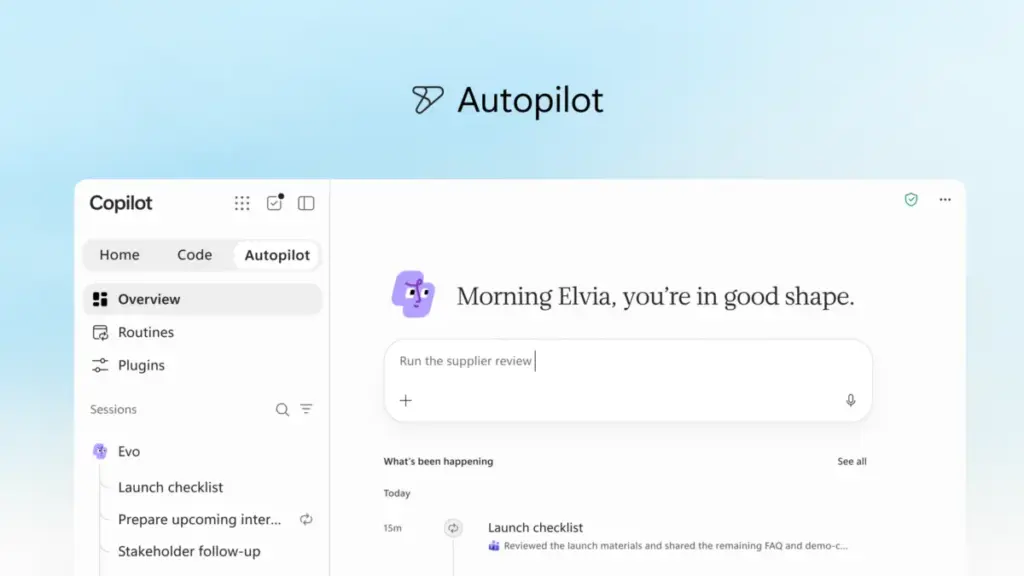
However, for more complex, long-running agentic work—such as that performed by Cowork, Code, and Autopilot—Microsoft is moving toward Usage-Based Billing (UBB). This model allows organizations to match their costs directly to the value generated, providing access to frontier models like Astra and Fable.
The new FinOps capabilities are designed to give organizations granular control over this spend. Administrators can now manage spending policies via APIs, route credit requests through existing approval workflows, and restrict certain model families to specific groups of users. For the end-user, Copilot will now display credit usage and remaining balances, encouraging a culture of responsible AI consumption within organizational guardrails.
A Glimpse into the Future: Today and @Copilot in Teams
Looking ahead, Microsoft provided a preview of upcoming features designed to make Copilot even more personalized. A new command center called "Today" is set to enter private preview in October. This feature acts as a proactive dashboard across mail, calendar, and tasks, surfacing what needs immediate attention and even pre-drafting responses or scheduling changes before the user asks.
Additionally, a new "@Copilot" capability in Teams will allow the AI to participate in group chats and channels with a shared understanding of the team’s context. It will be able to pull background information from past conversations to explain why decisions were made and offer to prepare cross-functional reviews that identify dependencies and owners.
These announcements come ahead of the Microsoft Ignite conference in November, where the company expects to share further innovations. For now, the rollout of these new features has begun through the Microsoft Frontier program, marking the start of a new chapter in the company’s efforts to turn AI from a novelty into the foundational engine of modern work.
 Productivity Software & Office Suites
Microsoft Announces Global Launch of Copilot Cowork, Introducing Agentic AI to the Modern Enterprise
In a move that signals a significant shift in the landscape of...
 Productivity Software & Office Suites
Microsoft Announces General Availability of Work IQ APIs, Ushering in the Era of Agentic Software
REDMOND, Wash. — In a move that signals a fundamental transformation in...
 Productivity Software & Office Suites
Microsoft Shifts Focus to Enterprise AI Utility: A New Strategic Framework for Agents, Economics, and Partnership
In an era defined by a relentless cycle of artificial intelligence breakthroughs,...







