
This capability is powered by the same underlying technology as GitHub Copilot, but it is tailored for a broader audience. To ensure enterprise-grade security, Microsoft is introducing the Copilot Managed Runtime. This hosting infrastructure allows the code generated by Copilot to run safely within a company’s existing Microsoft 365 environment. It provides a "sandboxed" space that is governed by IT departments but remains easily accessible to end-users. This managed runtime also serves as the foundation for apps built in Cowork and Copilot Studio, and Microsoft has announced plans to open this infrastructure to third-party and professional developers.
The Rise of Autopilot: A Persistent Digital Teammate
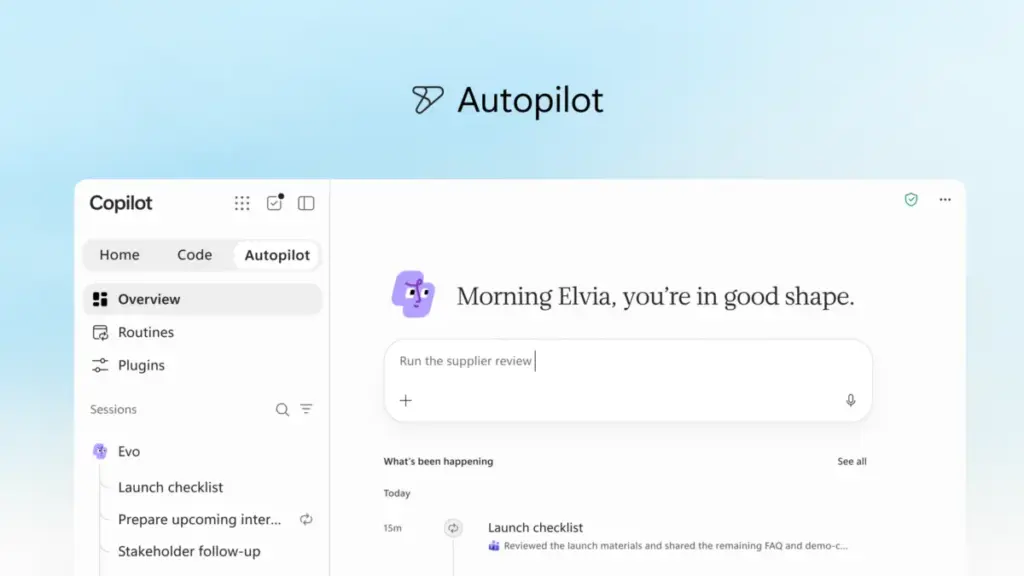
One of the most ambitious elements of the new Copilot is Autopilot, a feature previously known as Scout. Unlike traditional AI tools that require constant prompting, Autopilot is designed to function as a persistent, proactive digital teammate. Users can assign Autopilot a name, a specific role, and a long-term goal, after which the agent begins working independently.
Autopilot is capable of monitoring communication channels, following up on email threads, and managing recurring processes without human intervention. For example, it can oversee a full supplier review process by building a schedule, handling meeting preparations, and reaching out to stakeholders for status updates. Because it is cloud-hosted, Autopilot continues to operate even when the user is offline.

To function effectively within an organization, Autopilot is granted its own identity, memory, and workspace within the company’s tenant. It is built on Microsoft IQ, ensuring it understands the specific context and operational nuances of the business. Users can interact with it as they would a human colleague, @mentioning it in Teams or Outlook, while IT maintains full audit and governance control over its actions.
Expanding Business Context and Data Integration
The effectiveness of any AI is limited by the data it can access. To address this, Microsoft is expanding the business context available to Copilot through Microsoft IQ, a unified intelligence platform. A key component of this is Fabric IQ, which brings context from over 20 million semantic models in Power BI directly into Copilot’s grounding layer.
Furthermore, Copilot is now being grounded in data and workflows from Dynamics 365 and the Power Platform. This means that a salesperson drafting a proposal can have Copilot automatically incorporate deal histories or customer support tickets into the document without ever leaving the application.
To help organizations manage these expanding capabilities, Microsoft is launching a new plugin registry. This unified catalog serves as a single location for discovering and governing plugins from Microsoft, third-party partners, and custom internal builds. This allows IT departments to approve and deploy trusted capabilities at scale while giving developers a single point of publication to reach users across all Copilot-supported surfaces.
 Productivity Software & Office Suites
Microsoft Shifts Focus to Enterprise AI Utility: A New Strategic Framework for Agents, Economics, and Partnership
In an era defined by a relentless cycle of artificial intelligence breakthroughs,...
 Productivity Software & Office Suites
Microsoft Reimagines the Future of Productivity with a New Generation of Copilot and Autonomous Agents
Microsoft has announced a significant evolution of its artificial intelligence strategy, unveiling...
 Productivity Software & Office Suites
Microsoft to Headline ESPC 2026 in Amsterdam: A Deep Dive into the Future of AI-Powered Work and Agentic Ecosystems
The landscape of enterprise technology is currently undergoing one of its most...







