
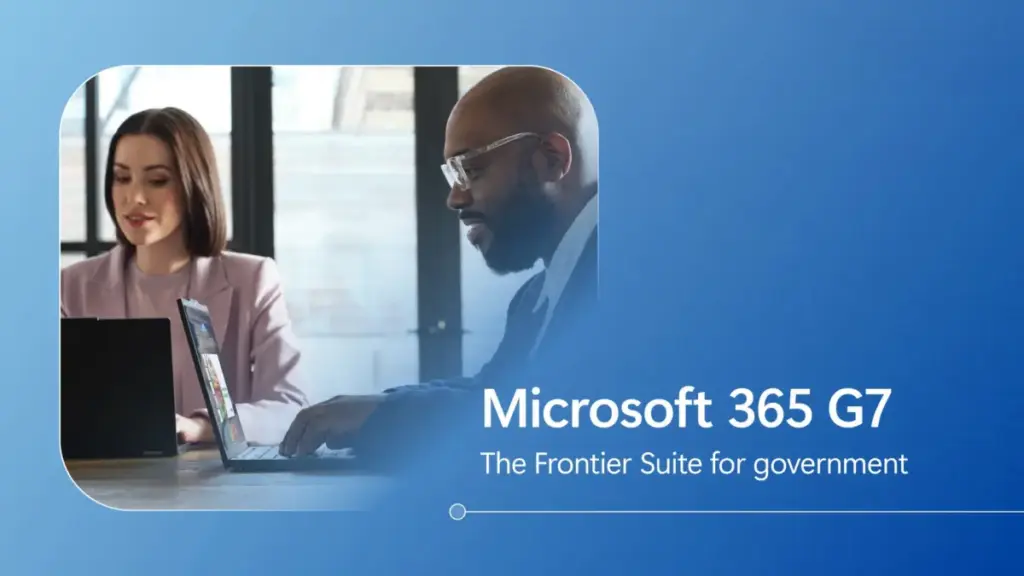
In a significant move to modernize the digital infrastructure of the U.S. public sector, Microsoft has officially announced the launch of Microsoft 365 G7, a comprehensive suite of tools designed to bring advanced artificial intelligence, enhanced security, and sophisticated governance to government organizations. Known as the "Frontier Suite for government," this new offering is specifically tailored for the Government Community Cloud (GCC) environment, marking a pivotal step in the evolution of how federal, state, and local agencies handle data, productivity, and mission-critical operations.
The announcement comes at a time when government leaders are under unprecedented pressure. Across all levels of the public sector, agencies are being tasked with a difficult trifecta of responsibilities: modernizing aging legacy services, defending against an increasingly complex landscape of cybersecurity threats, and meeting the rising expectations of constituents for faster, more efficient service delivery. While AI has long been touted as a potential solution to these challenges, Microsoft’s latest release acknowledges that technology in isolation is insufficient for the public sector. Instead, agencies require intelligence that is deeply grounded in their specific workflows, complemented by a robust control plane to ensure that AI adoption remains secure and compliant with federal standards.
The Foundation of Intelligence and Trust
The introduction of Microsoft 365 G7 is the public sector counterpart to the "Intelligence + Trust" vision originally introduced with the commercial Microsoft 365 E7 suite. By extending these capabilities to the GCC, Microsoft is aiming to provide government organizations with a unified platform that integrates productivity, AI agents, identity management, and rigorous compliance.
The core objective of G7 is to support what Microsoft calls "Frontier Transformation." This concept refers to the transition of government agencies from a state of isolated AI experimentation—where small teams might be testing individual tools in silos—toward a more mature, governed adoption of AI at an organizational scale. The suite is designed to connect intelligence directly into the daily flow of work, providing a foundation for creating mission-focused agents while maintaining the high-security standards required for government data.
The rollout of these new capabilities is scheduled to begin on October 1, 2024, for GCC customers. Microsoft has outlined a phased approach, with additional purchasing options becoming available on November 1. This staggered release is intentional, allowing agencies to begin the process of licensing and planning while Microsoft continues to move specific workloads through the rigorous GCC authorization milestones required for government use.
Expanding the Trusted Foundation of Microsoft 365
Microsoft 365 G7 is not a replacement for existing systems but rather an expansion of the trusted foundation already established by Microsoft 365 G5. For years, G5 has served as the standard for government agencies, offering a mix of productivity apps and basic security and compliance features. G7 builds upon this by integrating the Microsoft Entra Suite, which brings advanced identity management, access governance, and network security to the forefront.
In the context of the public sector, identity is the new perimeter. As agencies move toward zero-trust architectures, the ability to manage access not just for human users but also for automated AI agents becomes critical. The inclusion of Entra Suite within G7 ensures that as agencies deploy more automated systems, they have the tools to govern who—or what—has access to sensitive data and under what conditions.
This foundation is essential for moving toward "governed adoption." By providing IT and security leaders with the controls they need to manage data and access with confidence, G7 allows agencies to move past the "proof of concept" stage and begin deploying AI-driven solutions that can impact the broader mission of the organization.
AI Embedded in the Flow of Government Work
One of the primary goals of the G7 suite is to ensure that AI does not become another "destination" or a separate application that employees have to switch to. Instead, Microsoft is embedding Copilot and other AI-powered experiences directly into the applications that government employees use every day, such as Word, Excel, PowerPoint, and Teams.
Central to this experience is "Work IQ." This technology grounds AI experiences in an agency’s specific organizational data, context, and tools. Unlike consumer-grade AI, which draws from a broad and often unverifiable pool of internet data, Work IQ is designed to operate within the specific permissions and governance frameworks of a government agency. This means that when a public servant uses Copilot to draft a report or analyze a policy, the AI provides assistance informed by the agency’s internal work context, ensuring that the output is relevant, accurate, and compliant with internal data handling policies.
Upon general availability, government teams will be able to use Copilot for a variety of high-value tasks. These include conducting deep research and analysis, synthesizing organizational knowledge that might be buried across multiple documents, and collaborating on content creation. In the months following the initial launch, Microsoft plans to roll out even more advanced capabilities, including the latest commercially available GPT models and "Copilot Cowork," a feature designed to assist with longer-running, multi-step projects that require sustained collaboration between humans and AI.
The Rise of Mission-Focused Agents
Beyond standard productivity tools, the G7 suite introduces a significant focus on "agents." In the government context, agents are specialized AI entities designed to support specific mission-related tasks. These could range from policy analysis and case management to the administration of grants, field inspections, and direct constituent services.
Microsoft is providing an "agentic foundation" that allows agencies to start with pre-built agents, such as "Researcher" and "Analyst," which are already grounded in Work IQ and operating within accredited government clouds. For more specialized missions, agencies can utilize Agent Builder and Microsoft Copilot Studio to create custom agents tailored to their unique requirements.
To ensure these agents are useful, Microsoft 365 Copilot Connectors allow them to tap into agency knowledge stored in other systems. This connectivity is managed through secure, policy-governed access points, ensuring that agents only interact with approved data and line-of-business applications. By using natural-language creation tools, Microsoft is also broadening the pool of people who can build these agents, allowing subject matter experts—not just software developers—to create tools that solve specific operational challenges.
Agent 365: Establishing a Control Plane for AI
As the use of AI agents expands, government leaders face a new set of management challenges. The speed of adoption can lead to "agent sprawl," where multiple autonomous tools are running within an organization without clear oversight. To address this, Microsoft is launching Agent 365, which serves as the central control plane for AI adoption.
Agent 365 is designed to give IT and security leaders full visibility into the AI ecosystem within their agency. It allows them to discover which agents exist, identify who owns them, determine what data they have access to, and monitor whether they are operating as intended. This level of oversight is vital for maintaining security and accountability in a public sector environment.
At its launch, Agent 365 will provide the core controls necessary to deploy, block, or remove agents as needed. Over time, Microsoft expects these capabilities to evolve, incorporating more advanced security features, risk management tools, and lifecycle governance. This ensures that as the technology matures, the tools used to manage it remain equally sophisticated.
Advancing the Public Sector Mission with Confidence
The launch of Microsoft 365 G7 and Agent 365 represents a major milestone in the long-standing partnership between Microsoft and the U.S. government. By combining AI-driven productivity with a unified control plane and advanced security, Microsoft is providing a roadmap for agencies to modernize their operations without compromising on the stringent trust and governance standards required for public service.
Ultimately, this transformation is about more than just the technology itself. It is about empowering the public sector workforce to build capacity and respond more effectively to the needs of the communities they serve. By automating routine tasks and providing deeper insights into complex data, these tools allow public servants to focus on the high-value work that advances their agency’s mission.
As the phased rollout continues through the end of the year, government organizations will have the opportunity to mature their approach to AI, moving forward with the confidence that their innovation is built on a foundation of security and accountability. With the G7 suite, the promise of AI in government moves closer to a daily reality, providing the intelligence to support the mission and the controls to protect the public trust.
 Productivity Software & Office Suites
Microsoft Unveils Reimagined Copilot with Agentic Capabilities and New "Autopilot" Digital Teammate
Microsoft has announced a sweeping overhaul of its Copilot platform, signaling a...
 Productivity Software & Office Suites
Microsoft and European Tech Leaders Set Sights on Amsterdam for ESPC 2026: A Deep Dive into the Future of AI-Powered Work
As the global landscape of enterprise technology continues its rapid shift toward...
 Productivity Software & Office Suites
Microsoft Shifts Focus to Enterprise AI Utility: A New Strategic Framework for Agents, Economics, and Partnership
In an era defined by a relentless cycle of artificial intelligence breakthroughs,...







