
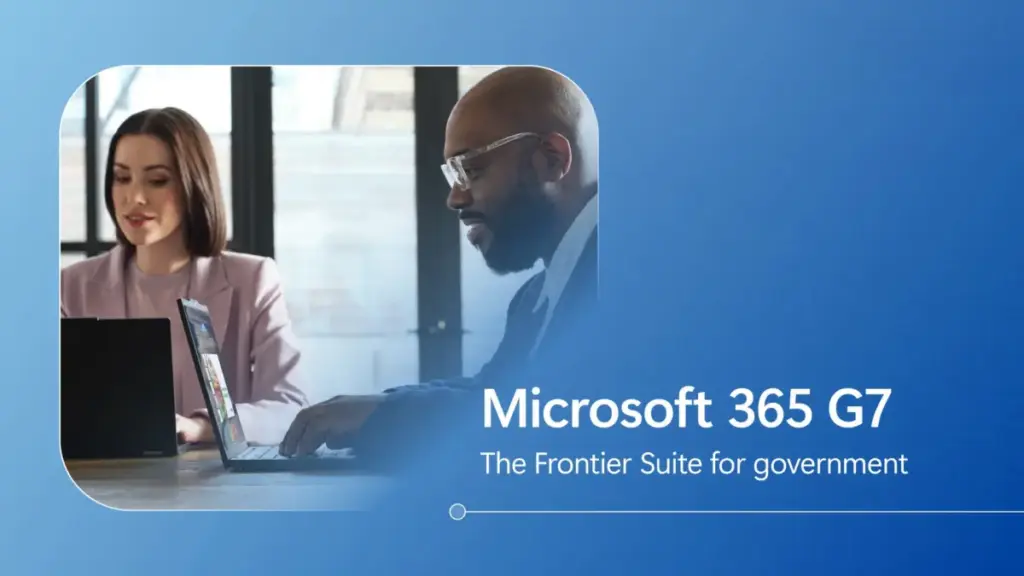
In an era where the public sector faces the dual challenge of rapid technological evolution and increasingly sophisticated cybersecurity threats, Microsoft has unveiled its next major leap in cloud productivity for the public sector. The company today announced the upcoming launch of Microsoft 365 G7, designated as the "Frontier Suite" for government, designed specifically for organizations operating within Government Community Cloud (GCC) environments.
Scheduled for release on October 1, the G7 suite represents a comprehensive evolution of the Microsoft 365 ecosystem. It is engineered to unify productivity, artificial intelligence, autonomous agents, security, identity management, compliance, and governance into a single, cohesive framework. This announcement comes at a critical juncture for government leadership, as agencies are increasingly tasked with modernizing public services and meeting rising constituent demands while simultaneously fortifying their digital infrastructure against a shifting landscape of cyber risks.
The introduction of G7 follows the earlier unveiling of the Microsoft 365 E7 "Frontier Suite" for commercial enterprises. By extending this "Intelligence + Trust" vision to the public sector, Microsoft aims to provide government agencies with the tools necessary to move beyond isolated AI experimentation and toward a more mature, governed approach to adopting generative AI at an organizational scale.
A Foundation Built on Security and Trust
The core of the Microsoft 365 G7 offering is built upon the established foundation of Microsoft 365 G5, which has long served as the standard for government productivity and collaboration. While G5 provided a robust set of tools for information protection and compliance, the G7 suite expands these capabilities significantly to meet the unique demands of the modern "Frontier Transformation."
A primary component of this new foundation is the integration of the Microsoft Entra Suite. In a government context, identity is the new perimeter. The Entra Suite brings advanced identity management, access governance, and network security capabilities to the forefront. Critically, these protections are designed to cover not only human users but also the growing number of AI agents that will soon be interacting with sensitive government data.
The G7 suite is positioned as a bridge for agencies transitioning from the experimental phase of AI to a state of "governed adoption." By providing a unified control plane, Microsoft intends to give IT and security leaders the confidence to manage people, data, and automated processes within a secured environment. This is particularly vital in the U.S. public sector, where the transition to AI must be handled with the highest degree of rigor to ensure mission continuity and public trust.
Integrating AI into the Daily Government Workflow
One of the central philosophies behind the G7 suite is that artificial intelligence should not be a separate destination or a siloed application. Instead, Microsoft is embedding AI directly into the "flow of work"—the applications and interfaces that government employees use every day.
At the heart of this integration is Microsoft Copilot, which will be available as part of a unified offering within G7. For government teams, this means the ability to use generative AI to support intensive research, conduct policy analysis, find and synthesize vast amounts of organizational knowledge, and draft or refine content directly within Word, Excel, PowerPoint, and Outlook.
To ensure these AI experiences are relevant to the specific needs of a government agency, Microsoft is introducing "Work IQ." This capability grounds Copilot’s intelligence in the agency’s own data, tools, and context. Importantly, Work IQ is designed to operate in accordance with existing permissions and governance protocols. This ensures that when an employee asks Copilot for assistance with a mission-related task, the AI provides answers informed by the agency’s specific work context without bypassing necessary security barriers.
The rollout of these AI capabilities will follow a phased approach. While the general availability of G7 begins in October, the months following the launch will see a "surge" of new features. These will include the integration of the latest commercially available GPT models, Work IQ memory and personalization features, and "Edit with Copilot" capabilities across the core Office suite. Additionally, the introduction of "Copilot Cowork" will enable the AI to assist with longer-running, multi-step projects, effectively acting as a digital collaborator for public servants navigating complex workflows.
The Emergence of Mission-Focused Agents
Beyond standard AI assistance, Microsoft 365 G7 introduces an "agentic foundation" for government missions. Agents are specialized AI entities designed to handle specific, often repetitive or highly complex tasks, ranging from grant processing and inspections to constituent services and case management.
By operating within accredited government clouds, these agents are governed by the same strict policy-access controls as the rest of the Microsoft 365 environment. Agencies can begin their journey with pre-built Microsoft agents, such as those tailored for research and analysis. However, the suite also includes "Agent Builder," a tool that allows agencies to create customized experiences that are more closely aligned with their specific operational requirements.
For more specialized or high-stakes missions, teams can utilize Microsoft Copilot Studio to build custom agents from the ground up. To ensure these agents have the information they need to be effective, Microsoft 365 Copilot Connectors allow agencies to bring in knowledge from other internal systems. Managed connections ensure that this access remains secure and is limited to approved data and line-of-business applications.
The goal of this "agentic" approach is to broaden the pool of people who can build and deploy AI solutions. Through natural-language creation, even non-technical staff can help design agents that solve local problems, while organizational controls ensure that every deployment remains aligned with agency-wide standards and security protocols.
Agent 365: Establishing a Control Plane for AI
As the use of AI agents expands, government leaders face a new set of management challenges. The speed of adoption can create "blind spots" where it becomes difficult to track which agents exist, who owns them, what data they are accessing, and whether they are operating as intended.
To address these concerns, Microsoft is launching Agent 365 alongside the G7 suite. Agent 365 serves as the dedicated control plane for AI adoption. It provides a unified foundation for organizations to discover, identify, and govern every agent within their environment. Through this interface, administrators can take decisive governance actions, such as deploying new agents, blocking unauthorized ones, or removing those that are no longer needed.
At its initial launch, Agent 365 will focus on core controls for deployment and usage. However, Microsoft has indicated that the platform will evolve over time to include more sophisticated features for security, risk management, and full lifecycle governance. This transparency is intended to give government agencies the oversight required to scale their AI initiatives without compromising their security posture.
A Phased Approach to Innovation
Microsoft has emphasized that the rollout of Microsoft 365 G7 and Agent 365 will be conducted with the rigor demanded by government missions. While customers can begin licensing and planning for the new experiences on October 1, the expansion of capabilities will occur in phases.
Additional workloads and features will roll out as they complete the required GCC authorization milestones. This phased approach ensures that every new tool meets the necessary compliance and security standards before it is put into the hands of public servants. Customers are encouraged to refer to official service descriptions for detailed information on feature availability as these milestones are reached.
Conclusion: Advancing the Mission with Confidence
The launch of Microsoft 365 G7 represents more than just a software update; it is a strategic effort to help the U.S. public sector navigate the complexities of the AI era. By combining intelligence with trust, Microsoft is offering a path for agencies to build capacity and strengthen their resilience in the face of growing demands.
The integration of AI into the daily flow of work, the deployment of mission-focused agents, and the implementation of a centralized control plane through Agent 365 are all designed to support the stringent governance needs of national missions. As government agencies move toward this "Frontier Transformation," the focus remains on empowering people to serve their communities more effectively, backed by technology that is as secure as it is intelligent.
 Productivity Software & Office Suites
Microsoft to Headline ESPC 2026 in Amsterdam as the European Tech Community Pivots Toward an Agentic AI Future
As the global landscape of work undergoes its most significant transformation since...
 Productivity Software & Office Suites
Microsoft Reimagines Copilot as a Comprehensive AI System for Enterprise Automation and Custom Development
In a significant shift that signals the next phase of the generative...
 Productivity Software & Office Suites
Microsoft Unveils ‘Autopilots’ and Microsoft Scout: The Next Evolution of Autonomous AI Agents for the Enterprise
The landscape of digital productivity is undergoing a fundamental shift, moving away...







