
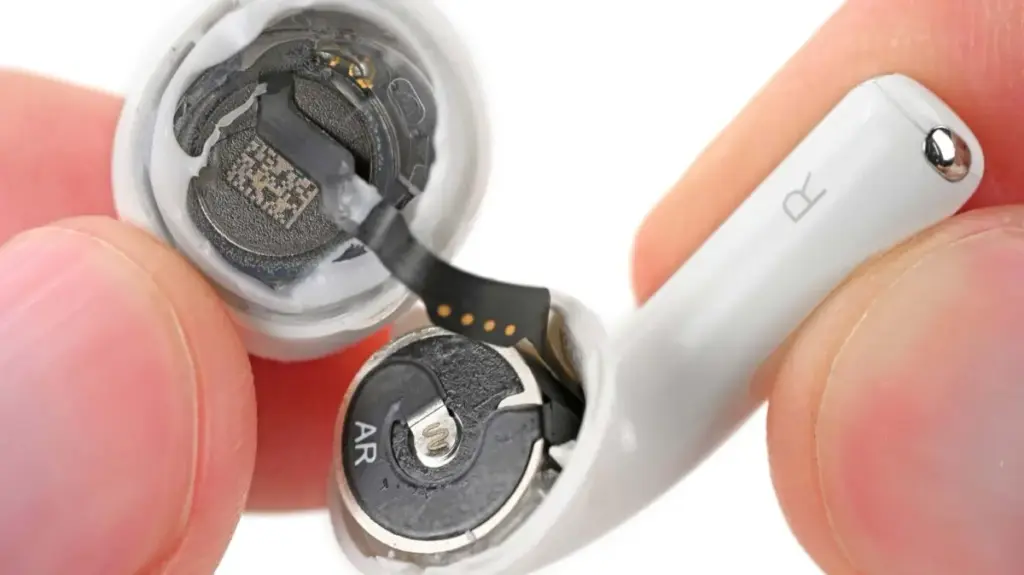
In its traditional deep-dive disassembly video, repair authority iFixit has taken apart Apple’s newly launched AirPods 5, revealing that the latest iteration of the tech giant’s popular wireless earbuds offers a slight improvement in repairability compared to its predecessors. While opening and servicing the tiny audio devices remains a challenging endeavor that is far from a simple home fix, the inner architecture of the AirPods 5 reflects a notable departure from previous generations, earning the model a 2 out of 10 on iFixit’s repairability scale. Though modest, the score represents a historic shift for the standard AirPods lineup, which had consistently received a zero out of ten repairability rating across all prior versions.
According to iFixit, the key factor behind the upgraded repair score lies in how the earbuds themselves are constructed and assembled internally. Accessing the internal components of the left and right earbuds requires heating the outer adhesive using a hair dryer to soften the glue bond, combined with the application of a specialized clamp to hold the earbud securely in place. Once properly heated and clamped, the earbud housing can be pried open with significantly less friction than earlier designs. Notably, iFixit observed that while the AirPods 5 are noticeably easier to open than the AirPods 3, getting inside the earbud shell still demands carefully applied force, patient application of heat, and appropriate holding tools.
Once inside the earbud housing, technicians encountered an internal component layout built around a pronged battery architecture. This specific battery design was previously utilized by Apple in the AirPods 3, though it was omitted in the intervening AirPods 4 model. In the AirPods 5, this pronged battery design is paired with an internal structure that makes the power unit substantially more accessible once the outer shell is breached. iFixit highlighted that the battery is "intuitive to unplug" from the main assembly and can be safely extracted using what the repair site described as a "nifty pair of tongs."
This structural layout marks a substantial departure from the original implementation seen in the AirPods 3. When Apple first introduced the pronged battery in the third-generation AirPods, there was no straightforward or safe method to open the earbud housing without inflicting heavy damage on the casing, effectively rendering battery replacement impossible for average users and professional technicians alike. The refined casing assembly of the AirPods 5 bridges that gap, allowing the earbud shell to separate cleanly enough for the internal connectors to be safely reached and detached.
However, the teardown also uncovered critical hardware nuances that self-repair enthusiasts must keep in mind when attempting any component replacements. Most prominently, iFixit discovered that the left and right earbuds utilize distinct batteries that feature reversed polarity. Because of this reversed electrical orientation, the battery from a left AirPod cannot be swapped into a right AirPod, nor can a right battery be used inside a left earbud. Anyone attempting a repair must source side-specific replacement batteries tailored precisely to the corresponding earbud.
Despite the welcome advancements made to the earbud enclosures, the teardown revealed that the accompanying wireless charging case has not shared in these repairability upgrades. iFixit characterized the construction of the charging case as "still a disaster," reporting that accessing the internal circuitry and battery of the case remains virtually impossible without physically destroying the plastic outer housing. Because the case remains aggressively glued and sealed shut, any attempt to service its internal hardware will result in severe structural damage, keeping the overall repair score of the product package low.
Ultimately, iFixit’s final verdict highlights both the progress and remaining limitations of Apple’s earbud design. By elevating the repairability score from a 0/10 to a 2/10, iFixit noted that skilled repair technicians and even intrepid DIY enthusiasts should now be able to execute battery replacements on the AirPods 5 earbuds with a decent success rate, provided they possess the patience, heat sources, clamping equipment, and precision tools required for the task. However, the score underscores that the product remains difficult to service compared to traditional consumer electronics and still presents substantial hurdles for non-professionals.
The teardown findings come on the heels of Apple’s official announcement of the AirPods 5, which took center stage alongside several major hardware reveals during the company’s "Surprise and Shine" special event on Wednesday, September 9, 2026. Positioning the fifth-generation model as a substantial upgrade to its entry-level personal audio category, Apple launched the new earbuds at a starting price of $129. Key highlights of the new model include the addition of Active Noise Cancellation (ANC), a feature historically reserved for higher-tier audio products in Apple’s lineup. Apple claims that the Active Noise Cancellation system in the AirPods 5 is capable of silencing up to 50% more external background noise than the AirPods 4 model equipped with Active Noise Cancellation.
Alongside the enhanced noise suppression capabilities, Apple redesigned the internal acoustic architecture of the AirPods 5 to deliver richer and more detailed audio playback across various frequencies. The earbuds also feature an updated implementation of Adaptive EQ alongside an improved Transparency mode, designed to allow ambient environmental sounds to pass through more naturally when users need to remain aware of their surroundings.
The unveiling of the AirPods 5 was part of a packed hardware lineup introduced during the September 9 keynote event. Apple’s "Surprise and Shine" presentation featured high-profile device reveals, including the debut of the foldable iPhone Duo, the flagship iPhone 18 Pro and iPhone 18 Pro Max smartphones, as well as the next-generation Apple Watch Series 12 and the rugged Apple Watch Ultra 4 wearable devices.
The hardware enhancements brought by the AirPods 5 are complemented by a suite of software capabilities delivered across Apple’s latest operating system updates, including iOS 27, iPadOS 27, and macOS Golden Gate. To support these software features across its broader audio accessory lineup, Apple released a major firmware update on Monday, September 14, 2026. Bearing build number 9A348, the firmware was rolled out to the AirPods Pro 2, AirPods Pro 3, AirPods 4, and AirPods Max 2.
Within iOS 27, iPadOS 27, and macOS Golden Gate, Apple introduced a completely overhauled AirPods management interface that streamlines how users control their wireless earbuds across Apple devices. The software suite adds a dedicated interactive slider for adjusting Adaptive mode settings, allowing users to fine-tune the balance between environmental passthrough and noise attenuation in real time. Additionally, the software updates introduce built-in support for custom EQ adjustments, giving listeners greater direct control over their audio output profiles.
While the software and firmware updates bring enhanced functionality and unified controls across Apple’s entire audio catalog, iFixit’s physical teardown provides a clear view of the engineering trade-offs inherent in making increasingly compact, feature-rich earbuds. The transition from total unrepairability to an achievable battery swap marks a notable architectural shift for Apple’s mainstream earbud design, even as the destruction required to open the charging case demonstrates that full end-to-end repairability remains an unfulfilled benchmark for the product line.
 macOS & Apple IT Support
IFixit Teardown Highlights Variable Aperture, Vapor Chamber Cooling, and New Repairability Challenges in iPhone 18 Pro
In-depth device teardowns offer an unfiltered window into the intricate engineering hidden...
 macOS & Apple IT Support
Banks and Credit Unions to Team Up Against Apple Pay Fees
In a major procedural setback for Apple Inc., a U.S. federal judge...
 macOS & Apple IT Support
Apple Reaches Agreement to Hire AI Audio Startup Huxe’s Key Personnel and License Its Technology
Apple has reached an agreement to recruit key personnel from Huxe, an...







