

The massive wave of investment in Generative AI (GenAI) has long been the primary engine driving the server market to unprecedented heights. For several quarters, the industry has watched as specialized compute nodes laden with high-end GPUs were snatched up by hyperscalers and enterprise giants alike. However, the networking infrastructure required to connect these behemoths is finally starting to respond in kind. Recent market data indicates that the Ethernet switch and router sectors are experiencing a significant growth spurt, moving in sympathy with the server explosion as organizations realize that compute power is only as effective as the fabric that binds it together.
According to the latest market analysis from IDC for the second quarter of 2026, the Ethernet switch market has reached a historic milestone. Revenues for the period soared by 43.4 percent year-over-year, hitting a staggering $18.91 billion. This performance also represents a robust sequential growth of 23.1 percent from the first quarter of the year. While the numbers are cause for celebration among vendors, the market is navigating a complex landscape defined by persistent component shortages and a shift in pricing power that favors semiconductor manufacturers.
The current climate has created a unique dynamic where demand significantly outstrips supply. In such an environment, the traditional rules of competitive pricing have been upended. With lead times extending and the necessity of high-speed networking becoming non-negotiable for AI workloads, semiconductor and component suppliers find themselves in an enviable position. There is a palpable sense in the industry that pricing is becoming increasingly discretionary; when demand is this inelastic, vendors have the leverage to adjust margins upward simply because the market lacks immediate alternatives.
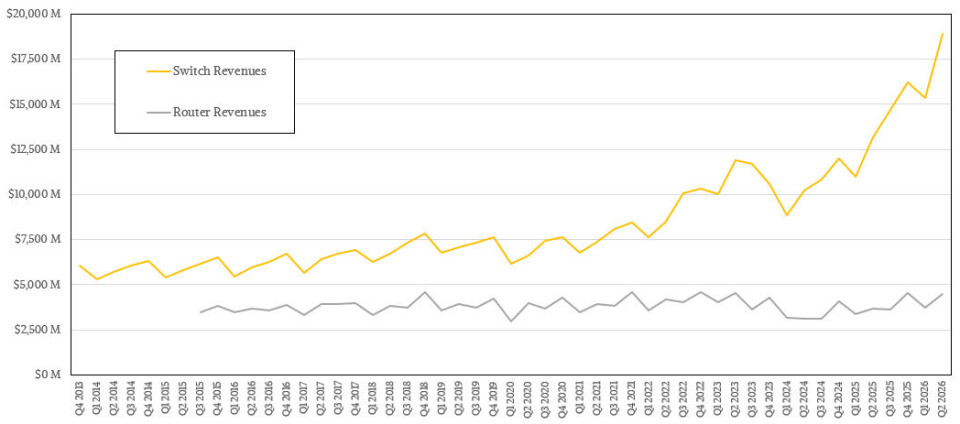
The router market, which many analysts had previously viewed as a legacy segment under pressure, has also demonstrated surprising resilience. For over a decade, routing functions have been steadily integrated into Ethernet switch Application-Specific Integrated Circuits (ASICs), leading to a slow cannibalization of dedicated routing hardware. Despite this long-term trend, the router market managed to grow by 22.8 percent in the second quarter, reaching $4.51 billion. This marks a 20.1 percent increase from the previous quarter.
This resurgence in routing is driven by a specific subset of the market. While hyperscalers and major cloud builders often have the engineering resources to write their own routing software to run on commodity or semi-custom Ethernet switches, other entities do not have that luxury. Service providers, telecommunications companies, and "neoclouds"—the emerging class of specialized AI cloud providers—still rely heavily on dedicated routing gear. For these organizations, the reliability and out-of-the-box functionality of hardware from legacy giants like Cisco Systems, Juniper Networks, Huawei Technology, Nokia, and Ericsson remain indispensable. While these routers may not always sit at the absolute core of a GenAI cluster, they serve as the critical gateways linking massive datacenters to the outside world.
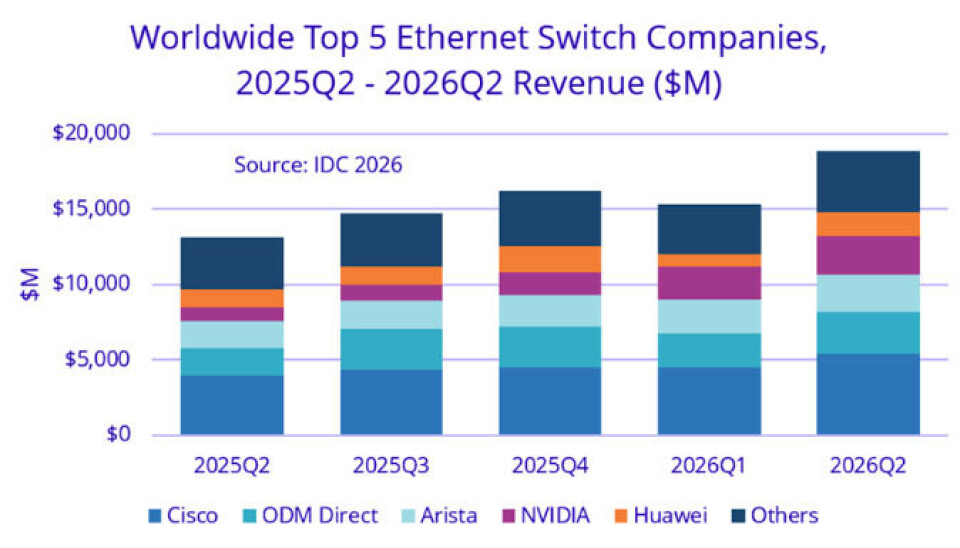
When examining the Ethernet switching landscape as a whole, it is clear that we are witnessing a transformative era. The current surge represents record-breaking sales levels, and while GenAI is the headline act, the ripple effects extend further. The need to feed massive amounts of data into GenAI training and inference systems has necessitated upgrades across the entire network hierarchy, including edge environments and campus networks. These peripheral systems must now handle significantly higher throughput to ensure that the data pipelines leading to the datacenter do not become bottlenecks.
The historical context of this growth is equally revealing. While IDC’s public dataset for Ethernet switches only dates back to the third quarter of 2013—leaving out the granular details of the Dot Com boom and the 2008 financial crisis—the current trajectory stands out even when compared to the volatility of the COVID-19 pandemic. The pandemic era was characterized by supply chain shocks and a sudden shift to remote work, but the GenAI boom is a different beast entirely, driven by a fundamental re-architecting of datacenter compute and connectivity.
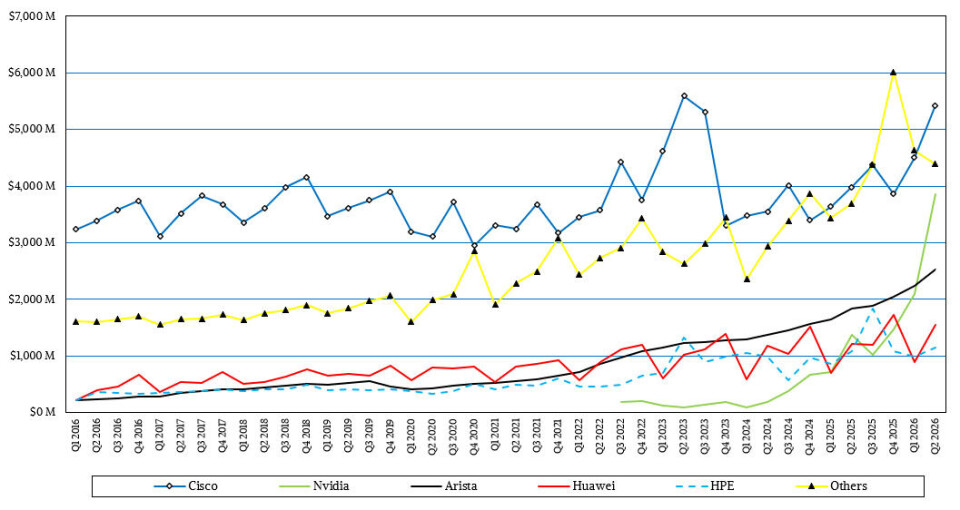
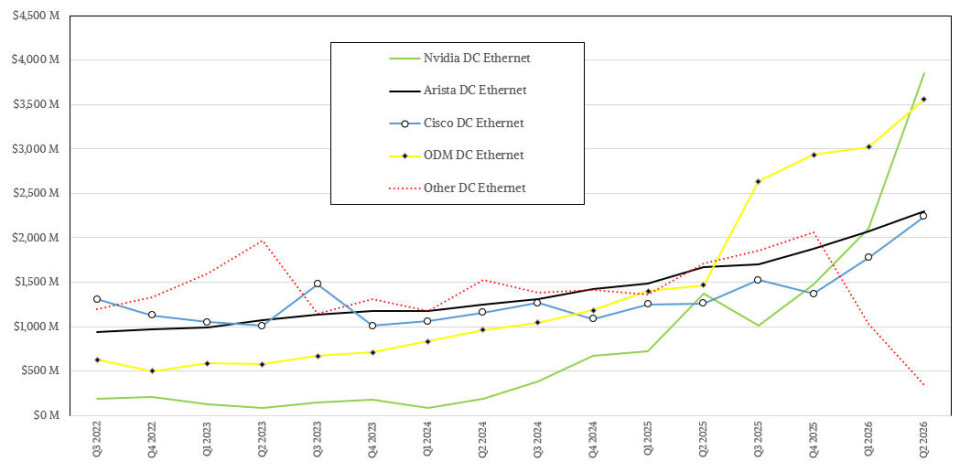
The competitive landscape among vendors highlights a dramatic shift in market share and influence. Cisco Systems remains a dominant force, with its overall Ethernet revenues growing 36.2 percent to $5.43 billion in the second quarter. However, the most startling performance came from Nvidia. Capitalizing on its dominance in the GenAI space, Nvidia’s networking business grew by a factor of 2.8. This growth is largely attributed to the high attachment rate of its Spectrum-X switches, which are designed specifically to scale out DGX server nodes and its massive NVL72 rack-scale systems.
Nvidia’s networking revenue for the quarter reached $3.86 billion, effectively dwarfing Arista Networks, which has long been considered Cisco’s primary challenger in the high-performance space. Arista, for its part, still posted a strong performance, growing 37.6 percent to $2.53 billion. Meanwhile, the integration of Juniper Networks into Hewlett Packard Enterprise (HPE) is beginning to show in the data, though the combined entity’s Ethernet switch business grew by a more modest 6.1 percent to $1.15 billion. Much of HPE’s legacy strength in this area was concentrated in the Aruba wireless brand, and the company is now working to translate that into a more formidable datacenter presence. Huawei Technology continues to be a major player on the global stage, reporting $1.55 billion in revenue, an increase of 28.6 percent, as it continues to battle for market share outside of North America.
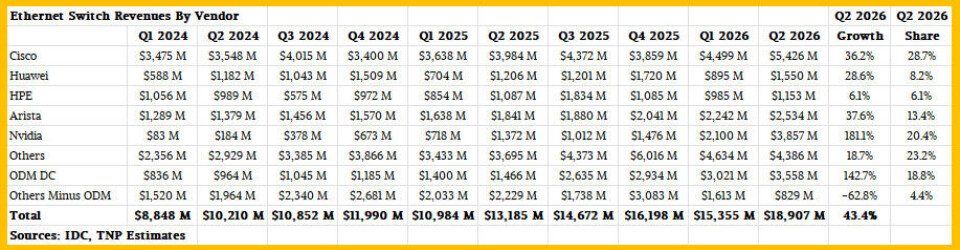
The role of Original Design Manufacturers (ODMs) also remains a critical component of the market, particularly for hyperscalers who prefer to design their own hardware specifications. While official figures for the collective ODM market are no longer explicitly broken out in public datasets, estimates suggest they generated approximately $3.56 billion in the second quarter, representing a 2.43-fold increase year-over-year.
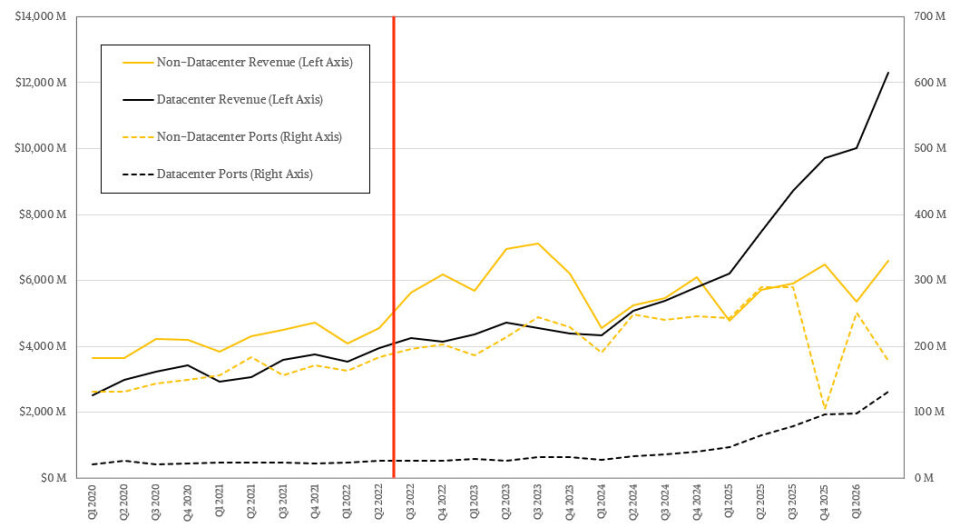
A deeper dive into the datacenter-specific portion of the market reveals where the most intense activity is occurring. In the second quarter, datacenter Ethernet switch revenues totaled $12.3 billion, accounting for 65.1 percent of the total market revenue. This segment grew by 64.5 percent year-over-year and 23 percent sequentially. In terms of volume, the datacenter accounted for an estimated 129.5 million ports, or roughly 42.8 percent of all ports shipped. The discrepancy between revenue share and port share underscores the high cost of the advanced, high-speed ports required for modern datacenter environments.
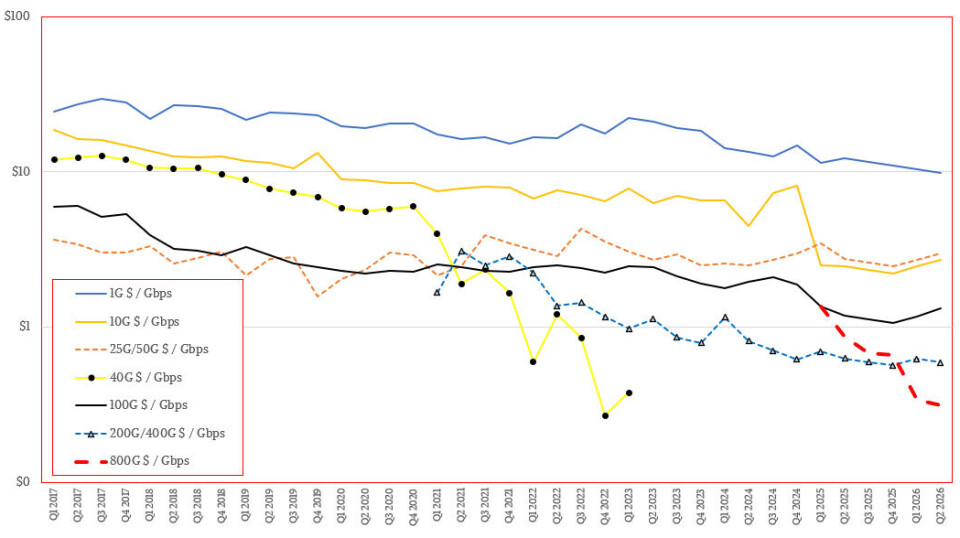
The transition to higher speeds is perhaps the most visible technical trend. Switches featuring 800 Gb/sec ports are now the gold standard for GenAI clusters. Sales of these high-end switches rose by 6.1 times year-over-year to $5.07 billion. In a significant shift, 800 Gb/sec ports now represent 41.2 percent of all datacenter switch ports shipped, up from 35.9 percent in the previous quarter. This rapid adoption is occurring even as vendors and customers deal with component shortages. Interestingly, while the volume is exploding, the cost per port for 800 Gb/sec technology is beginning to stabilize as hyperscalers leverage their massive buying power to negotiate discounts.
Similarly, the market for 200 Gb/sec and 400 Gb/sec switches remains robust, with revenues rising 71.6 percent to $6.35 billion. These speeds are almost exclusively utilized within the datacenter. The demand for higher radix and higher bandwidth is driving a hardware refresh cycle that shows no signs of slowing down. Looking ahead, the industry is already preparing for the ramp-up of 1.6 Tb/sec switches. Furthermore, the emergence of low-latency Ethernet protocols, such as UALink and ESUN, is poised to provide a standardized alternative to proprietary solutions like Nvidia’s NVLink and NVSwitch combinations.
The relationship between server growth and networking growth provides a final, sobering perspective on the state of the industry. Historically, networking investments have often lagged behind compute investments. While the server market is being propelled by the GenAI boom and the shift toward expensive, GPU-laden rack-scale systems, the networking market is only now beginning to catch up.
Data suggests a growing imbalance between compute capacity and connectivity. In the second quarter of 2026, estimates indicate that approximately 6.2 times more server cores were sold than high-speed switch ports (defined as those above 10 Gb/sec). This ratio suggests that many organizations may not be spending enough on their networking fabric to fully realize the potential of their compute investments. When networking cannot keep pace with the sheer volume of data generated and processed by modern server clusters, utilization rates drop, and the return on investment for expensive AI hardware is diminished.
As the industry moves forward, the focus will likely shift from merely acquiring GPUs to optimizing the entire architectural stack. For the Ethernet switch and router markets, the GenAI boom has provided a powerful second act, turning what was once a steady utility business into a high-growth, high-stakes arena where speed and scale are the only metrics that matter.
 Enterprise Tech & Infrastructure
The Long Road to Open Silicon: How OpenTitan and the Rise of Secure Roots of Trust are Reshaping the Semiconductor Industry
The 2018 Hot Chips conference served as a pivotal moment for the...
 Enterprise Tech & Infrastructure
Bridging the Gap in Data Center Convergence: The Evolving Role of Fibre Channel over Ethernet
As data centers face unprecedented pressure to handle massive workloads driven by...
 Enterprise Tech & Infrastructure
Understanding Fibre Channel over Ethernet: Bridging the Gap Between High-Performance Storage and Ethernet Ubiquity
In the rapidly evolving landscape of data center infrastructure, the quest for...







