

The historical context of this growth is equally revealing. While IDC’s public dataset for Ethernet switches only dates back to the third quarter of 2013—leaving out the granular details of the Dot Com boom and the 2008 financial crisis—the current trajectory stands out even when compared to the volatility of the COVID-19 pandemic. The pandemic era was characterized by supply chain shocks and a sudden shift to remote work, but the GenAI boom is a different beast entirely, driven by a fundamental re-architecting of datacenter compute and connectivity.
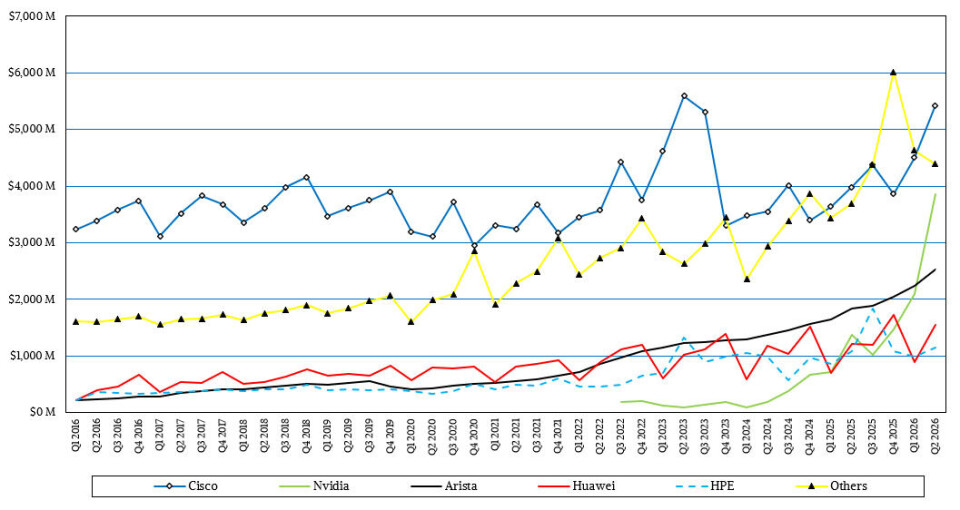
The competitive landscape among vendors highlights a dramatic shift in market share and influence. Cisco Systems remains a dominant force, with its overall Ethernet revenues growing 36.2 percent to $5.43 billion in the second quarter. However, the most startling performance came from Nvidia. Capitalizing on its dominance in the GenAI space, Nvidia’s networking business grew by a factor of 2.8. This growth is largely attributed to the high attachment rate of its Spectrum-X switches, which are designed specifically to scale out DGX server nodes and its massive NVL72 rack-scale systems.
Nvidia’s networking revenue for the quarter reached $3.86 billion, effectively dwarfing Arista Networks, which has long been considered Cisco’s primary challenger in the high-performance space. Arista, for its part, still posted a strong performance, growing 37.6 percent to $2.53 billion. Meanwhile, the integration of Juniper Networks into Hewlett Packard Enterprise (HPE) is beginning to show in the data, though the combined entity’s Ethernet switch business grew by a more modest 6.1 percent to $1.15 billion. Much of HPE’s legacy strength in this area was concentrated in the Aruba wireless brand, and the company is now working to translate that into a more formidable datacenter presence. Huawei Technology continues to be a major player on the global stage, reporting $1.55 billion in revenue, an increase of 28.6 percent, as it continues to battle for market share outside of North America.
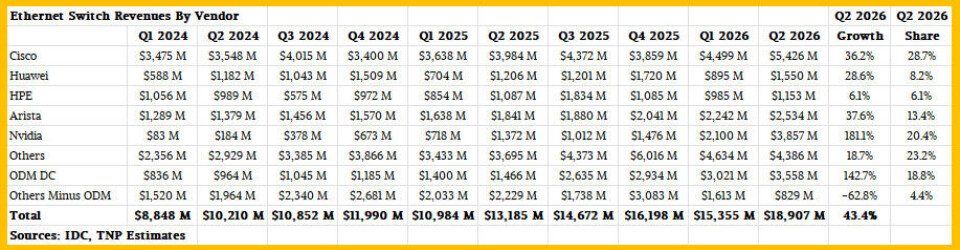
The role of Original Design Manufacturers (ODMs) also remains a critical component of the market, particularly for hyperscalers who prefer to design their own hardware specifications. While official figures for the collective ODM market are no longer explicitly broken out in public datasets, estimates suggest they generated approximately $3.56 billion in the second quarter, representing a 2.43-fold increase year-over-year.
A deeper dive into the datacenter-specific portion of the market reveals where the most intense activity is occurring. In the second quarter, datacenter Ethernet switch revenues totaled $12.3 billion, accounting for 65.1 percent of the total market revenue. This segment grew by 64.5 percent year-over-year and 23 percent sequentially. In terms of volume, the datacenter accounted for an estimated 129.5 million ports, or roughly 42.8 percent of all ports shipped. The discrepancy between revenue share and port share underscores the high cost of the advanced, high-speed ports required for modern datacenter environments.
 Enterprise Tech & Infrastructure
The Pillars of Data Infrastructure: A Comprehensive Evaluation of the Top Enterprise Hard Drives for 2023
In the modern landscape of digital infrastructure, the demand for robust, high-capacity...
 Enterprise Tech & Infrastructure
Navigating the Hidden Complexities of Amazon S3 Cost Management
For many enterprise IT departments, the monthly Amazon Web Services (AWS) bill...
 Enterprise Tech & Infrastructure
Upscale AI Unveils SkyHammer Architecture to Challenge Nvidia’s Scale-Up Networking Monopoly
In the history of the semiconductor industry, the desire for a "universal...







