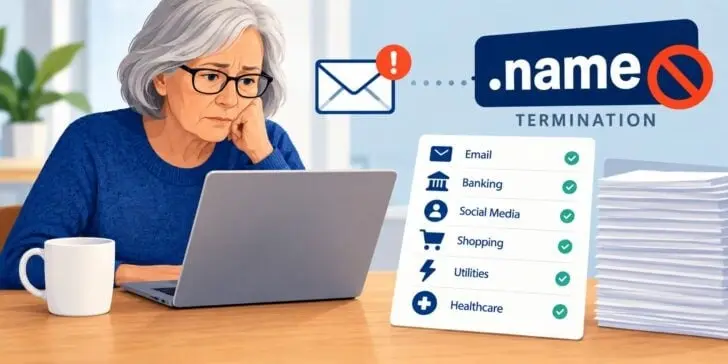
For Judy Johnston, a digital identity established at the dawn of the modern internet is on the verge of being erased. After nearly a quarter-century of consistent use, Johnston is facing the forced termination of her third-level .name domain, a move sanctioned by the Internet Corporation for Assigned Names and Numbers (ICANN) and Verisign, the registry operator. What might seem like a minor technical sunsetting to a global corporation has become a grueling, full-time administrative burden for Johnston, who must now untangle her entire digital life from an email address she has used since 2002.
The situation, detailed in a recently published ICANN reconsideration request, highlights a growing friction between the management of internet infrastructure and the real-world lives of the people who inhabit it. For twenty-five years, Johnston’s domain has served as the foundation for her online presence, as well as that of her 97-year-old mother. The looming termination of third-level .name registrations is not merely a change in service; for users like Johnston, it is a catastrophic disruption of their digital continuity.
The .name top-level domain was originally launched with a specific vision: to provide individuals with a digital space that reflected their personal identities. Unlike .com or .net, which were often crowded with commercial interests, .name allowed for a structured personal branding, often utilizing a third-level format such as "first.last.name." For Johnston, this was more than a novelty; it was a permanent address in an ever-shifting digital landscape. Over the decades, that address became the primary point of contact for every facet of her life, from financial institutions and healthcare providers to social connections and government services.
Now, that foundation is being removed. Johnston reports that she is currently tasked with the monumental challenge of updating at least 211 separate online accounts. Each of these accounts is tied to her .name email address, and each requires a manual update to a new service provider. This process is far from a simple matter of clicking a "change email" button. In the modern era of heightened digital security and data protection, changing a primary email address—especially one that may soon no longer exist to receive confirmation codes—is an ordeal fraught with bureaucratic hurdles.
The administrative weight of this transition is particularly heavy for Johnston and her mother, both of whom are senior citizens. Johnston describes the effort to salvage their digital identities as a "full-time daily job" that has already consumed weeks of her time. The difficulty is compounded by the fact that many service providers have implemented rigorous security protocols to prevent account hijacking. When a user attempts to change their primary email address, they are often met with demands for multiple forms of identification, the completion of complex data protection forms, and manual verification processes that can take days or weeks to resolve.
The problem is exacerbated by a "catch-22" inherent in the termination process. If Johnston does not successfully migrate an account before the domain is officially terminated, she will lose the ability to receive the very password reset links and verification emails required to access those accounts. Once the domain goes dark, any account that hasn’t been updated becomes a digital orphan. Recovering such accounts manually, without access to the original email, is a notoriously difficult process that often requires speaking with human customer service representatives—a resource that is increasingly scarce in the tech industry.
The hardship experienced by Johnston is a direct result of a policy decision made by Verisign and ICANN. While the industry has moved toward different standards and the popularity of third-level .name domains may have waned in favor of more traditional formats, the users who remain on the platform are often those with the deepest roots. Industry experts, including Andrew Allemann of Domain Name Wire, have argued that the decision to terminate these domains should be reversed. The argument is simple: the technical overhead required to maintain these existing registrations is negligible compared to the massive personal and professional disruption caused by their elimination.
One of the most troubling aspects of this transition is the lack of clear communication and support from the registrars responsible for managing these domains. Johnston’s experience with Network Solutions, a major domain registrar, serves as a cautionary tale of institutional incompetence. After receiving a notification about the impending termination of her domain, Johnston contacted Network Solutions to explore her options and verify the timeline. To her shock, multiple customer service representatives told her that the notification was a scam.
These representatives assured her that her domain was secure and pointed to the fact that her registration was paid for and valid through the year 2030. They encouraged her to ignore the warnings, effectively advising her to walk blindly into a digital lockout. It was only after Johnston insisted that the representatives perform a specific search for ".name termination" that they realized the notice was legitimate. This breakdown in communication highlights a dangerous gap: if the frontline support staff of a major registrar are unaware of a major policy change, the average user stands little chance of navigating the transition successfully.
The confusion at the registrar level suggests that many other .name users may be currently ignoring valid termination notices, believing them to be phishing attempts or fraudulent emails. For those who are not as persistent as Johnston, the first realization that their email is gone may come only after the service is disconnected. By then, the path to recovery will be significantly more difficult, if not impossible.
The plight of Johnston and her 97-year-old mother also brings to light the digital divide that exists within the aging population. While younger, tech-savvy users might find the migration of 211 accounts to be a nuisance, for senior citizens, the technical and cognitive load can be overwhelming. The internet has become a vital utility for seniors, providing access to telehealth, social security management, and communication with family. Forcing this demographic to undergo a complex digital migration with little to no professional support is a failure of the systems meant to govern the internet for the benefit of all users.
Johnston’s reconsideration request to ICANN is a formal plea for the organization to acknowledge the human element of its technical mandates. It serves as a reminder that behind every "third-level domain" and "registry agreement" are people who have built their lives around these technologies. The request captures a sense of desperation and exhaustion, noting that the process of verifying her identity and securing her data across hundreds of platforms is a task that no individual should be forced to undertake simply because a registry operator wishes to streamline its offerings.
The broader implications for the domain name industry are significant. The trust that users place in their domain names is based on the assumption of permanence. When someone registers a domain for their personal email, they are making a long-term commitment to that address. If ICANN and registry operators can unilaterally decide to terminate specific classes of domains, it undermines the perceived stability of the entire Domain Name System (LDNS). It suggests that no digital identity is truly "owned" by the user, but is instead held at the whim of corporate and regulatory entities that may prioritize administrative convenience over user stability.
As the deadline for the .name termination approaches, the pressure on users like Johnston continues to mount. The manual recovery of accounts, the submission of identification documents, and the constant fear of losing access to vital services have turned her daily routine into an exercise in crisis management. Her story is a stark illustration of why many in the industry are calling for a stay on the termination.
The argument for reversing the course is rooted in the principle of "do no harm." If the infrastructure exists to keep these domains operational—and it does, as evidenced by the fact that many are registered for years into the future—then the justification for shutting them down must be weighed against the tangible suffering of the user base. For Johnston, the 211 accounts she is currently struggling to update represent 25 years of history, memory, and utility.
The outcome of the reconsideration request remains to be seen, but the visibility of Johnston’s case has already sparked a renewed debate about the responsibilities of ICANN and Verisign. It poses a fundamental question about the future of the internet: is it a space governed primarily for the efficiency of the providers, or is it a global utility that must protect the rights and identities of the individuals who rely on it? For Judy Johnston and her mother, the answer to that question will determine whether their next few months are spent in a state of administrative purgatory or if they can return to the digital lives they have spent decades building.
 Web Hosting & Domain Management
ICANN Selects Adelaide for 2027 Annual General Meeting, Marking a Strategic Return to Australia
The Internet Corporation for Assigned Names and Numbers (ICANN) has officially announced...
 Web Hosting & Domain Management
Norton antivirus software maker in talks to acquire GoDaddy
The discussions are currently in their early stages, and while there is...
 Web Hosting & Domain Management
AI Automation Offers New Solution for Bulk Domain Transfer Authorization Challenges
The process of managing a large portfolio of domain names has long...