

The annual rhythm of the supercomputing community is defined by two major milestones: the Supercomputing conference in the United States and the International Supercomputing conference in Europe. For those embedded in the industry, these events are more than just showcases for the latest silicon and interconnects; they are endurance tests of networking and knowledge. One of the most storied traditions of these gatherings is the early Tuesday morning trek to the breakfast briefing hosted by Hyperion Research, formerly the IDC high-performance computing group. It is a ritual where attendees shake off the social fatigue of the previous evening, fueled by strong coffee and a traditional breakfast, to absorb the most authoritative data on the state of the High-Performance Computing (HPC) and AI for Science (AI-Sci) markets.
While physical attendance at this year’s SC26 and ISC26 was not possible for everyone, the data presented by industry stalwarts Earl Joseph, Bob Sorensen, and Mark Nossokoff provides a comprehensive window into the trajectory of the market through the first half of 2026. The findings reveal a sector in the midst of a profound transformation, where traditional simulation and modeling are increasingly intertwined with—and sometimes overshadowed by—the massive infrastructure requirements of modern artificial intelligence. The numbers suggest a market that is not only expanding in terms of dollar value but is also undergoing a significant realignment of vendor leadership and a strategic shift in how compute capacity is consumed.
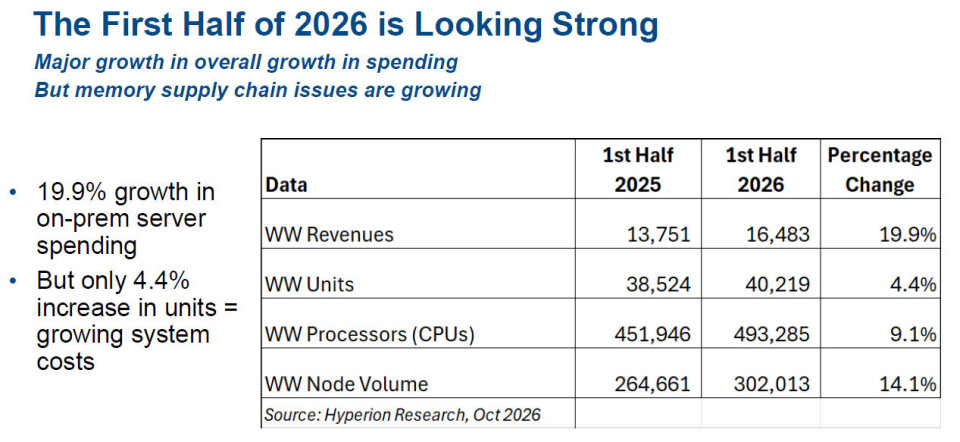
According to the Hyperion Research data, the first half of 2026 was a period of robust financial growth for on-premises HPC and AI-Sci systems. Total revenues for this period reached $16.48 billion, representing a significant 19.9 percent increase compared to the same period in 2025. However, this double-digit revenue growth masks a more complex reality regarding the volume of hardware actually moving into data centers. While the money flowing into the sector surged, worldwide unit shipments of these systems only grew by a modest 4.4 percent. This stark divergence between revenue and units highlights a fundamental change in the composition and cost of modern supercomputing infrastructure.
Several factors contribute to this gap. Modern systems are increasingly dense, packing more nodes into each rack and a higher number of CPUs and accelerators into each node. Furthermore, the industry has been grappling with sustained price increases for critical components. The cost of high-end CPUs, sophisticated GPUs, and specialized memory like HBM (High Bandwidth Memory), along with flash storage, has risen steadily. In many ways, it is surprising that the gap between revenue and units isn’t even wider. The data suggests that many HPC centers are adopting a more conservative procurement strategy, perhaps hanging back one or two generations on hardware to manage capital outlays. This trend is visible in recent Top500 rankings, where many new installations feature NVIDIA Grace-Hopper or Intel Xeon-Hopper configurations, despite the fact that the newer Blackwell architectures have been available for some time. For many scientific research centers, the most cutting-edge GPUs remain both too scarce and too expensive to deploy at scale immediately.
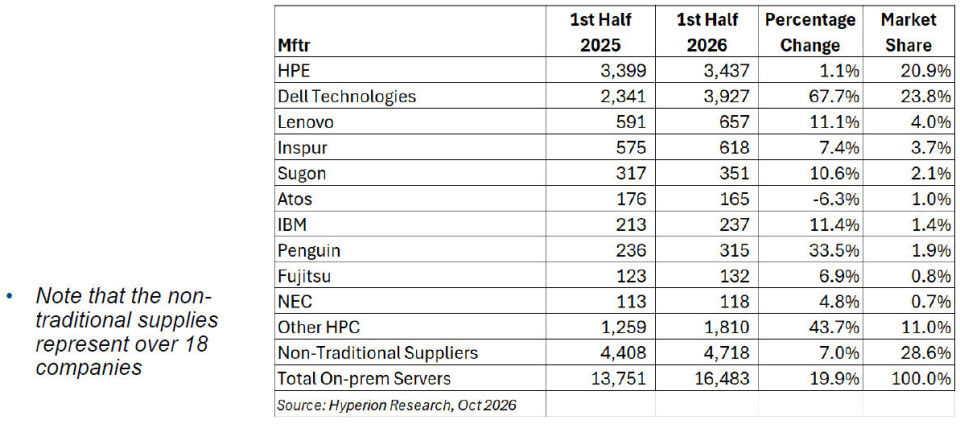
Perhaps the most striking revelation from the mid-2026 data is the shift in vendor leadership. For years, Hewlett Packard Enterprise (HPE) has maintained a firm grip on the top spot for on-premises HPC and AI-Sci installations, a position fortified by its strategic acquisitions of SGI and Cray. However, the first half of 2026 saw Dell emerge as the revenue leader in this space. Dell’s technical computing revenues skyrocketed by 67.7 percent to reach $3.93 billion, while HPE saw a much flatter growth rate of just 1.1 percent, bringing in $3.44 billion.
The reasons behind Dell’s sudden surge are multifaceted. A significant factor appears to be the allocation of high-demand GPUs. Dell has reportedly received preferential treatment in recent years regarding the supply of NVIDIA hardware, a dynamic that has allowed them to capitalize on the AI-driven demand for accelerated systems. While HPE continues to be a formidable force in the "flops race"—often winning massive contracts for traditional exascale-class supercomputers that rely heavily on specialized interconnects and custom engineering—Dell has successfully positioned itself as the primary provider for the broader market of GPU-accelerated clusters. It is possible that HPE’s portfolio remains more heavily weighted toward CPU-only machines for traditional modeling and simulation, while Dell has successfully pivoted to meet the demand for machines that can handle both simulation and the increasingly heavy requirements of AI-Sci workloads.
Beyond the top two titans, the market becomes highly fragmented. Dozens of other system builders, including both traditional OEMs and specialized ODMs, accounted for $9.12 billion in sales during the first half of 2026. This segment grew by 13.8 percent, a respectable figure that nonetheless lags behind the overall market average, which was pulled upward by Dell’s explosive performance. Whether Dell can maintain this momentum through the second half of the year remains to be seen, and the industry will have to wait until the next Hyperion Research briefing in Hamburg to see if this leadership change is a permanent shift or a temporary fluctuation in supply chain cycles.
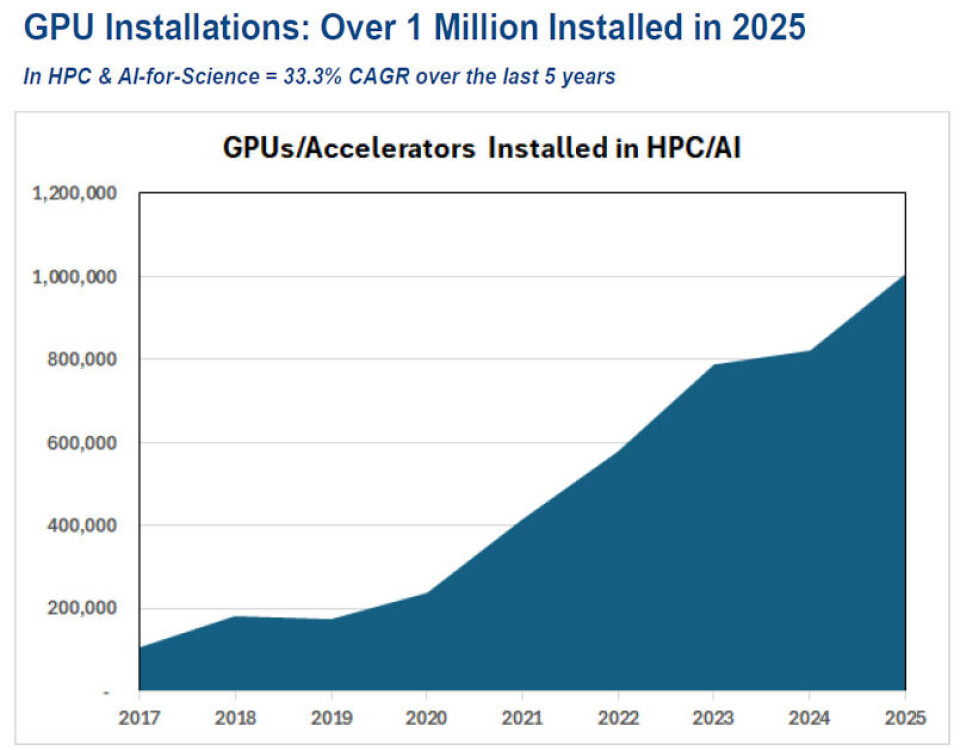
To understand the scale of this growth, one must look at the underlying engine of modern supercomputing: the accelerator. Hyperion’s analysis of the installed base of GPUs in the HPC and AI-Sci market shows a steady and relentless climb. By the end of 2026, it is projected that there will be approximately 1.2 million GPU accelerators installed in scientific systems worldwide. While this number sounds impressive, it is essential to place it in the context of the global "fleet" of accelerators.
When looking at the total worldwide inventory of GPUs and custom AI processors (XPUs) that have shipped over the last six or seven years and remain in operation, the numbers are staggering. The total installed base is estimated to be between 18 million and 20 million GPUs. When adding custom silicon—such as Google’s TPUs, which likely number between 9 million and 11 million, and Amazon’s Trainium and Inferentia chips—the total global fleet of high-end accelerators reaches between 31 million and 37 million units. In this context, the 1.2 million GPUs dedicated to HPC and AI for Science represent only about 3 to 4 percent of the world’s total accelerated compute power.
This disparity underscores a major shift in the computing landscape. A decade ago, AI was often viewed as a "tail" on the HPC "dog"—a niche application of supercomputing techniques. Today, the situation has reversed. The AI sector, encompassing massive training and inference workloads for commercial applications, is now orders of magnitude larger than the scientific computing sector that birthed it. For the HPC community, which has spent decades at the bleeding edge of architecture, it is a strange new world where they are no longer the primary drivers of hardware volume, even as they utilize the same underlying technologies to solve the world’s most complex scientific problems.
Looking toward the end of the decade, Hyperion Research forecasts a market that will continue to expand, albeit at a more measured pace than the initial generative AI explosion. The market for on-premises HPC and AI-Sci servers is expected to triple in the decade leading up to 2030. While large-scale supercomputers will continue to command the bulk of the spending, divisional, departmental, and workgroup systems are expected to maintain their relative share of the market. By 2030, the broader ecosystem—which includes not just the servers, but also storage, middleware, applications, services, and cloud capacity—is projected to exceed $100 billion.
The role of the cloud in this ecosystem is also evolving. While on-premises hardware remains the backbone of many national laboratories and large research institutions, the rental of cloud-based clusters is growing rapidly. Spending on cloud capacity for HPC and AI-Sci applications is forecast to grow nearly fivefold between 2022 and 2030, reaching approximately $30 billion. Currently, North America leads this trend, with higher cloud adoption rates than Europe or the Asia-Pacific region, despite the economic might of those areas.
When combining on-premises acquisitions with cloud rental spending, the total infrastructure investment for scientific computing is expected to hit $135 billion by 2030, up from roughly $40 billion in 2022. This 3.4-fold increase reflects a world where researchers are increasingly "hybrid," using on-premises systems for steady-state workloads while bursting to the cloud for additional capacity or specialized hardware. The debate over whether the cloud or on-premises is more cost-effective remains a point of contention, but the data suggests that the answer for most organizations is a pragmatic mix of both.
The sheer power available to researchers today is perhaps best illustrated by the "baby supercomputers" now appearing on individual desks. A modern workstation, such as a DGX Spark, packs more computational power than the room-sized behemoths of decades past. If such a machine could be transported back to the late 1970s, it would represent a leap in capability that would have been unimaginable even to pioneers like Seymour Cray. We are living in an era where the tools of discovery are becoming more powerful and more accessible, even as the market dynamics that produce them become increasingly complex. As we look toward 2030, the fusion of traditional high-performance computing and artificial intelligence promises to accelerate scientific discovery at a rate that matches the growth of the hardware itself.
 Enterprise Tech & Infrastructure
Optimizing the Modern Data Center: Best Practices for Implementing Software-Defined Storage Architecture
The landscape of enterprise data management is undergoing a fundamental transformation as...
 Enterprise Tech & Infrastructure
IBM Accelerates Quantum Roadmap with Nighthawk Evolution and Modular Path to Fault Tolerance
For the past several years, IBM has maintained a relentless pace in...
 Enterprise Tech & Infrastructure
The Architecture of Digital Storage: Navigating the Complex Landscape of Primary and Secondary Computer Memory
In the modern technological landscape, computer memory serves as the fundamental bedrock...







