

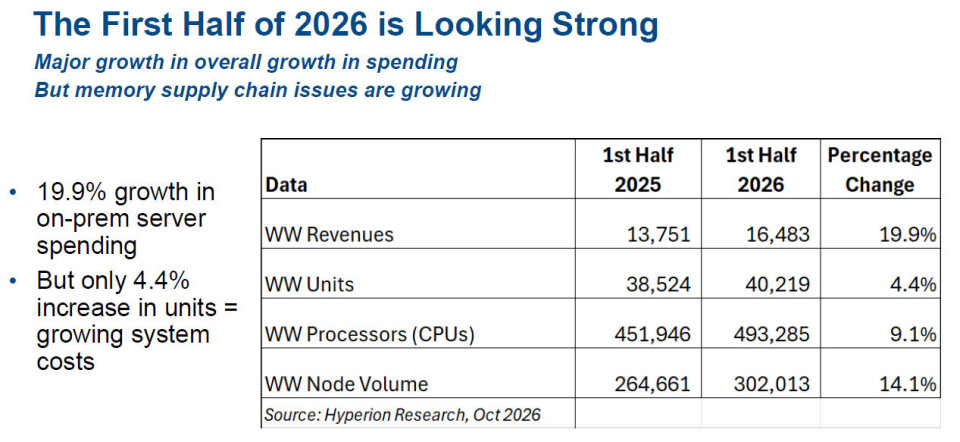
The reasons behind Dell’s sudden surge are multifaceted. A significant factor appears to be the allocation of high-demand GPUs. Dell has reportedly received preferential treatment in recent years regarding the supply of NVIDIA hardware, a dynamic that has allowed them to capitalize on the AI-driven demand for accelerated systems. While HPE continues to be a formidable force in the "flops race"—often winning massive contracts for traditional exascale-class supercomputers that rely heavily on specialized interconnects and custom engineering—Dell has successfully positioned itself as the primary provider for the broader market of GPU-accelerated clusters. It is possible that HPE’s portfolio remains more heavily weighted toward CPU-only machines for traditional modeling and simulation, while Dell has successfully pivoted to meet the demand for machines that can handle both simulation and the increasingly heavy requirements of AI-Sci workloads.
Beyond the top two titans, the market becomes highly fragmented. Dozens of other system builders, including both traditional OEMs and specialized ODMs, accounted for $9.12 billion in sales during the first half of 2026. This segment grew by 13.8 percent, a respectable figure that nonetheless lags behind the overall market average, which was pulled upward by Dell’s explosive performance. Whether Dell can maintain this momentum through the second half of the year remains to be seen, and the industry will have to wait until the next Hyperion Research briefing in Hamburg to see if this leadership change is a permanent shift or a temporary fluctuation in supply chain cycles.
To understand the scale of this growth, one must look at the underlying engine of modern supercomputing: the accelerator. Hyperion’s analysis of the installed base of GPUs in the HPC and AI-Sci market shows a steady and relentless climb. By the end of 2026, it is projected that there will be approximately 1.2 million GPU accelerators installed in scientific systems worldwide. While this number sounds impressive, it is essential to place it in the context of the global "fleet" of accelerators.
When looking at the total worldwide inventory of GPUs and custom AI processors (XPUs) that have shipped over the last six or seven years and remain in operation, the numbers are staggering. The total installed base is estimated to be between 18 million and 20 million GPUs. When adding custom silicon—such as Google’s TPUs, which likely number between 9 million and 11 million, and Amazon’s Trainium and Inferentia chips—the total global fleet of high-end accelerators reaches between 31 million and 37 million units. In this context, the 1.2 million GPUs dedicated to HPC and AI for Science represent only about 3 to 4 percent of the world’s total accelerated compute power.
This disparity underscores a major shift in the computing landscape. A decade ago, AI was often viewed as a "tail" on the HPC "dog"—a niche application of supercomputing techniques. Today, the situation has reversed. The AI sector, encompassing massive training and inference workloads for commercial applications, is now orders of magnitude larger than the scientific computing sector that birthed it. For the HPC community, which has spent decades at the bleeding edge of architecture, it is a strange new world where they are no longer the primary drivers of hardware volume, even as they utilize the same underlying technologies to solve the world’s most complex scientific problems.
 Enterprise Tech & Infrastructure
The Pillars of Data Infrastructure: A Comprehensive Review of 2023’s Top Enterprise Hard Drives
In the modern corporate landscape, data storage is no longer a secondary...
 Enterprise Tech & Infrastructure
Micron and the High Bandwidth Memory Revolution: A Profit Engine Surpassing the Mainframe Era
In the sweeping six-decade history of commercial information technology, certain milestones stand...
 Enterprise Tech & Infrastructure
The Shift to Software-Defined Excellence: Understanding the Rise and Impact of Hyperconverged Storage
The landscape of enterprise data management is undergoing a fundamental transformation as...







