
Where the Legacy Seams Begin to Show
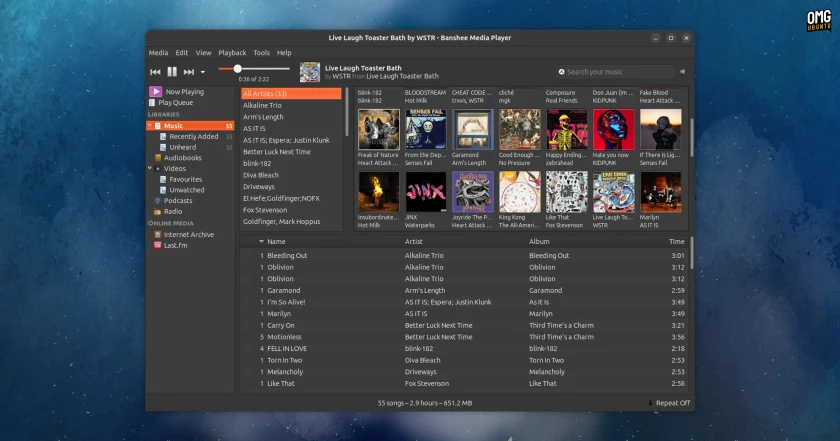
While local audio playback remains solid, attempting to use the application across a broader set of features quickly exposes the practical limits of running a 2014 application in the modern computing landscape.
The software’s once-vaunted external network integrations are where the software’s age becomes most evident. A test attempt to authenticate with Last.fm to scrobble tracks highlights these technical barriers. When invoking the login handshake, the application halts and triggers a local error dialog stating that it could not launch the external URL. The underlying protocol calls, web authentication handshakes, and application launchers built into the 2014 codebase struggle to interface with modern browser handoffs and updated web security requirements.
Similarly, secondary media functions from the original Banshee feature suite do not hold up under modern demands. Video playback inside the player fails to render modern files reliably. In the years since Banshee 2.6.2 made its debut, the industry has shifted toward newer compression standards, container formats, and resolutions that the player’s bundled media engines simply were not architected to decode smoothly. Meanwhile, support for physical media like DVD playback—a capability that was notoriously finicky even in the player’s heyday—remains essentially unviable on contemporary hardware setups.
The application also remains frozen with whatever software bugs and idiosyncrasies were present in the codebase when development ceased in 2014. Because the snap functions as an archival packaging project rather than an ongoing rewrite, upstream flaws that were never resolved during the project’s original run remain permanently baked into the software experience.
Banshee and Ubuntu Go Way Back
The return of Banshee carries historical significance for longtime Linux enthusiasts because the media player previously occupied a central, highly debated position in the desktop ecosystem. Between 2011 and 2012, Banshee enjoyed a tenure as the default out-of-the-box music application for Ubuntu, having been selected to replace Rhythmbox starting with the release of Ubuntu 11.04.
At the time, the decision to elevate Banshee to default status was one of the most widely discussed architectural choices in the Linux community. The conversation centered not on the player’s intuitive user interface or robust podcast management, but on its technical foundation: Banshee was written in C# and built upon the Mono platform.
Mono, originally initiated by GNOME project co-founder Miguel de Icaza, was an open-source development platform created to enable developers to run Microsoft .NET-compatible applications across Unix-like operating systems. While Mono enabled rapid software development and gave Linux users access to modern cross-platform software frameworks, it also provoked profound philosophical and practical anxieties among traditional open-source advocates.
A vocal segment of the Linux community harbored deep-seated suspicions regarding Mono, arguing that building critical desktop infrastructure around technologies tied directly to Microsoft’s intellectual property created an unnecessary vulnerability. Critics frequently voiced concerns that Microsoft could leverage patent claims against Linux distributions or third-party developers that relied heavily on .NET-derived architectures.
Those intellectual property disputes never came to pass. Over the subsequent decade, Microsoft’s posture toward the open-source community shifted dramatically. Rather than pursuing patent litigation, Microsoft eventually acquired Xamarin—the commercial firm that maintained Mono—and took direct custody of the Mono project. In August 2024, Microsoft took the final step of officially handing stewardship of the Mono project over to the Wine community, solidifying its place as a community-driven compatibility layer.
 Linux & Open Source Solutions
Ubuntu 26.10 Introduces Top-Screen Layout Picker to Streamline Window Tiling
Ubuntu 26.10 is introducing a new way for users to organize their...
 Linux & Open Source Solutions
Ubuntu 26.10 Introduces Restricted Media Codec Installation to App Center’s Add-Ons Hub
Ubuntu 26.10 has expanded the functionality of its modern App Center by...
 Linux & Open Source Solutions
Ubuntu 26.10 Beta Rescheduled to October 1 Following Unforeseen Infrastructure Issues
Canonical has officially postponed the public beta release of its upcoming operating...







