
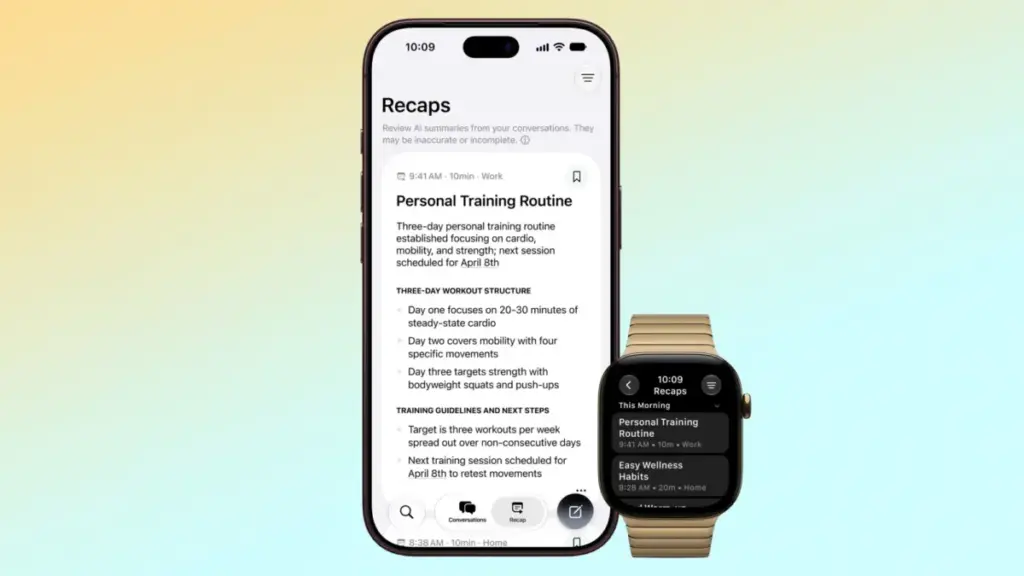
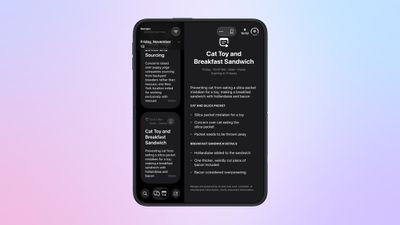
Despite these significant operational flaws, Siri Recap does demonstrate localized areas of impressive technical capability, particularly when processing highly specific, structured factual data. In test scenarios involving explicit dates, times, and numerical values, the feature performed admirably. When scheduling follow-up appointments, Siri Recap consistently extracted correct calendar dates and times from spoken dialogue. Surprisingly, the system also accurately recorded exact billing totals when spoken aloud during checkout—a notable outcome given Apple’s public documentation stating that Siri Recap is designed to filter out financial information. Furthermore, the on-device language models exhibited remarkable accuracy in parsing complex medical terminology. Technical drug names such as benazepril and clopidogrel were correctly identified and transcribed from spoken conversation without error, demonstrating that the feature’s underlying speech-to-text vocabulary parsing is highly sophisticated even when its contextual summarization logic falters.
Beyond technical accuracy, the hands-on evaluation uncovered a more subtle, psychological challenge associated with passive AI summarization: the potential to alter human memory. When reviewing inaccurate or distorted Siri Recap summaries days after an event, the artificial text began to compete with organic recollection. Reading a flawed Siri summary tended to anchor those specific, incorrectly framed details in the user’s mind, subtly overwriting their true memory of the conversation. Because Apple’s privacy architecture deliberately discards the original raw audio recordings, users have no objective audio baseline to consult when a summary feels inaccurate. This creates a dilemma where inaccurate AI notes can supplant actual human memory, effectively replacing authentic recollections with distorted algorithmic interpretations.

Siri Recap arrives at a pivotal moment in Apple’s broader software roadmap as the company continues to expand its Apple Intelligence initiative across its hardware ecosystem. The watchOS 27.3 beta coincides with a wave of major updates across Apple’s lineup, including the recent release of iOS 27.2 and iPadOS 27.2—which expanded Siri AI language support across devices like the iPhone Duo and the OLED iPad mini—and tvOS 27.2.1, which brought Siri AI capabilities to second- and third-generation Apple TV 4K units. Concurrently, Apple is actively testing daily access limits for server-side Apple Intelligence tasks across the latest iOS 27.3, iPadOS 27.3, and macOS 27.3 betas, laying the groundwork for tiered iCloud+ AI upgrades for power users. Yet while Apple continues to refine its cloud and on-device AI integration across platforms, Siri Recap highlights the clear boundaries of current wearable AI technology. In its pre-release form ahead of the public launch of watchOS 27.3, Siri Recap demonstrates that Apple’s noble focus on user privacy creates severe functional trade-offs. By stripping away speaker attribution, discarding audio verification tracks, and aggressively condensing complex dialogue, Apple has created a feature that regularly distorts reality rather than capturing it.
 macOS & Apple IT Support
Apple Store Subscription Controversy Prompts Removal of Retail Sales Metric and Internal Memo on Customer Consent
A growing controversy surrounding sales practices at Apple Store retail locations has...
 macOS & Apple IT Support
Early Black Friday 2026 Apple Deals Hit Record-Low Prices Across Mac, iPhone 18, Apple Watch, and Accessories
With Black Friday approaching on Friday, November 27, 2026, the annual holiday...
 macOS & Apple IT Support
Apple’s Annual R&D Spending Surges to $45.77 Billion Driven by AI Expansion and Next-Generation Hardware
Apple’s annual expenditure on research and development experienced a dramatic upward shift...







