As Apple prepares for its highly anticipated "Welcome Home" special event scheduled for October 13, the tech industry is buzzing with new details regarding the company’s ambitious expansion into the smart home market. For years, Apple’s presence in the home has been defined by the HomePod and the Home app, acting as a bridge for third-party manufacturers. However, recent leaks and code discoveries suggest a fundamental shift in strategy. Apple is moving toward a "second-party" model, co-developing a suite of premium accessories with LG that will boast features unavailable to standard HomeKit or Matter-enabled devices.
The latest revelation, unearthed by developers and hardware analysts, centers on a feature dubbed "Proximity Control." This functionality aims to bridge the gap between physical hardware and the iPhone’s software interface, utilizing the Dynamic Island to provide a seamless, context-aware user experience that has become a hallmark of the Apple ecosystem.
An Exclusive New HomeKit Feature: Proximity Control
The first clues regarding this new interaction model appeared earlier this week when developer Aaron Perris discovered references within Apple’s software code. The strings indicated that "nearby smart home accessories could show controls in the Dynamic Island." While the initial discovery was vague, a subsequent leak from the social media account @itspdfu has provided a much clearer picture of how this technology will manifest in the real world.
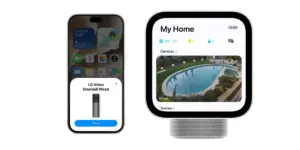
According to the new details, Proximity Control is designed to work specifically with the upcoming line of accessories co-developed by Apple and LG. The feature functions similarly to the existing "Handoff" experience between an iPhone and a HomePod. When a user brings their iPhone within close range of a compatible device—or physically taps the phone against the accessory—a notification will expand from the Dynamic Island at the top of the screen.
The behavior of this notification is contextually dependent on the type of device being accessed. For instance, if a user approaches a smart thermostat, the Dynamic Island will present an "Open Controls" button, allowing for immediate temperature adjustments without the need to manually find and launch the Home app. For security-focused hardware, such as smart doorbells or indoor and outdoor cameras, the interaction is even more direct. Tapping or nearing these devices will trigger a "camera viewer" pop-up, providing an instant live feed of the premises.
This level of integration represents a significant leap over the current HomeKit experience. Presently, interacting with a smart device typically requires navigating a series of menus or waiting for a push notification to arrive. Proximity Control effectively turns the iPhone into a universal, context-sensitive remote that understands exactly which piece of hardware the user is standing in front of.
The Technical Foundation: Matter, NFC, and Bluetooth Low Energy
The underlying technology that enables Proximity Control is a sophisticated blend of existing standards and Apple’s proprietary software layers. To ensure the iPhone can identify specific hardware with high precision, the LG-manufactured accessories utilize a specialized Matter payload.
As revealed in the code analysis, these devices store an "apple-deviceid" within the Matter payload located on the accessory’s NFC (Near Field Communication) tag. When a user taps their iPhone against the device, the NFC handshake instantly transmits this ID to iOS. This allows the operating system to identify the specific accessory and its current state with near-zero latency.
However, the system does not rely solely on physical contact. To facilitate the "nearness" detection that doesn’t require a direct tap, the accessories broadcast a Bluetooth Low Energy (BLE) advertisement specifically for Apple Proximity Control. This BLE beacon allows the iPhone to calculate the distance to the accessory, triggering the Dynamic Island hint as the user enters the immediate vicinity.

The pairing process is also being streamlined through this new hardware. When a user first sets up one of these second-party accessories, the Dynamic Island will provide real-time visual feedback on the pairing status, moving away from the traditional modal pop-ups that have defined the iOS setup experience for years. For users who prefer a more traditional experience or have privacy concerns regarding proximity-based triggers, Apple is expected to include a toggle within the Home app to disable these features on a per-device basis.
The Strategic Shift to Second-Party Hardware
The collaboration between Apple and LG marks a turning point in Apple’s smart home philosophy. While Apple has historically relied on the "Made for iPhone" (MFi) and HomeKit certification programs to populate its ecosystem, the results have been mixed. Third-party manufacturers often prioritize broad compatibility across multiple platforms like Amazon Alexa and Google Home, which can sometimes lead to a "lowest common denominator" feature set.
By entering a "second-party" partnership with LG, Apple can exert much tighter control over both the hardware specifications and the software integration. This approach mirrors how Apple works with partners in other sectors, such as its collaboration with LG on the UltraFine display line. In this scenario, LG handles the large-scale manufacturing and industrial design, while Apple dictates the internal silicon requirements, security protocols, and exclusive software features like Proximity Control.
Reports from Bloomberg earlier this week confirmed that the Apple-LG initiative includes a comprehensive lineup of essential home hardware. The initial rollout is expected to feature a smart thermostat, a deadbolt lock, an indoor security camera, an outdoor security camera, and a floodlight camera. By focusing on these core categories, Apple is positioning itself to compete directly with established players like Amazon’s Ring and Google’s Nest, but with a unique value proposition centered on the privacy and convenience of the Apple ecosystem.
Integration with the "Welcome Home" Event
The timing of these leaks aligns perfectly with Apple’s official announcement of a special event on October 13, titled "Welcome Home." The branding of the event strongly suggests a heavy focus on the domestic space, and it is widely anticipated that these LG-developed accessories will be the stars of the show.

While the hardware may be showcased next week, industry analysts suggest that a commercial release might still be several months away. Bloomberg’s Mark Gurman has noted that Apple likely won’t ship these products until early next year. However, a preview at the October event would serve to build momentum and give developers time to understand how these new proximity-based interactions might be leveraged in future updates to the HomeKit framework.
The "Welcome Home" event is also expected to provide updates on Apple’s broader AI strategy. With the recent launch of Apple Intelligence, there is significant speculation regarding how Siri will evolve to handle more complex home automation tasks. The combination of smarter, more context-aware AI and hardware that knows exactly where the user is located could lead to a more "proactive" smart home—one that adjusts the lighting or temperature based on the user’s physical movement throughout the house without requiring a single voice command or screen tap.
The Evolution of the Dynamic Island
This new smart home functionality also represents a maturation of the Dynamic Island itself. Introduced with the iPhone 14 Pro, the Dynamic Island was initially seen as a clever way to disguise the camera cutout while providing basic system alerts. Over the past two years, Apple has steadily expanded its utility, incorporating Live Activities for sports scores, flight tracking, and music playback.
By integrating smart home controls into this space, Apple is transforming the Dynamic Island into a persistent "command center" for the physical world. It moves the iPhone away from being a device you "go to" for information and toward a device that "reacts to" your environment.
As the October 13 event approaches, the picture of Apple’s future in the home is becoming clearer. By leveraging the manufacturing prowess of LG and the technical flexibility of the Matter standard, Apple is attempting to create a premium tier of smart home devices that offer a level of "magic" that third-party manufacturers simply cannot replicate. Whether Proximity Control and the Dynamic Island integration will be enough to sway users away from established ecosystems remains to be seen, but for the Apple faithful, the smart home is about to become significantly more intuitive.
 Smart Home & IoT Solutions
Apple Prepares for "Welcome Home" Event with Major iOS 27 Home App Overhaul and 4K Video Support
As Apple prepares to host its highly anticipated "Welcome Home" special event...
 Smart Home & IoT Solutions
The Apple Home Collection: Why Seamless Integration Could Finally Drive Mass Market Smart Home Adoption
In the rapidly evolving world of consumer technology, it is often difficult...
 Smart Home & IoT Solutions
Apple Prepares Major Smart Home Overhaul as Siri AI Integration Signals New Hardware Cycle
For several years, Apple’s ambitions in the smart home sector have appeared...