
Following an intense autumn season defined by major hardware announcements, new product form factors, and sweeping smart home introductions, Apple is entering a brief lull in its physical release schedule. With the final wave of hardware reaching consumers and delivery timelines settling, attention has turned toward internal operational changes, software updates, community shifts, and retail practices.
From a fundamental shift in how Apple engineers construct future operating systems to the abrupt closure of a decades-old support portal, the tech giant is navigating a dynamic period of transition. At the same time, software developers continue to adapt their applications to Apple’s latest hardware while consumer advocates raise serious questions about retail sales tactics.
Top Stories
Apple Re-engineers Software Workflow for iOS 28 and macOS 28
Apple is quietly overhauling its internal software engineering process as it prepares the groundwork for iOS 28, macOS 28, and companion operating system releases. According to details reported by Bloomberg’s Mark Gurman in his Power On newsletter, the company is adjusting the balance between feature development and bug-fixing to grant engineers greater creative freedom.
Historically, Apple has divided its annual operating system development cycle into three primary milestone stages. Under the traditional structure, each milestone consisted of a four-week coding block, followed immediately by a four-week "convergence" period. During convergence, engineers would halt major feature development to integrate new code into the broader operating system build, test stability, and iron out bugs.
Under the newly implemented framework, Apple is altering this timeline by extending the active coding phase of each stage to six weeks while compressing the convergence period down to two weeks.
| Stage Phase | Traditional Schedule | Revised Schedule |
|---|---|---|
| Coding Period | 4 Weeks | 6 Weeks |
| Convergence Period | 4 Weeks | 2 Weeks |
This adjustment effectively provides software teams with 50 percent more time during each block to experiment, develop, and refine new features before code freezes take effect. The revised cycle aims to foster greater agility within Apple’s engineering ranks, allowing teams to move more rapidly on complex software concepts. The shift reflects a broader organizational push toward increased operational flexibility under CEO John Ternus as Apple seeks to maintain a faster tempo across its ecosystem updates.
Apple Support Community Forums to Permanently Close on November 20
In a move that has caught many long-time users off guard, Apple has announced the permanent shutdown of the Apple Support Community discussion boards. The official support forums, which have served for years as a central repository for user-to-user troubleshooting, technical advice, and product discussions, will officially cease operation on Friday, November 20.
Without prior warning, Apple placed the entire forum network into a read-only state. Effective immediately, registered users are no longer able to post new questions, submit replies, or engage in ongoing discussion threads.
The abrupt nature of the announcement has sparked widespread frustration among active community members. Many long-standing contributors reported being blindsided by the decision, noting that the immediate lockdown prevented them from exchanging contact information, archiving helpful threads, or posting farewell messages to fellow community members who had populated the boards for years. While the archived posts remain accessible for standard reading at present, the interactive era of Apple’s flagship self-service support portal has effectively come to an end.
iPhone Duo Ecosystem Expands Beyond 100,000 Optimized Apps
Following the high-profile launch of Apple’s first foldable smartphone, the iPhone Duo, software developers are continuing to optimize their catalog for the device’s dual-display layout. Apple confirmed that more than 100,000 applications have now been updated to offer full native support for both the inner foldable display and the external cover screen.
The unique form factor of the iPhone Duo introduces distinct opportunities for user interface design, allowing developers to split control schemes, offer side-by-side multi-tasking windows, and re-imagine landscape viewing modes. Early app updates have introduced novel implementations across productivity utilities, immersive mobile gaming, and specialized tools tailored to dual-screen interaction.
Despite reaching the 100,000-app milestone, the transition remains ongoing. A notable selection of high-profile third-party applications have yet to release full optimization patches, leaving them to run in legacy scaling modes on the inner display. However, development momentum remains strong, with additional major application updates arriving in the App Store daily as developers work to capture user interest on Apple’s newest mobile platform.
Hands-On: Touchscreen OLED MacBook Pro, HomeView, and Updated Apple TV
Early hardware shipments have arrived for Apple’s latest device lineup, providing a closer look at several of the company’s most anticipated product redesigns.
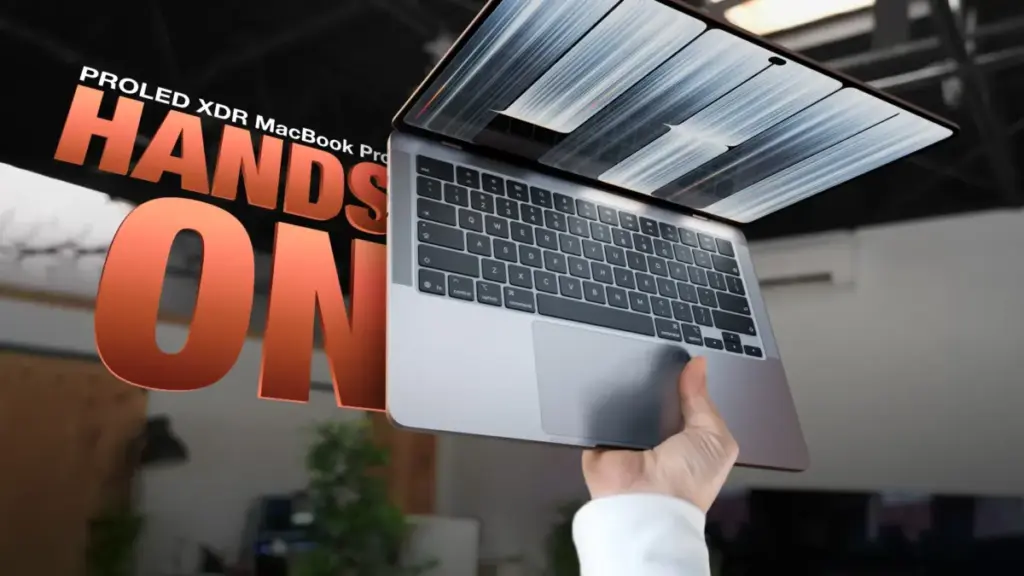
Headlining the hardware updates is the new MacBook Pro featuring a PROLED XDR Display, marking Apple’s official entry into touchscreen Mac computing. First impressions highlight a significantly lighter chassis compared to prior generations, paired with the vibrant color performance and deep contrast levels of OLED display technology. The machine also brings back a nostalgic design touch: the classic illuminated Apple logo on the display lid, updated for modern hardware.
Beyond the flagship notebook, hands-on evaluations are underway for Apple’s expanded home hardware offerings:

- HomeView Smart Home Hub: Designed as a dedicated central controller for HomeKit and Matter-enabled smart home ecosystems, the HomeView hub integrates visual management controls into a standalone form factor.
- Fourth-Generation Apple TV 4K: The updated media box refines performance within Apple’s television software interface while introducing expanded feature compatibility across the home entertainment ecosystem.
Apple Store Retail Practices Draw Scrutiny Over Trial Subscriptions
Apple’s retail sales tactics have come under public scrutiny following a series of investigative videos published by consumer rights advocate and repair technician Louis Rossmann. The report alleges that some Apple Store retail employees have been enrolling customers into auto-renewing subscription free trials—including Apple One and individual service packages—without obtaining clear, informed consent during the point-of-sale process.
According to internal accounts highlighted in the exposure, retail staff faced systemic pressure driven by internal tracking metrics, specifically the "services attach rate." This performance metric measured how successfully individual employees bundled digital service trials with hardware purchases, leading some staff members to register trial accounts on behalf of customers during device setup to meet internal targets.
In the wake of the publicity, Apple quietly removed the services attach rate metric from its retail evaluation tracking. Officially, Apple stated that the removal was planned due to the onset of the holiday shopping season, noting that attach metrics are less representative when customers are purchasing hardware as gifts for others rather than setting up personal devices. However, industry observers note that the timing of the policy change closely follows the heightened public criticism surrounding the subscription sign-up practices.

Apple Rolls Out iOS 27.2.1 and tvOS 27.2.1 Bug Fix Updates
To address stability issues and security vulnerabilities, Apple has released minor software updates across its mobile and home operating systems, headlined by iOS 27.2.1.
The iOS 27.2.1 update delivers essential underlying security fixes and targets specific operational bugs reported in the previous software build. Parallel to the mobile update, Apple also deployed tvOS 27.2.1. A notable inclusion in the tvOS release is the expansion of Siri AI features to second- and third-generation Apple TV 4K models, bringing enhanced voice intelligence to existing home theater hardware.
These point releases serve as bridge updates while Apple continues developer testing for the upcoming iOS 27.3 update. Currently in early beta evaluation, iOS 27.3 is expected to deliver a broader set of functional updates and user-facing features when it reaches public availability next month.
 macOS & Apple IT Support
Apple Weekly Round-Up: iPhone Duo Sales Trigger Retail Crowds, ‘Pro and Tell’ Event Set for LA, and iOS 27.2 Nears Launch
In what is proving to be one of the most intense autumn...
 macOS & Apple IT Support
Apple Developing Proactive ‘Agentic’ AI to Automate Web Browsing, App Usage, and Coding Across Devices
Apple has quietly begun laying the foundation for a general-purpose, proactive artificial...
 macOS & Apple IT Support
Early Black Friday Deals Bring Apple Watch Series 12 to Record Lows Alongside Broader Apple Hardware Discounts
With the annual holiday shopping season entering high gear, early Black Friday...







