
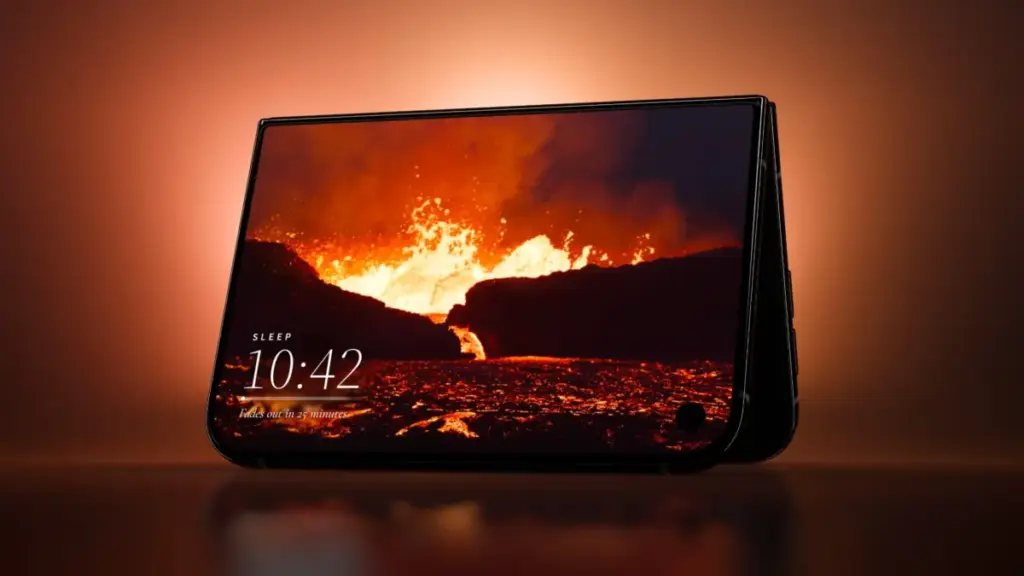
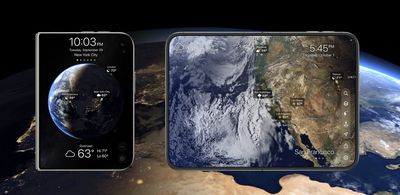
The application renders a 3D simulation of planet Earth featuring real-time global cloud coverage, live satellite weather tracking, tropical storm pathways, and day/night light terminators. When the iPhone Duo is unfolded flat, the interactive globe spans both screens, allowing users to spin, zoom, and inspect global weather fronts across a large display area.
When placed into tent mode on a nightstand or office desk, Living Earth converts into a split-screen dashboard. One panel displays live time, local temperature, and multi-day forecasts, while the opposite panel maintains a rotating visual view of the earth rendered from live meteorological satellite feeds.
Duometry ($2.99)
Designed as a spatial puzzle game, Duometry turns the physical calibration of the iPhone Duo’s hinge into a core gameplay challenge.
The game presents players with a target geometric angle on screen—such as 45 degrees, 120 degrees, or 88 degrees. The player must rely purely on spatial awareness and hand judgment to physically bend the Duo’s hinge to match the requested target angle without the assistance of on-screen protractors. Once the player believes they have hit the exact angle, they tap the screen to lock in their answer.
The game reads the device’s internal angle sensors to evaluate the guess, scoring the user based on angular precision down to fractions of a degree. As players progress through levels, target angles must be matched faster, under varying visual lighting conditions, or through multi-step folding sequences.
Deck-Man ($4.99)
Deck-Man approaches audio playback through pure analog nostalgia, transforming the dual-screen foldable into an interactive cassette deck player inspired by classic portable media devices of the 1980s.
When the application is active, opening the iPhone Duo unlatches a virtual cassette door mechanism on screen, allowing users to browse their music library formatted as customizable cassette tape shells. Once a tape track is selected and inserted into the virtual deck, the user snaps the physical iPhone Duo closed.
Snapping the device closed engages the simulated playback head, commencing audio output while displaying animated spinning tape reels through the window of the outer display interface. External volume buttons and tap-based transport controls allow users to play, pause, rewind, and fast-forward tracks with realistic mechanical audio sound effects accompanying every physical action.

Orisuji ($4.99)
Orisuji is a specialized spatial puzzle game centered around virtual paper folding and maze navigation. The game challenges players to guide a character or marker through intricate labyrinths that wrap around both the internal and external surfaces of the device.
Gameplay begins on the large main internal display, where players trace paths through complex geometric lines. However, as mazes encounter physical edges, paths dead-end unless the user physically folds or flips the iPhone Duo to transfer the puzzle continuum onto the outer display panel.
By constantly transitioning between unfolded, semi-folded, and completely closed states, players manipulate the geometry of the maze itself to bridge gaps, uncover hidden paths, and solve three-dimensional spatial puzzles that would be impossible to render on a static, single-display smartphone.
A Changing Software Ecosystem
The immediate emergence of these specialized applications underscores a distinct wave of developer interest surrounding Apple’s newest hardware architecture. Rather than treating foldability as a simple screen-extension feature, independent creators are actively treating the hinge, outer panels, and physical folding gestures as essential software inputs.
This early wave of third-party software releases provides a glimpse into how software design may evolve on dual-screen devices, balancing utilitarian productivity updates with tactile, retro-inspired skeuomorphism that redefines how users physically interact with their daily technology.
 macOS & Apple IT Support
Apple Seeds iOS 27.3 Beta 2: Face Unlock for iPhone Duo, Siri AI Web Awareness, Tiered Usage Limits, and System Refinements
Apple has officially seeded the second beta of iOS 27.3 to developers...
 macOS & Apple IT Support
Apple Weekly Round-Up: iPhone Duo Sales Trigger Retail Crowds, ‘Pro and Tell’ Event Set for LA, and iOS 27.2 Nears Launch
In what is proving to be one of the most intense autumn...
 macOS & Apple IT Support
Apple Shell Company Filings Point to ‘HomeView’ and ‘homeOS’ Ahead of October ‘Welcome Home’ Launch
As Apple prepares for an upcoming hardware launch event, recent trademark discoveries...







