

The competitive landscape AMD is entering is crowded and well-funded. Beyond Nvidia, global giants like Tencent and Google are active in the space with their HunyanWorld and Genie 3 projects, respectively. A wave of well-capitalized startups, including Runway, Odyssey, and Decart, are also racing to define the world model category. Furthermore, Yann LeCun, the Chief AI Scientist at Meta, has reportedly been developing similar technologies through his AMI Labs startup, emphasizing the industry-wide belief that spatial intelligence is the next major frontier.
One of the most pressing questions following the acquisition is how AMD will handle the "openness" of its new assets. Nvidia has made headlines with its "open weight" Nemotron models, but critics point out that these models often come with restrictive licenses and lack transparency regarding their training data. For instance, Nvidia’s Cosmos model was reportedly trained on 20 million hours of video content, much of which was likely scraped from the internet without explicit licensing.
Industry analysts suggest that AMD has a unique opportunity to differentiate itself by leaning into true open-source principles. If Li and Su choose to release a frontier-level model including not just the weights, but also the source code and a transparent look at the training data, it could fundamentally shift the loyalty of the developer community. Such a move would reinforce AMD’s narrative as the "open" alternative to Nvidia’s increasingly proprietary ecosystem.
As the integration of World Labs begins, the focus will turn to how quickly AMD can translate this $8.2 billion investment into tangible market gains. With the robotics market poised for exponential growth and the demand for sophisticated 3D simulation tools rising in industries ranging from automotive to film production, the stakes are high. By bringing World Labs into the fold, AMD has signaled that it is no longer content to simply provide the "shovels" for the AI gold rush; it intends to own the mine as well.
The acquisition marks a coming-of-age for AMD’s AI ambitions. With a trillion-dollar valuation and one of the world’s most renowned AI scientists at the helm of its research division, the company is now better positioned than ever to challenge the status quo. Whether this bold bet on world models will pay off remains to be seen, but for now, the message to the industry is clear: AMD is playing for keeps in the race for artificial general intelligence.
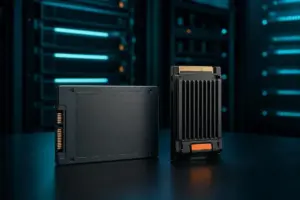 Enterprise Tech & Infrastructure
Understanding the Architecture of Modern Storage: Why the ‘Flash vs. SSD’ Debate Misses the Point
In the rapidly evolving landscape of enterprise data management, the terminology used...
 Enterprise Tech & Infrastructure
Beyond the Per-Gigabyte Rate: Navigating the Hidden Complexities of Amazon S3 Cost Management
In the landscape of enterprise cloud infrastructure, Amazon S3 has long been...
 Enterprise Tech & Infrastructure
Understanding Fibre Channel over Ethernet: Bridging the Gap Between High-Performance Storage and Ethernet Ubiquity
In the rapidly evolving landscape of data center infrastructure, the quest for...







