
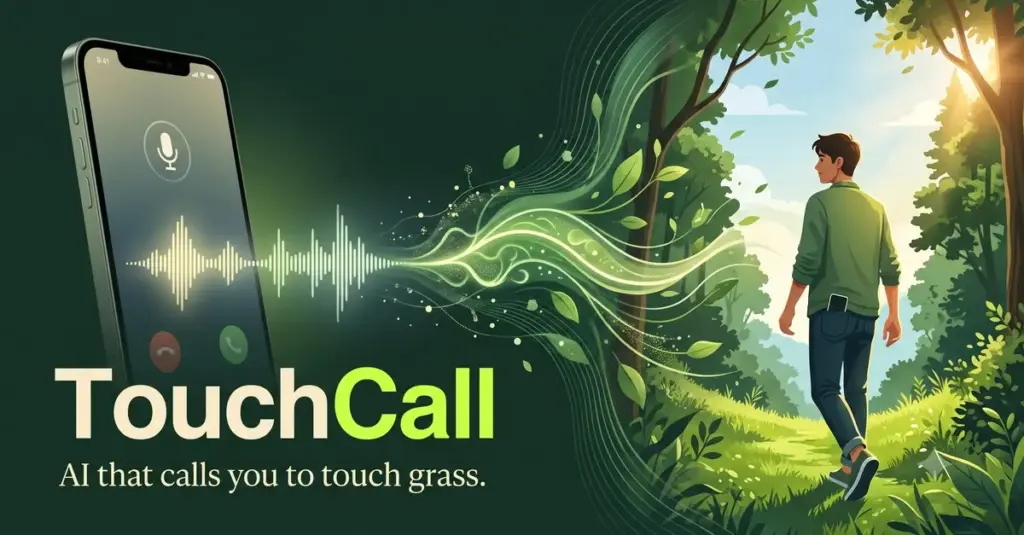
In an era where digital wellness applications often paradoxically demand more of our screen time to monitor our health, a new open-source project is attempting to flip the script. Developed by Pranav Suryawanshi, "TouchCall" is a voice-first AI assistant designed with a singular, counter-intuitive goal: to use the power of artificial intelligence to encourage users to put their phones down and engage with the physical world.
The project was recently introduced as a submission for the Hacktoberfest Open-Source AI Challenge, specifically addressing the "Touch Grass" theme of the competition’s first week. By moving away from traditional graphical user interfaces and toward a seamless voice-only interaction model, Suryawanshi aims to solve a persistent problem in the productivity and wellness space—the "notification trap" that keeps users tethered to their devices even when they are trying to disconnect.
The Vision Behind TouchCall: Technology as a Bridge to the Real World
The philosophy driving TouchCall is rooted in the observation that most modern technology is designed for maximum "stickiness." From social media feeds to productivity suites, the goal is often to keep the user’s eyes on the glass. Even wellness apps, which are intended to help users relax or exercise, frequently require them to navigate complex menus, log data manually, and respond to pings, thereby increasing overall screen time.
Suryawanshi’s approach suggests that technology should sometimes serve as a reason to step away from technology. TouchCall functions as a conversational partner that encourages outdoor activities, such as taking a walk or exercising, through natural dialogue. By utilizing voice interaction, the assistant removes the need for visual engagement, allowing the user to keep their phone in their pocket or across the room while they prepare to head outside.
The developer describes TouchCall as a lightweight, open-source initiative. The core mission is to create an AI that acts as a nudge toward the physical environment, rather than a vacuum for digital attention. In his project documentation, Suryawanshi emphasizes that the assistant is built to be a voice-first experience, ensuring that the transition from a digital task to a real-world activity is as frictionless as possible.
A Functional Prototype: Demonstrating the Voice Pipeline
While still in the prototype stage, TouchCall—which is also hosted on GitHub under the repository name "OutVoice"—demonstrates a sophisticated and functional voice processing pipeline. The project currently exists as a local implementation that proves the feasibility of a fully open-source, voice-operated AI assistant.
The current iteration of the system allows a user to speak to the assistant, which then processes the speech, generates a contextually relevant response using a Large Language Model (LLM), and speaks back to the user. This "round-trip" interaction is the foundation of the TouchCall experience. Unlike many commercial voice assistants that rely heavily on cloud-based processing and proprietary algorithms, Suryawanshi’s prototype is built to run locally, ensuring that the interaction is both private and customizable.
The repository provides the necessary framework for speech recording and transcription, alongside the logic required for the AI to provide encouraging prompts. While a live phone-call demonstration or a globally deployed web demo has not yet been released, the repository serves as a blueprint for developers interested in the intersection of local AI and digital well-being.
Technical Architecture: The Engineering Behind the Voice
The technical foundation of TouchCall is a testament to the rapid maturation of open-source AI tools. Developed primarily in Python on an Ubuntu environment, the system integrates several high-performance components into a modular pipeline.
The interaction begins with the microphone, which captures the user’s voice. This audio is processed by OpenAI’s Whisper, a state-of-the-art open-source speech recognition model that transcribes the spoken words into text. This text is then fed into a local instance of the Qwen model—a powerful, open-weight language model known for its efficiency and reasoning capabilities. Qwen generates a response focused on encouraging the user to "touch grass" or engage in a specific outdoor task. Finally, the response is converted back into audio using Piper, a fast, local text-to-speech (TTS) engine, and played through the system’s speakers.
One of the more nuanced engineering achievements in this prototype is the implementation of silence-based recording. Traditional voice triggers often rely on fixed recording durations, which can lead to awkward pauses or cut-off sentences. Suryawanshi implemented a system that detects when a user has finished speaking, allowing the assistant to stop recording and begin processing almost immediately. This creates a more natural, conversational flow that mimics human interaction.
The developer noted that one of the primary challenges during the build was ensuring these disparate components worked together reliably. Synchronizing audio recording behavior with model output parsing and TTS generation requires careful handling of data streams to minimize latency and ensure that the assistant feels responsive rather than sluggish.
The Importance of Open Innovation in AI
The decision to build TouchCall using open-source tools was a deliberate choice by Suryawanshi, driven by more than just the desire to avoid API costs. For this project, open innovation is a matter of control, privacy, and architectural freedom.
By utilizing open-weight models like Qwen and local tools like Piper and Whisper, the developer is not locked into any single proprietary platform. This "anti-lock-in" philosophy is central to the project’s identity. It allows the core AI pipeline to be inspected, modified, and improved by the community. Furthermore, local inference—running the AI on the user’s own hardware—provides a significant privacy advantage. In a voice-first system, where transcripts of personal conversations are generated, keeping that data on the user’s machine rather than sending it to a third-party server is a critical design consideration.
Suryawanshi argues that open tools are essential for individual developers to experiment with the future of human-computer interaction. Without the barrier of expensive enterprise APIs or closed-door models, developers can build technology that prioritizes the user’s needs over a platform’s business metrics. In the case of TouchCall, this means building an assistant that is actually willing to tell the user to go away and leave the computer behind.
Future Development: From Local Prototype to Outbound Calls
While the current prototype is a functional proof of concept running on a laptop, the roadmap for TouchCall includes significant expansions. The next phase of development focuses on improving multi-turn conversation context, which would allow the AI to remember previous interactions and provide more personalized encouragement over time.
Perhaps the most ambitious goal for the project is the integration of scheduled outbound phone calls. Suryawanshi envisions a system where the AI can proactively call the user’s phone at a designated time. This would serve as a reminder to take a break or head outside, all without the user ever having to unlock their screen or open an app. This "push" model of interaction further reinforces the voice-first philosophy, using the most basic function of a mobile phone—the phone call—to pull the user away from the digital distractions of the modern smartphone interface.
The developer acknowledges that while the AI core will remain open and replaceable, certain future features like telephony integration may require external providers. However, the commitment to an open-source heart remains the project’s guiding light.
A New Category of Productivity Tool
TouchCall is currently being considered for several prize categories within the Hacktoberfest AI Challenge. Its focus on local inference and the "Touch Grass" theme positions it as a unique entry in a field often dominated by tools designed to increase digital output.
As the project grows, it stands as a reminder that the goal of innovation is not always to create more "usage," but to create better outcomes for the user. By building an AI that values the user’s time spent away from the machine as much as the time spent with it, Pranav Suryawanshi is contributing to a growing movement of "calm technology." TouchCall serves as a practical example of how open-source AI can be harnessed to help people reconnect with the physical world, one voice command at a time.
 Software Development & Scripting for IT
Bridging the Context Gap: TokenCap Introduces Schema Intelligence to Eliminate AI Coding Errors
In the rapidly evolving landscape of software development, the integration of Artificial...
 Software Development & Scripting for IT
The Architecture Gap: Why AI Coding Agents Are Generating More Code but Less Software
In the modern landscape of software development, a peculiar paradox has begun...
 Software Development & Scripting for IT
"Outside in 20" Redefines Digital Wellness with Local AI-Driven Outdoor Encouragement
In an era where digital connectivity often feels inescapable, a new open-source...







