
In the fast-paced world of software-as-a-service (SaaS) development, the simplest path is often the most dangerous. For years, the standard approach for handling user-generated content, such as profile avatars, was straightforward: when a user uploads a new image, the system overwrites the existing file at a predictable path like users/id/avatar.jpg. While this design is aesthetically tidy and minimizes database complexity, it masks a structural vulnerability that can lead to irreversible data loss.
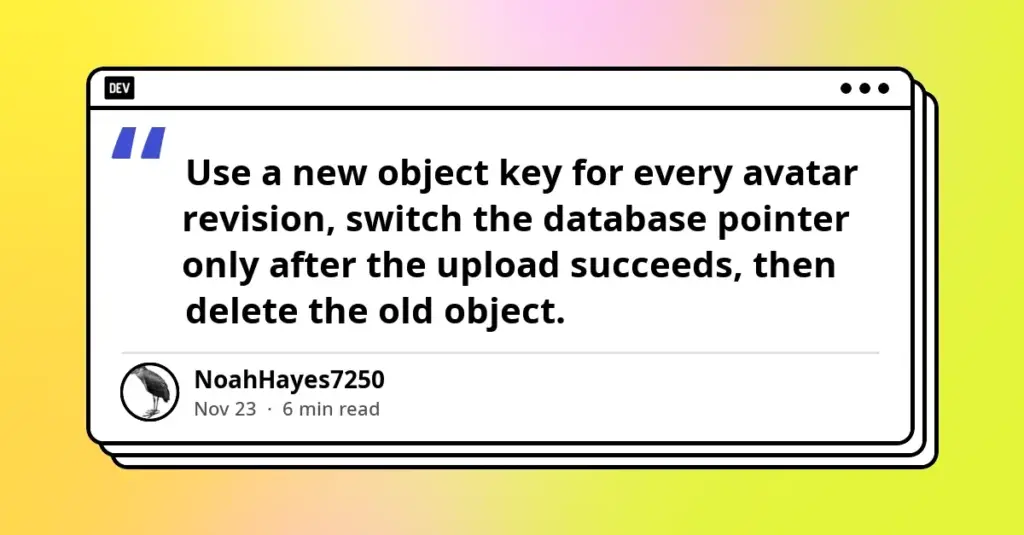
Technical architects are now advocating for a more resilient four-step sequence: upload, verify, commit, and clean up. By utilizing unique object keys for every revision and switching database pointers only after a successful upload, developers can ensure that a "bad write" never destroys the only recoverable copy of a user’s data. This shift toward immutability in object storage is becoming a hallmark of professional cloud architecture, particularly for solo founders and small teams where engineering hours are the most precious resource.
The Risks of the Beginner Design
The "beginner" approach to avatar management is attractive because it requires no pointer updates and keeps the database schema lean. In this model, one user row corresponds to one predictable object key. However, if the underlying storage provider does not offer native object versioning or object locking, a replacement operation is final. If the upload is interrupted, or if the new file is corrupted, the original bytes are lost permanently.
Industry experts point out that in such a system, rollback is not a feature; it is merely a hope. For a one-person gaming SaaS, the stakes are high. While shipping new features weekly is the priority, spending a "founder’s Friday" attempting to restore a customer’s identity data from non-existent backups is a catastrophic use of time. The trade-off, therefore, tilts heavily in favor of a slightly more complex application logic that guarantees data safety.
By keeping an active_avatar_key in the database and making every storage key immutable—incorporating a revision ID or a timestamp—developers create a clear safety margin. This allows for safe retries and provides a structured environment to enforce data retention and deletion policies.
Addressing the Multi-Tenant Security Boundary
The challenges of object storage are amplified in multi-tenant environments, such as a gaming service that hosts multiple independent studios. A generic key like users/42/avatar fails to express ownership at the storage level. To resolve this, architects recommend scoping every key by tenant, using a structure such as tenants/tenantId/users/userId/avatars/revision.
This prefixing serves two purposes. First, it provides a useful organizational hierarchy within the storage bucket. Second, and more importantly, it establishes a security boundary. By checking tenant ownership in the database before any storage API call is initiated, the application ensures that one tenant cannot inadvertently or maliciously access or overwrite the data of another.
Furthermore, this architectural pattern allows for the separation of different data categories. While a user avatar can usually tolerate a brief delay in a cleanup queue, other types of data require stricter handling. For example, a signed tournament agreement with an explicit legal deletion deadline requires its own immutable key, a recorded deadline in the database, and a dedicated deletion job. If an agreement mandates audit-grade legal holds or specific regional placement, the consensus is to use a specialist storage provider that offers those specific guarantees, as an API aggregator cannot manufacture these features if they are not supported by the underlying infrastructure.
 Software Development & Scripting for IT
Unified Workflow for AI Development: The Rise of the Two Engines Kit for Claude and Codex
In the rapidly evolving landscape of artificial intelligence-assisted software engineering, the reliance...
 Software Development & Scripting for IT
Re-evaluating the Enterprise Test Automation Stack: Why Past Decisions Require New Scrutiny in the Age of AI
In the fast-moving world of enterprise software, a test automation tool that...
 Software Development & Scripting for IT
The Evolution of Polymorphic Serialization: Why System.Text.Json Offers a Safer Path for Obfuscated .NET Applications
In the landscape of .NET development, maintaining the integrity of serialized data...







