
In the rapidly evolving landscape of artificial intelligence, the hardware that powers the world’s most sophisticated models is undergoing a fundamental shift. It is no longer enough to simply produce faster, more powerful chips; the industry is now moving toward highly specialized configurations designed to match specific, increasingly complex workloads. Google, a pioneer in custom silicon, is doubling down on this philosophy by introducing two significant new variants of its Tensor Processing Unit (TPU) accelerators. These new entries, the "Sunfish" TPU 8t and "Zebrafish" TPU 8i, represent a strategic refinement of the hardware Google first teased earlier this year, aiming to optimize everything from massive frontier model training to the high-frequency demands of agentic AI inference.
These upcoming accelerators, which are slated for a gradual rollout starting next year, are designed to serve both Google’s internal research needs and its growing base of Google Cloud customers. While Google remains its own best customer—using these machines to develop the next generations of its Gemini models—the company is also paving the way for direct customers to eventually harness this homegrown compute power within their own data centers. However, the road from announcement to availability is a long one, often dictated by the complex physics of chip fabrication and the logistical challenges of global data center deployment.
The two new variants are essentially specialized versions of the TPU 8 architecture revealed in April. The TPU 8t, shepherded through the design and production process by Broadcom’s chip unit, is currently making its way into Google’s data centers. Meanwhile, the TPU 8i, which involves a partnership with MediaTek, has faced some developmental delays, leaving its current shipping status somewhat opaque. Industry analysts expect the modified versions of these Sunfish and Zebrafish systems to begin their installation phase in early 2027. If current trends hold, a ramp-up period would follow, likely extending through mid-2028 before these machines are widely available across multiple Google Cloud regions.
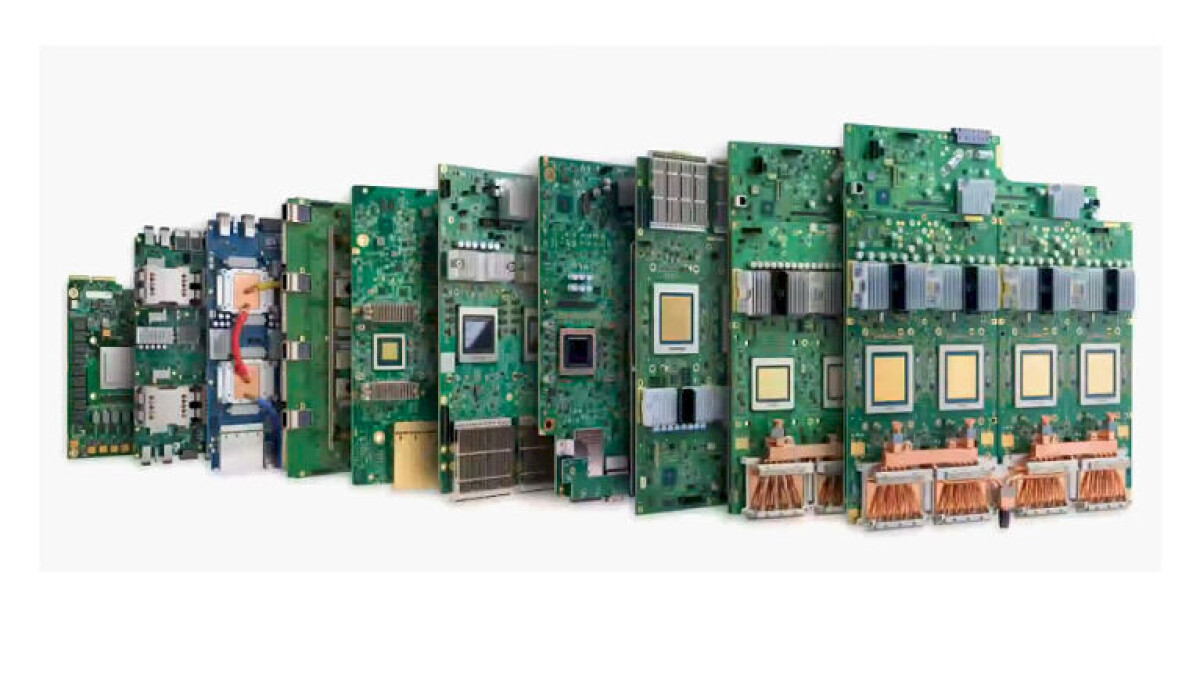
To understand the timeline for such a massive infrastructure project, one only needs to look at the history of the TPU v7p, codenamed "Ironwood." First deployed for Google’s internal use in late 2025, it took approximately a year for the company to build enough excess capacity to offer the Ironwood accelerators for rent on the public cloud. Today, pricing for Ironwood is active in regions like US-Central1 in Iowa and Europe-West2 near London, highlighting the significant lag between the birth of a chip and its commercial accessibility.
At the heart of Google’s training strategy is the TPU 8t (Sunfish). This device is explicitly engineered for the Herculean task of AI training. It utilizes Google’s proprietary 3D torus interconnect, a networking topology that allows for a shared coherent memory space spanning up to 9,600 accelerators. This configuration is capable of delivering an extraordinary 121 exaflops of performance at FP4 precision. Each individual Sunfish device is equipped with 216 GB of HBM3E memory distributed across six stacks, providing what is arguably the largest shared memory footprint in the current AI sector. This massive memory overhead is essential for training "frontier" models like Gemini, which require enormous amounts of data to be processed simultaneously.
Mark Lohmeyer, vice president and general manager of AI and computing infrastructure at Google, recently detailed how these machines are being deployed. The 9,600-unit pods are ganged together to form clusters exceeding one million TPU 8t devices. It was this level of unprecedented scale that allowed Google to train its Gemini 4 Carbon model. While the development of Gemini 4 Carbon faced some internal delays, its release on October 28 marked a significant milestone, outperforming its predecessor, Gemini 4 Argon, across various benchmarks. For those accessing these models via API, Google has set introductory pricing at $2 per million input tokens and $10 per million output tokens, with substantial discounts for cached inputs.
 Enterprise Tech & Infrastructure
Decoding the Amazon S3 Bill: Why the Per-Gigabyte Rate Is Often the Smallest Part of Cloud Storage Costs
In the world of enterprise cloud infrastructure, the Amazon S3 storage bill...
 Enterprise Tech & Infrastructure
Bridging the Gap: The Role of Fibre Channel over Ethernet (FCoE) in Modern Data Center Storage
In the complex landscape of enterprise data management, the quest for a...
 Enterprise Tech & Infrastructure
Qualcomm Validates High-Bandwidth Computing Architecture to Overcome the AI Memory Wall
In a significant move to reshape the landscape of artificial intelligence infrastructure,...







