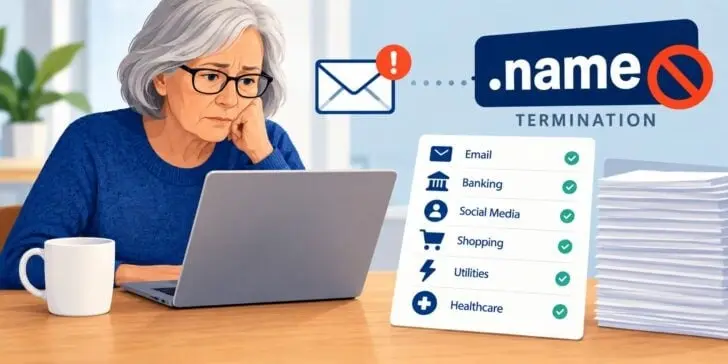
For Judy Johnston, a digital identity established at the dawn of the modern internet is on the verge of being erased. After nearly a quarter-century of consistent use, Johnston is facing the forced termination of her third-level .name domain, a move sanctioned by the Internet Corporation for Assigned Names and Numbers (ICANN) and Verisign, the registry operator. What might seem like a minor technical sunsetting to a global corporation has become a grueling, full-time administrative burden for Johnston, who must now untangle her entire digital life from an email address she has used since 2002.
The situation, detailed in a recently published ICANN reconsideration request, highlights a growing friction between the management of internet infrastructure and the real-world lives of the people who inhabit it. For twenty-five years, Johnston’s domain has served as the foundation for her online presence, as well as that of her 97-year-old mother. The looming termination of third-level .name registrations is not merely a change in service; for users like Johnston, it is a catastrophic disruption of their digital continuity.
The .name top-level domain was originally launched with a specific vision: to provide individuals with a digital space that reflected their personal identities. Unlike .com or .net, which were often crowded with commercial interests, .name allowed for a structured personal branding, often utilizing a third-level format such as "first.last.name." For Johnston, this was more than a novelty; it was a permanent address in an ever-shifting digital landscape. Over the decades, that address became the primary point of contact for every facet of her life, from financial institutions and healthcare providers to social connections and government services.
Now, that foundation is being removed. Johnston reports that she is currently tasked with the monumental challenge of updating at least 211 separate online accounts. Each of these accounts is tied to her .name email address, and each requires a manual update to a new service provider. This process is far from a simple matter of clicking a "change email" button. In the modern era of heightened digital security and data protection, changing a primary email address—especially one that may soon no longer exist to receive confirmation codes—is an ordeal fraught with bureaucratic hurdles.
The administrative weight of this transition is particularly heavy for Johnston and her mother, both of whom are senior citizens. Johnston describes the effort to salvage their digital identities as a "full-time daily job" that has already consumed weeks of her time. The difficulty is compounded by the fact that many service providers have implemented rigorous security protocols to prevent account hijacking. When a user attempts to change their primary email address, they are often met with demands for multiple forms of identification, the completion of complex data protection forms, and manual verification processes that can take days or weeks to resolve.
The problem is exacerbated by a "catch-22" inherent in the termination process. If Johnston does not successfully migrate an account before the domain is officially terminated, she will lose the ability to receive the very password reset links and verification emails required to access those accounts. Once the domain goes dark, any account that hasn’t been updated becomes a digital orphan. Recovering such accounts manually, without access to the original email, is a notoriously difficult process that often requires speaking with human customer service representatives—a resource that is increasingly scarce in the tech industry.
 Web Hosting & Domain Management
Woman faces changing 211 accounts after .name domain termination
The plight of Judy Johnston, a long-term registrant of a .name domain,...
 Web Hosting & Domain Management
Verisign Unveils "Verisign Informed" Security Service and Formally Applies for .pki Top-Level Domain
Verisign, the global leader in domain name registry services and internet infrastructure,...
 Web Hosting & Domain Management
Industry Anxiety Mounts as ICANN Withholds Critical Timeline for New gTLD Reveal Day
The global domain name industry is currently suspended in a state of...