

The history of high-performance computing has long been defined by a tension between proprietary innovation and the industry’s desire for open standards. For decades, every major CPU manufacturer maintained its own highly guarded method for linking multiple processors into shared memory clusters. Whether it was the specialized interconnects used by IBM, Intel, or AMD, these technologies served as the "universal glue" that allowed several independent chips to function as a single, massive computational unit. Despite the efforts of various industry groups, such as the CCIX and CXL consortia, to create a standardized fabric for this purpose, the market largely remained fragmented.
The failure to establish a truly universal standard for Symmetric Multiprocessing (SMP) and Non-Uniform Memory Access (NUMA) was driven by two primary factors. First, while customers appreciated the idea of interoperability, the actual demand for mixing and matching different CPU architectures from different vendors within a single shared-memory system was remarkably low. Second, and perhaps more importantly, proprietary control allowed vendors to innovate at their own pace. They could refine their SMP and NUMA chipsets—technologies that eventually moved from external components directly onto the CPU die—without waiting for a standards body to ratify new features. This independence allowed for rapid differentiation, but it also cemented vendor lock-in.
Today, as the industry pivots from general-purpose CPU computing to AI-centric GPU and XPU architectures, the same battle for the "scale-up" network is being waged. While "scale-out" networking—the traditional Ethernet or InfiniBand used to connect thousands of nodes—is well-understood, "scale-up" networking refers to the high-speed, low-latency interconnects that allow GPUs within a rack to share memory and work on a single large model as if they were one giant processor. Currently, Nvidia sits at the center of this universe with its NVLink and NVSwitch technologies, charging a significant premium for the privilege of unparalleled bandwidth and latency.
However, the industry’s "hope springs eternal" regarding standards, driven by the economic law of substitution. Markets naturally crave competition to drive down costs. This environment has provided the perfect backdrop for the emergence of Upscale AI, a startup that is rapidly gaining momentum as it attempts to break the proprietary stranglehold on AI scale-up fabrics.
The Rise of Upscale AI and the SkyHammer Architecture
Upscale AI first caught the industry’s attention earlier this year when it announced a significant $200 million Series A funding round. Since then, the company’s trajectory has been nothing short of explosive. The firm has now raised a total of $500 million, its valuation has surged to $2 billion, and its workforce has expanded to more than 300 employees. This week, the company’s leadership, including co-founder and executive chairman Rajiv Khemani and CEO Barun Kar, provided a deeper look into their technical roadmap and the "SkyHammer" scale-up switch ASIC that has been under development for several years.
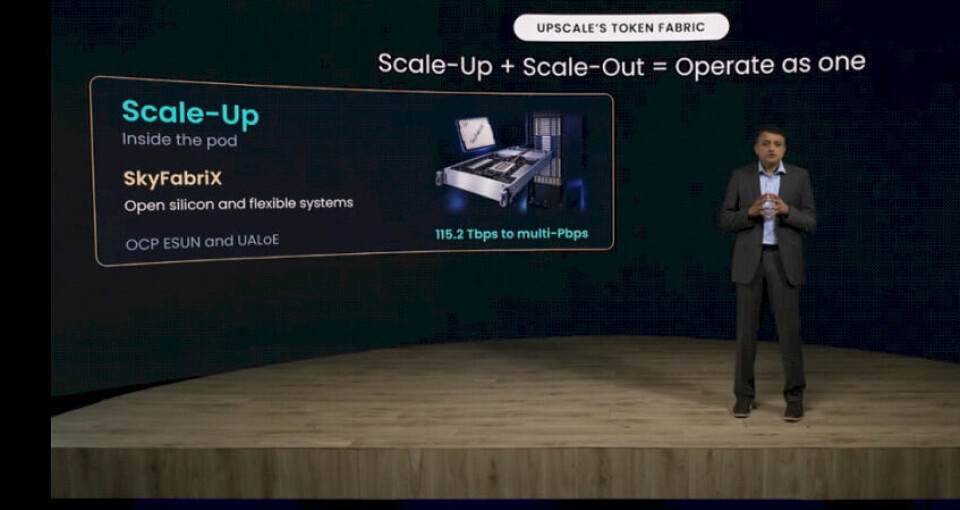
Khemani and Kar are industry veterans with extensive backgrounds in high-performance systems and networking, and their strategy reflects a "clean sheet" approach to the challenges of modern AI workloads. The centerpiece of their offering is the SkyHammer ASIC, which boasts an aggregate bandwidth of 115.2 Tb/sec. This figure places Upscale AI on a level playing field with the state-of-the-art scale-out network ASICs produced by industry titans like Broadcom, Cisco Systems, and Nvidia.
The SkyHammer chips are designed to power the "SkyFabriX" architecture, which Upscale AI claims will eventually support switch gear capable of reaching multiple petabits per second of aggregate bandwidth. Achieving such massive scale typically involves ganging multiple ASICs together within a single switch. This is a common practice for companies like Broadcom and Meta, where a two-tier internal network within a switch can double port bandwidth, albeit at the cost of increased latency for some port hops. Upscale AI appears poised to follow a similar path, optimizing the economics of port density and bandwidth to provide a competitive alternative to the status quo.
Scaling the Memory Domain: Bandwidth vs. Predictability
One of the most critical metrics for any scale-up fabric is how many accelerators it can support in a single memory domain. Nvidia’s current NVL72 rack-scale machine can glue together up to 72 GPUs, with the company aiming to scale its NVSwitch architecture to support 1,152 GPUs in the upcoming "Rubin Ultra" generation through multi-tier networking. Upscale AI’s SkyHammer architecture is entering this fray with the promise of supporting up to 576 accelerators in a single networking tier, with the ability to scale to "thousands" of devices across multiple tiers.
While the raw bandwidth per device on a 576-accelerator SkyHammer fabric—calculated at approximately 200 Gb/sec—is lower than the staggering 1.8 TB/sec offered by Nvidia’s NVSwitch 5/NVLink 5 generation, Upscale AI argues that bandwidth is only one part of the equation. For AI inference workloads in particular, the company contends that predictable latency and jitter are more important than peak theoretical throughput.
Arvind Srikumar, senior vice president of product and marketing at Upscale AI, emphasized that the SkyHammer ASIC was built from the ground up to handle the specific demands of AI. Traditional Ethernet fabrics often rely on fixed pipeline arrangements that lack the parallelism required for the most demanding AI models. In contrast, SkyFabriX incorporates mechanisms to ensure the fabric remains 100 percent lossless while maintaining a highly predictable latency profile. By starting with a "clean sheet" rather than retrofitting existing Ethernet protocols, Upscale AI believes it can offer a level of reliability that legacy systems struggle to match.
The Protocol War: UALink, ESUN, and the Ethernet Foundation
The battle for the scale-up market is also a battle of protocols. Currently, the industry is watching the development of UALink (Ultra Accelerator Link) and the associated UALoE (UALink over Ethernet) and ESUN memory protocols. These standards are being designed to run on top of fast Ethernet switches that have been specifically modified for scale-up tasks.
Interestingly, Upscale AI’s SkyHammer is designed to run UALoE and ESUN, confirming that, beneath its specialized features, SkyHammer is fundamentally an Ethernet switch ASIC. While some had hoped for a native UALink implementation with even higher radix, the decision to stick with an Ethernet-based foundation reflects the broader industry trend. Many experts, including the founders of Upscale AI, believe that Ethernet will eventually supersede InfiniBand as the dominant scale-out fabric for AI, especially as the Ultra Ethernet Consortium (UEC) finalizes its specifications.
While InfiniBand remains the gold standard for the absolute lowest port-to-port hop latency—a lead it has held for nearly three decades—Ethernet is closing the gap. More importantly, Ethernet offers superior scalability and a more robust ecosystem for the kind of massive, multi-tenant AI clusters being built by hyperscalers and cloud providers.
A Strategic Partnership with Nvidia
In a move that highlights the complex "coopetition" of the semiconductor industry, Upscale AI has partnered with Nvidia for its scale-out needs. Specifically, Upscale AI will acquire Nvidia’s Spectrum-X Ethernet ASICs to build its own scale-out switches. These devices will run Upscale AI’s "SkyOS," a network operating system that will span both the scale-up SkyFabriX and the scale-out Spectrum-X hardware.
SkyOS is an AI-optimized evolution of SONiC (Software for Open Networking in the Cloud) and the Switch Abstraction Interface (SAI). Originally created by Microsoft in 2016, SONiC has become the de facto standard for many of the world’s largest data centers. By leveraging this open foundation, Upscale AI ensures that its telemetry and orchestration tools, known as SkyCMD, can view both the scale-up and scale-out networks as a unified whole.
This approach offers a tantalizing prospect for data center operators: the ability to mix and match CPUs, GPUs, and XPUs from various vendors, all managed through a single, consistent software layer. However, a significant hurdle remains. As of now, Nvidia does not support SkyHammer or SkyOS as an alternative to its own NVSwitch for scaling up Nvidia GPUs. This means that while a customer could use SkyHammer to build a cluster of AMD or third-party accelerators, they cannot yet use it to create a shared-memory domain for Nvidia H100s or B200s.
The Path Forward for the AI Interconnect Market
The emergence of Upscale AI represents a significant challenge to the proprietary models that have dominated the industry. By providing a high-performance, Ethernet-based alternative for scale-up networking, the company is giving hope to those who wish to break free from the "Nvidia tax."
The strategic implications are vast. AMD, which is actively seeking scale-up options to support its own MI300 and future accelerator series, is a natural beneficiary of Upscale AI’s progress. Some industry observers have even suggested that AMD might eventually seek to acquire Upscale AI to secure its own competitive scale-up fabric and diversify its revenue streams.
For Nvidia, the rise of standard-based scale-up networks presents a choice. The company could continue to guard its NVLink ecosystem, or it could eventually adopt an industry-standard scale-up network with its own protocol overlays, particularly for the burgeoning AI inference market. Nvidia has already shown some flexibility with its NVLink Fusion effort, allowing custom CPUs and XPUs to hook into its memory space.
As the industry moves toward the next generation of AI hardware, the success or failure of ventures like Upscale AI will determine whether the future of AI infrastructure remains a collection of proprietary silos or evolves into an open, competitive ecosystem. For now, the "SkyHammer" is poised to strike, and the results will be felt across every data center in the world.
 Enterprise Tech & Infrastructure
Strategic Navigation of Amazon S3 Economics: Beyond the Per-Gigabyte Price Point
In the landscape of modern enterprise cloud architecture, Amazon S3 has long...
 Enterprise Tech & Infrastructure
Micron Technology and the Global Memory Boom: HBM’s Ascent to the Most Profitable Product in IT History
The history of the commercial information technology sector spans more than six...
 Enterprise Tech & Infrastructure
Decoding the Total Cost of Ownership: A Strategic Approach to Amazon S3 Storage Optimization
For the modern enterprise, the Amazon S3 bill is frequently a source...







