

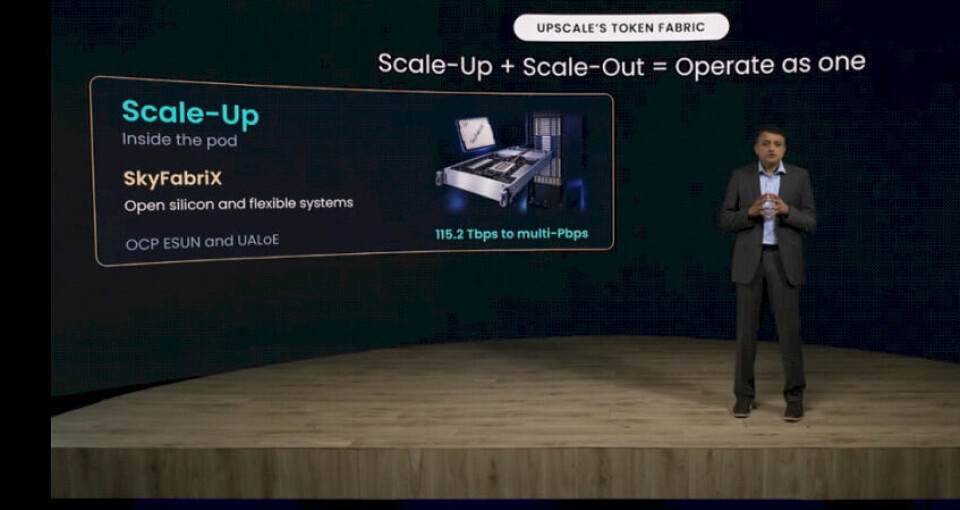
In a move that highlights the complex "coopetition" of the semiconductor industry, Upscale AI has partnered with Nvidia for its scale-out needs. Specifically, Upscale AI will acquire Nvidia’s Spectrum-X Ethernet ASICs to build its own scale-out switches. These devices will run Upscale AI’s "SkyOS," a network operating system that will span both the scale-up SkyFabriX and the scale-out Spectrum-X hardware.
SkyOS is an AI-optimized evolution of SONiC (Software for Open Networking in the Cloud) and the Switch Abstraction Interface (SAI). Originally created by Microsoft in 2016, SONiC has become the de facto standard for many of the world’s largest data centers. By leveraging this open foundation, Upscale AI ensures that its telemetry and orchestration tools, known as SkyCMD, can view both the scale-up and scale-out networks as a unified whole.
This approach offers a tantalizing prospect for data center operators: the ability to mix and match CPUs, GPUs, and XPUs from various vendors, all managed through a single, consistent software layer. However, a significant hurdle remains. As of now, Nvidia does not support SkyHammer or SkyOS as an alternative to its own NVSwitch for scaling up Nvidia GPUs. This means that while a customer could use SkyHammer to build a cluster of AMD or third-party accelerators, they cannot yet use it to create a shared-memory domain for Nvidia H100s or B200s.
The Path Forward for the AI Interconnect Market
The emergence of Upscale AI represents a significant challenge to the proprietary models that have dominated the industry. By providing a high-performance, Ethernet-based alternative for scale-up networking, the company is giving hope to those who wish to break free from the "Nvidia tax."
The strategic implications are vast. AMD, which is actively seeking scale-up options to support its own MI300 and future accelerator series, is a natural beneficiary of Upscale AI’s progress. Some industry observers have even suggested that AMD might eventually seek to acquire Upscale AI to secure its own competitive scale-up fabric and diversify its revenue streams.
For Nvidia, the rise of standard-based scale-up networks presents a choice. The company could continue to guard its NVLink ecosystem, or it could eventually adopt an industry-standard scale-up network with its own protocol overlays, particularly for the burgeoning AI inference market. Nvidia has already shown some flexibility with its NVLink Fusion effort, allowing custom CPUs and XPUs to hook into its memory space.
As the industry moves toward the next generation of AI hardware, the success or failure of ventures like Upscale AI will determine whether the future of AI infrastructure remains a collection of proprietary silos or evolves into an open, competitive ecosystem. For now, the "SkyHammer" is poised to strike, and the results will be felt across every data center in the world.
 Enterprise Tech & Infrastructure
Securing the Data Core: Evaluating the Security Architectures of DAS and NAS in the Enterprise
In the modern enterprise landscape, data is frequently described as the new...
 Enterprise Tech & Infrastructure
The Hidden Architecture of Amazon S3 Costs: Why the Per-Gigabyte Rate is Only the Tip of the Iceberg
For many enterprise IT leaders, the initial appeal of Amazon S3 lies...
 Enterprise Tech & Infrastructure
Quantum Elements Bridges the Hardware-Software Gap in Quest for Fault-Tolerant Computing
The journey toward a practical, large-scale quantum computer has long been defined...







