

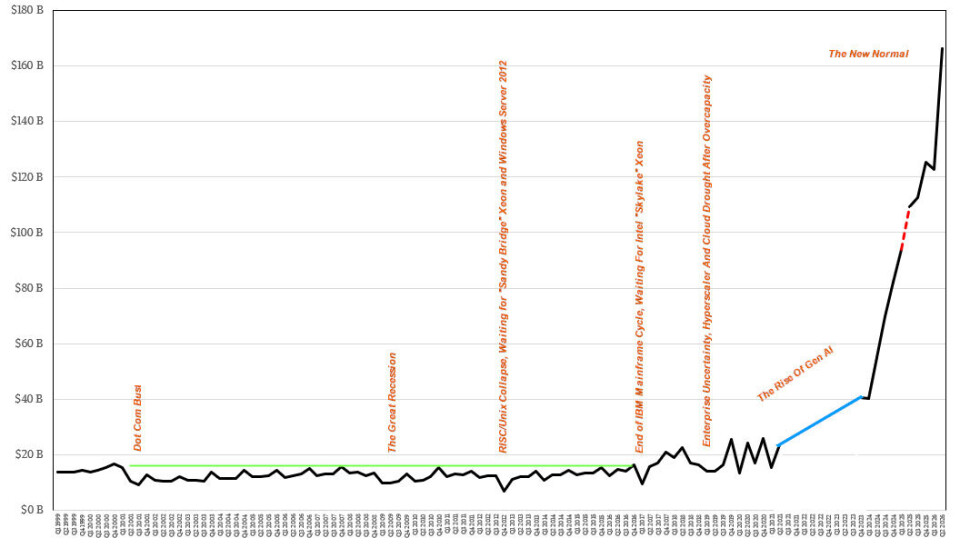
There is a specific, visceral sensation associated with watching an F-18A Hornet ignite its afterburners and scream off the deck of an aircraft carrier. As the jet pitches upward to intercept long-range bombers at 50,000 feet, the observer is forced into a steep, neck-craning posture just to keep the craft in sight. It is a display of raw power and vertical momentum. In the current economic landscape, that same physical strain is being felt by anyone attempting to track the revenue trends of the global server market. We are witnessing a vertical takeoff that defies historical precedent, leaving the steady growth curves of the past decades looking like flat runways in comparison.
In the second quarter of 2026, the global appetite for compute reached a fever pitch. According to the latest data from IDC, the world consumed a staggering $166.32 billion in servers during the three-month period ending in June. To put the scale of this expansion into perspective, this represents a 52 percent increase year-over-year. Even more startling is the sequential growth; the market surged by 35.6 percent compared to the first quarter of the year. In the six-decade history of corporate computing, from the era of mainframes to the peak of the Dot Com boom, the industry has never seen a spike of this magnitude. We are no longer looking at a cyclical recovery or a standard growth phase; we are observing a fundamental re-architecting of global infrastructure.
The composition of this $166 billion spend reveals a market that has been bifurcated by the demands of artificial intelligence. We now live in a world where more than half of the total revenue spent on systems is dedicated to what would historically have been classified as supercomputers. The remaining half is split in a telling fashion: two-thirds of that expenditure is directed toward the "butlers and secretaries" of the AI world—the control planes, storage arrays, and networking systems required to feed and manage the supercomputers. The final third of that second half is all that remains for the traditional workloads that defined corporate IT for the last ten years: data processing, standard analytics, and web infrastructure. What was once the state of the art is now a minority share of the total spend.
Of the total $166.32 billion invested in server nodes and rackscale systems during the second quarter, approximately 52.5 percent was allocated to GPU-accelerated systems. This translates to a massive $87.4 billion in revenue for high-performance, accelerated hardware. IDC’s quarterly tracker highlights a significant shift in the economics of these machines, noting that the average selling price (ASP) of a GPU-accelerated system has climbed to $170,220. This is a 43.5 percent increase from the previous year’s ASP of $118,600.
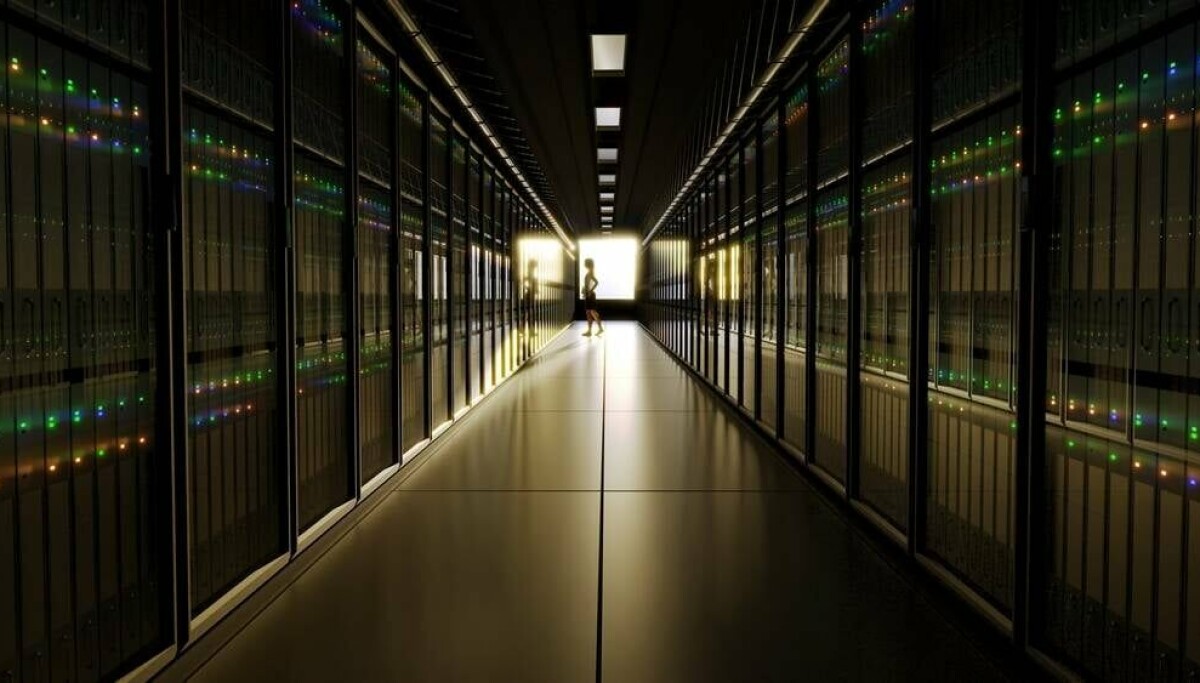
This escalation in price provides a window into the changing physical nature of data centers. While revenue is skyrocketing, unit sales of GPU systems actually saw a decline. In the second quarter, shipments of distinct GPU systems fell by 10.7 percent, dropping to 513,453 units from 575,278 units in the same period in 2025. This paradox—falling units and soaring revenue—is driven by the transition from individual server nodes to massive rackscale architectures. In a traditional setup, several nodes might fit into a single rack, each operating with its own distinct memory domain. In the new era of generative AI, the industry is moving toward systems where the memory domain is unified across every GPU and CPU in the entire rack.
However, the ASP of $170,220 also suggests that the market is more diverse than the headlines might imply. While there is significant industry chatter regarding the massive Grace-Blackwell NVL72 rackscale systems from Nvidia—which can carry price tags of $4 million to $5 million depending on the configuration—the IDC average indicates that a vast number of customers are still purchasing smaller-scale equipment. A significant portion of the market remains rooted in "fat" server nodes containing four or eight GPUs, or even lower-end systems utilizing PCI-Express cards like the Nvidia RTX Pro 6000. A four-way node in this class might cost between $90,000 and $125,000, while an eight-way version might range from $180,000 to $250,000. These lower-cost configurations are keeping the overall ASP from reaching the multi-million-dollar levels associated with the most advanced rackscale deployments.
The acceleration of the market is not limited to GPUs alone. IDC also reported on the rise of "XPU" systems—machines utilizing specialized matrix math engines designed specifically for AI workloads rather than the more general-purpose capabilities of a standard GPU. Revenue for XPU systems grew by a factor of 3.4X, reaching $27.5 billion in the second quarter. While specific ASPs for these specialized chips are not publicly detailed, estimates suggest they likely cost less than half of a high-end GPU system, placing their ASP around $85,000. This would imply quarterly shipments of approximately 325,000 units. This segment is expected to grow as hyperscalers, cloud providers, and AI model builders increasingly look toward custom, in-house silicon to optimize inference tasks and reduce reliance on third-party vendors.
When these two categories of accelerated computing are combined, the resulting picture is one of total market dominance. Accelerated machines now account for roughly 16.1 percent of total unit shipments but command a staggering 69.1 percent share of total market revenue. In total, approximately 840,000 accelerated units were shipped in the second quarter, accounting for $137.35 billion of the market’s total value.
Despite the focus on AI, "plain vanilla" servers—those without specialized accelerators—continue to see healthy demand. Sales of these traditional systems reached $51.42 billion, a 55.8 percent increase. This growth is being fueled by two primary factors: a general server refresh cycle as aging infrastructure is replaced, and the emergence of "AI sandbox" systems. These are standard servers used to execute the code and management processes generated by GenAI models, acting as the bridge between AI logic and real-world application. North of 4 million such servers were sold in the quarter, representing a 16.7 percent increase in volume. Across all categories, the total global market moved approximately 5.16 million machines during the three-month window.
The beneficiaries of this spending spree are divided between traditional brand-name vendors and the Original Design Manufacturers (ODMs) that build custom hardware for the world’s largest cloud providers. The ODM segment is currently seeing unprecedented prosperity, hauling in $89.66 billion in the June quarter. This represents a 35.2 percent increase for the group, which now controls 53.9 percent of the total global server market by revenue.
Among the traditional vendors, the competitive landscape is shifting. Dell has emerged as a primary beneficiary of the generative AI boom, leveraging its supply chain and enterprise reach to move ahead of its long-time rival, Hewlett Packard Enterprise (HPE). Dell’s server business has grown to the point where it is now roughly twice the size of Supermicro, another major player that has seen significant gains from the AI trend. Lenovo also reported an exceptional quarter, doubling its server revenue year-over-year. Conversely, IEIT Systems, an arm of the Chinese manufacturer Inspur, saw a contraction in its business—a rare outlier in an otherwise explosive market.
However, this massive influx of revenue does not necessarily equate to a golden age of profitability for server manufacturers. There is a prevailing suspicion that as these companies chase the "GenAI bear," their margins are being squeezed. The cost of the high-end components—most notably the silicon provided by Nvidia—is so high that server makers may be operating on thin margins just to maintain their market share. In the server business, the traditional wisdom is that you can make up for thin margins with sheer volume. But as the cost of entry and the complexity of the systems increase, the risk profile changes.
Nvidia, as the primary provider of the compute engines and networking that power this entire movement, remains the clear victor in terms of wealth accumulation. For the server makers themselves, the challenge will be to turn this record-breaking revenue into sustainable profit. For now, the market continues its vertical climb, fueled by an insatiable demand for AI that shows no signs of leveling off. The industry is looking up at heights it has never reached before, and the strain of keeping up with that ascent is being felt by every player in the ecosystem.
 Enterprise Tech & Infrastructure
Decoding the Total Cost of Ownership: A Strategic Approach to Amazon S3 Storage Optimization
For the modern enterprise, the Amazon S3 bill is frequently a source...
 Enterprise Tech & Infrastructure
Navigating the Hidden Complexities of Amazon S3 Cost Management
For many enterprise IT departments, the monthly Amazon Web Services (AWS) bill...
 Enterprise Tech & Infrastructure
Navigating the Shift to Software-Defined Storage: Essential Strategies for Modern Enterprise Data Management
The landscape of enterprise data management is undergoing a fundamental transformation as...







