
The curator workflow is perhaps the most technically distinct aspect of the project. Unlike standard content management systems where an "edit and save" cycle is the norm, the Museum of Almost implements a rigorous revision-based process. In the curator room, a user can edit an exhibit’s description, but the change does not immediately go "on the wall." Instead, the workflow necessitates a "Review changes" phase, followed by a formal request for review, an approval of the specific revision, and finally, a publication action that moves the content across the "draft boundary."
This sandbox environment stores changes in a local JSON file to demonstrate the workflow without requiring a live Sanity connection, though the hosted version of the museum utilizes Sanity’s full suite of tools. This distinction is vital for understanding the project’s goal: to treat the administrative schema as an integral part of the artistic experience. The act of "approving" a story is as much a part of the "Museum of Almost" as the story itself.
Development Process and the Role of Agent-Led Implementation
The creation of the Museum of Almost was a collaborative effort between the developer and a suite of digital agents. According to the project’s documentation, Codex desktop was responsible for producing the bulk of the implementation, including the exhibition copy, the CSS-based illustrations, and the automated tests. Other agents were utilized to review the code and verify the tests, while browser inspections were conducted to ensure the running application met the desired specifications.

This build process was guided by a precise constraint: the curator must be able to approve an exact revision and publish only that unchanged revision. This requirement turned the content schema into a narrative device. The developer noted that the first implementation faced significant hurdles. For instance, an early version of the possibility map would open an object but lose the user’s selected branch. This led to a refactoring of the state management to ensure that a choice and its consequence remained tethered together during navigation.
Further technical challenges arose during the integration of Sanity. A generated mapper initially caused a collision by overwriting Sanity’s document types with embedded content types, a bug that was caught by the suite of 127 automated tests. Additionally, the use of namespaced document IDs required authenticated server reads despite the public nature of the dataset, necessitating a reconfiguration of the adapter’s access settings.
By September 26, a major revision was deployed to make the invitation to the visitor more explicit and to repair critical browser behaviors, such as URL restoration, keyboard focus, and the functionality of the "Back" and "Forward" buttons. The final build passed all type-checking and production tests, ensuring a stable environment for both desktop and mobile users.
 Software Development & Scripting for IT
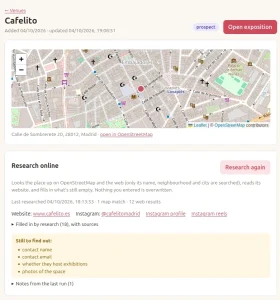
Bridging the Gap Between Canvas and Cafe: Developer Builds Local AI Suite to Help Madrid Artist Manage Exhibitions
In the bustling cultural landscape of Madrid, where neighborhood cafes and local...
 Software Development & Scripting for IT
Bridging the Linguistic Divide: How Word Embeddings Revolutionized Machine Understanding of Human Language
In the rapidly evolving landscape of artificial intelligence, one of the most...
 Software Development & Scripting for IT
Architecting Precision: Why Staged Retrieval and Explicit Contracts are Redefining AI Insurance Claims Intake
In the rapidly evolving landscape of insurance technology, the integration of Large...






