
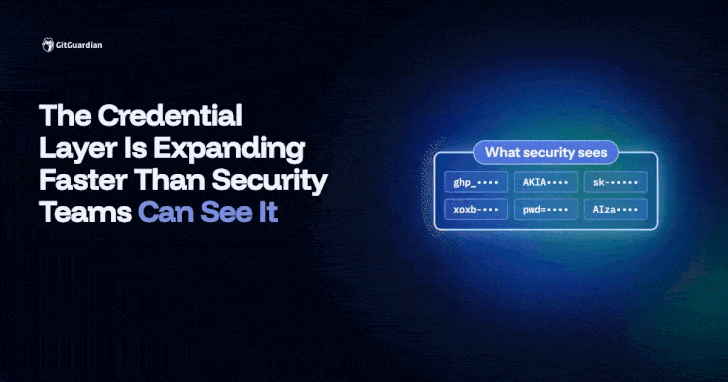
In the modern enterprise, credentials have become the fundamental currency of operations. They are the primary mechanism through which human users, automated systems, and, increasingly, artificial intelligence agents connect to sensitive data and critical services. As the digital landscape expands, securing this "credential layer" has moved from a routine IT task to a core strategic necessity. For GitGuardian, a leader in secret protection, this challenge is addressed through a three-pillared methodology: Detect, Remediate, and Prevent.
However, before an organization can fix a leak or prevent a future exposure, it must first understand the landscape it is defending. This journey begins with detection—a process that is becoming exponentially more complex as software production reaches unprecedented speeds. As organizations grapple with a future where code is generated not just by humans but by autonomous agents, the ability to map the credential layer has become the most critical step in maintaining a secure supply chain.
The Credential Layer Has No Convenient Perimeter
The concept of a traditional security perimeter has been dissolving for years, but the sprawl of credentials has accelerated its demise. The "credential layer" is best defined as the total collection of secrets—API keys, tokens, certificates, and passwords—that facilitate connections across an enterprise’s infrastructure. Unlike a firewall or a local network, this layer has no fixed boundary. Its perimeter follows the credentials themselves, wherever they may travel.
The path of a single secret often involves multiple environments. A developer might generate a credential within a secure, sanctioned cloud environment. Later, that same key may appear in plaintext within a repository for testing purposes or be pasted into a shared knowledge base during a troubleshooting session. While the primary version of a secret might be stored in an approved vault, plaintext copies often linger on developer laptops, in shell histories, or in local configuration files.
This sprawl is further complicated by the rise of "citizen developers." With the advent of AI-powered coding agents, more employees outside of traditional engineering roles are writing scripts and deploying automations. These users often lack the rigorous security training of professional developers, leading to secrets being created and stored outside the view of central security teams. The result is an attack surface that crosses every technology and ownership boundary within the organization, creating a discovery challenge that traditional scanners are ill-equipped to solve.
The Accelerating Pace of Software Production
The scale of the challenge is best illustrated by the sheer volume of code being produced today. Software production is currently outstripping the growth assumptions that shaped many of the security controls still in use. Recent data highlights a staggering trend: GitHub, the world’s largest host of source code, saw its monthly commit volume jump from approximately 1 billion commits in 2025 to 2.9 billion commits in August 2026. This puts the annualized pace at over 14 billion commits for the 2026 reporting year.
This explosion in code production is not merely a reflection of more developers entering the field; it is a symptom of the shift toward agentic development. GitHub’s own engineering teams have reported that they are no longer planning for 10x growth but are instead designing infrastructure to handle 30x today’s scale. When code production increases, the infrastructure required to support it—and the secrets required to connect that infrastructure—increases in tandem.
More applications and more automations inevitably mean more credentials. According to GitGuardian’s State of Secrets Sprawl 2026 report, this growth has directly translated into a security crisis. The firm detected 28.65 million new hardcoded secrets in public GitHub commits during 2025, a 34% increase year-over-year. Even more concerning is the 81% surge in leaked credentials associated specifically with AI services. For security teams, establishing visibility into this rapidly expanding layer is no longer optional; it is a race against time.
Why Every Discovery Source Provides a Partial Picture
One of the primary obstacles to securing the credential layer is that most security tools only see a fraction of the total population. To build a complete map, organizations must aggregate data from multiple, disparate sources, as each provides a different piece of the puzzle.
Source control remains a primary focus because hardcoded credentials leave a durable, historical trail. Even if a secret is removed from the current version of a file, it remains embedded in the Git history, where it can be easily retrieved by an attacker. Furthermore, copies of these secrets often spread into different branches or are cloned into personal repositories, making them difficult to track.
Internal repositories often house a vast population of "working" credentials—those used by developers and applications for daily tasks, including access to internal databases and cloud environments. GitGuardian’s research indicates that internal repositories are roughly six times more likely than public ones to contain at least one secret.
Beyond code, collaboration and productivity systems have emerged as a significant source of exposure. Around 28% of secret-related incidents originate outside of source-code repositories. Credentials are often pasted into Jira tickets, shared via Slack or Microsoft Teams during handoffs, or documented in Confluence pages. These secrets can remain searchable and accessible long after the project they supported has been completed, providing a goldmine for attackers who have gained initial access to a corporate network.
The Developer Laptop: The New Front Line
While much attention is paid to cloud environments and repositories, the developer laptop has emerged as a high-value target. For years, it was common practice for developers to use local environment files and command-line tools that cache credentials. This was seen as a low-risk convenience until attackers shifted their tactics.
The end of 2025 and the beginning of 2026 saw a rise in sophisticated "infostealer" malware campaigns, such as Shai-Hulud and S1ingularity. These attacks specifically target developer machines to harvest authentication material that can be used to pivot into the broader software supply chain. An unscrubbed local shell history or a forgotten .env file can provide the keys to an entire production environment.
Every developer laptop is an active part of the enterprise credential layer. Repository scanning only shows what has been committed; it does not account for the secrets that live on the endpoints where code is created. To truly map the credential layer, organizations must bridge the gap between central monitoring and endpoint discovery.
AI Agents and the Density of Local Secrets
The introduction of AI coding agents has added a new dimension to endpoint risk. These agents have the ability to read files, execute commands, and interact with external services via protocols like the Model Context Protocol (MCP). Each of these connections requires authentication, creating a new wave of credentials that often bypass traditional management systems.
GitGuardian’s analysis of the Shai-Hulud 2 campaign provided a rare glimpse into the density of secrets on these compromised machines. Across nearly 7,000 infected systems, researchers found over 33,000 unique secrets. Nearly half of the machines held more than 10 secrets, and 5% held more than 100. This density makes developer machines an incredibly lucrative target for automated malware.
Furthermore, the way AI agents are authenticated is creating new vulnerabilities. In 2025 alone, over 24,000 unique secrets were found in public MCP configuration files, with thousands of them verified as valid. When an AI agent has access to a credential, it can take actions that the human developer might not anticipate—such as accidentally deleting a production database or exposing sensitive data through an external API. Understanding what these agents can access is a prerequisite for managing AI risk.
The Critical Role of Context in Discovery
Finding a secret is only the first step. To manage risk effectively, security teams need the surrounding context to prioritize their response. Without context, a list of 28 million secrets is simply noise.
Validity: This is the most immediate signal of risk. GitGuardian’s research found that secrets are often valid for far longer than they should be. In a retest of credentials confirmed valid in 2022, 64% were still active in early 2026. A credential that remains valid for years is a standing invitation to attackers.
Location and Fingerprinting: A secret found in an internal repository represents a different risk profile than one found in a public repository. Credential fingerprinting allows security teams to connect multiple occurrences of the same secret. If a single key appears on a laptop, in a private repo, and in a public repo, it indicates a high degree of spread and a much larger potential "blast radius."
Ownership and Permissions: Security teams must identify which user or workload relies on a credential. More importantly, they need to know the scope of that credential’s permissions. A key with read-only access to a dev environment is a lower priority than a key with administrative rights to a production cloud account.
Dependencies: Before a secret can be revoked or rotated, the organization must understand what will break if it is removed. Mapping these dependencies is essential for remediation that doesn’t disrupt business operations.
Establishing a Real Denominator for Coverage
Many enterprises believe they have a handle on their secrets because they use management tools like vaults. However, these systems only provide information on credentials that are already under management. They do not account for the "shadow" credentials created outside of these paved paths.
A company might have 50,000 secrets in a vault, but if there are another 5,000 plaintext secrets scattered across developer laptops and Slack channels, the vault’s protection is incomplete. Security teams need a "real denominator"—a total count of the credential population—to measure their actual coverage. Only by discovering the entire population can an organization determine how much of its credential layer is truly governed.
Shifting Toward Machine-Speed Prevention
The window of opportunity for defenders is shrinking. CrowdStrike recently reported that the average "breakout time"—the time it takes for an attacker to move laterally from an initial compromise—dropped to just 29 minutes in 2025. In the fastest cases, lateral movement occurred in just 27 seconds.
As attackers leverage automation to move at machine speed, human-led response is no longer sufficient. The goal of detection is to build the map necessary for automated prevention. By understanding the surfaces where credentials leak, organizations can implement controls that stop secrets from ever reaching a repository or a public forum.
The acceleration of software production, driven by AI and global developer growth, means that the credential layer will only continue to expand. GitHub’s preparation for a future at 30 times its current scale is a clear signal of what is to come. For security teams, the ability to detect and map this layer in real-time is the only way to keep pace with both the growth of technology and the speed of modern threats. Detection is not just the first step in GitGuardian’s mission—it is the foundation upon which all modern enterprise security must be built.
 Cybersecurity Basics & Security News
The Evolution of the Vulnerability Gap: Defending Against the Rise of Mythos-Class AI Attacks
In the modern cybersecurity landscape, the arrival of a new Common Vulnerabilities...
 Cybersecurity Basics & Security News
AI vs. AI: How Researchers Used Claude Opus 5 to Breach OpenAI’s Internal Systems
In a sophisticated demonstration of the "double-edged sword" nature of generative artificial...
 Cybersecurity Basics & Security News
Beyond Policy Intent: Why Identity Visibility Has Become the Critical Frontier in Modern Cybersecurity
In the current landscape of enterprise security, the traditional perimeter has not...







