
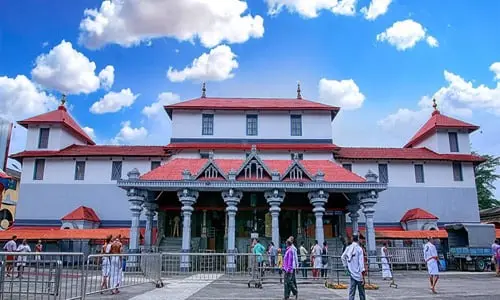
In a landmark decision for the protection of digital assets belonging to historic religious institutions, Shri Dharmasthala, one of South India’s most revered and ancient landmarks, has successfully recovered its primary domain name following a sophisticated cyberattack. The recovery of the domain, shridharmasthala.org, marks the end of a high-stakes legal battle conducted through international arbitration, highlighting the increasing vulnerabilities faced by cultural and educational organizations in an era of globalized cybercrime.
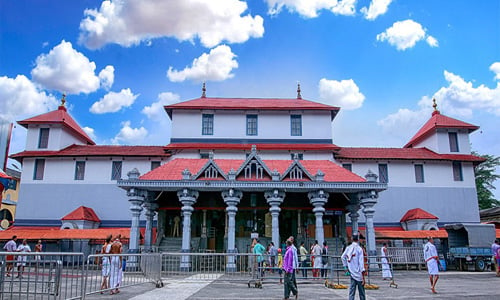
Shri Dharmasthala, located in the Belthangady taluk of Karnataka, holds a unique and prestigious position in the Indian cultural landscape. With a documented history spanning more than 800 years, the temple is not only a site of deep religious significance but also a cornerstone of social welfare and education in the region. The Shri Dharmasthala Manjunatheshwara Educational Society (SDMES), which manages the institution’s vast network of schools, colleges, and social initiatives, had the foresight to establish a digital presence early in the internet era, registering the domain name shridharmasthala.org in 2001. For over two decades, this digital portal served as the primary interface between the institution and its global community of devotees and students.
The importance of this digital infrastructure cannot be overstated, given the scale of the temple’s operations. Shri Dharmasthala attracts approximately 5.5 million devotees annually, many of whom rely on the official website for information regarding pilgrimage logistics, religious services, and the various philanthropic activities spearheaded by the Heggade family, the traditional trustees of the temple. The sudden loss of this domain earlier this year posed a significant threat to the institution’s reputation and its ability to communicate securely with its millions of followers.
The crisis began to unfold in early 2026, according to the records submitted during the dispute resolution process. The Shri Dharmasthala Manjunatheshwara Educational Society reported that the domain name was fraudulently transferred away from their control on June 10, 2026. This transfer was executed without the knowledge, authorization, or consent of the society’s administrators. The subsequent investigation into the breach revealed a calculated and coordinated effort by unknown actors to infiltrate the society’s digital accounts and seize control of their most valuable online asset.
Technical evidence provided by the domain registrar painted a picture of a multi-stage compromise. The forensic trail indicated that unauthorized access began months before the actual transfer. Registrar records showed that starting from March 11, 2026, account logins were registered from IP addresses located in Sweden and Switzerland. These initial incursions were likely reconnaissance efforts or attempts to modify account settings in preparation for the eventual theft. Following the illicit transfer in June, the IP trail shifted to Japan, suggesting a sophisticated attempt to mask the perpetrators’ true location by routing traffic through multiple international jurisdictions.
The breach was facilitated by a combination of security vulnerabilities that are common even among large organizations. It was confirmed during the proceedings that Two-Factor Authentication (2FA) was not activated on the registrar account at the time of the incident. This lack of a secondary security layer proved fatal when the primary credentials were compromised. Furthermore, the investigation revealed that the administrative email address associated with the account—[email protected]—had appeared in various publicly reported data breaches. This exposure meant that the credentials used by the society’s administrators had likely been leaked in unrelated third-party hacks years prior, allowing the attackers to gain entry through a method known as credential stuffing or simple password exploitation.
The sophistication of the attack was further evidenced by the compromise of the society’s secondary recovery systems. The attackers managed to intercept or gain control of a Gmail account that served as a backup for authorization notifications. This allowed the perpetrators to receive and potentially delete the mandatory transfer authorization emails sent by the registrar, ensuring that the legitimate owners remained unaware of the theft until the domain had already been moved to a new registrar and a new owner.
Faced with the loss of their digital identity, the Shri Dharmasthala Manjunatheshwara Educational Society initiated formal legal proceedings to reclaim the domain. They filed a cybersquatting dispute under the Uniform Domain-Name Dispute-Resolution Policy (UDRP) with the Czech Arbitration Court. The UDRP is a global framework designed to resolve disputes involving the registration and use of internet domain names in bad faith. Because the domain in question was a .org extension, it fell under the jurisdiction of these international arbitration bodies, which are empowered to order the transfer of domains in cases of clear intellectual property theft or bad faith registration.
The society was represented in this complex international matter by Ankur Raheja, a legal expert specializing in domain name disputes and cyber law. The complaint argued that the domain was an essential component of the temple’s identity and that the fraudulent transfer constituted a clear case of cybersquatting and digital theft. To succeed in a UDRP claim, a complainant must typically prove that the domain name is identical or confusingly similar to a trademark in which they have rights, that the current holder has no legitimate interests in the name, and that the domain was registered or is being used in bad faith.
In the case of Shri Dharmasthala, the arguments were compelling. The name "Shri Dharmasthala" is inextricably linked to the 800-year-old institution and the educational society that bears its name. The long-term prior use of the domain since 2001 established a clear "prior right" that the fraudulent transfer could not supersede. The evidence of the compromised email accounts and the suspicious IP addresses from Sweden, Switzerland, and Japan provided the necessary proof of bad faith and unauthorized activity.
After reviewing the evidence and the circumstances of the fraudulent transfer, a UDRP panelist at the Czech Arbitration Court ruled in favor of the Shri Dharmasthala Manjunatheshwara Educational Society. The panelist recognized the unauthorized nature of the transfer and the clear evidence of a coordinated cyberattack. Consequently, an order was issued for the domain name shridharmasthala.org to be transferred back to the rightful control of the society.
This victory is significant not only for the temple but also as a cautionary tale for other large-scale religious and non-profit organizations. The incident underscores the critical importance of robust cybersecurity protocols, particularly for institutions that manage significant public trust and historical legacies. The fact that an 800-year-old institution could have its modern identity hijacked through a leaked email address highlights the bridge between ancient traditions and modern digital risks.
The recovery of the domain ensures that the 5.5 million annual devotees can once again interact with the official Shri Dharmasthala portal with confidence. For the educational society, the return of the domain restores a vital link to its students and faculty across its various institutions. As religious landmarks increasingly move their services and outreach programs online, the protection of their digital "real estate" becomes as vital as the physical security of their temples and shrines.
The resolution of this case also brings into focus the role of international arbitration in policing the internet. The ability of a South Indian religious society to seek and receive justice through a court in the Czech Republic demonstrates the effectiveness of the UDRP system in handling cross-border digital disputes. Without such a framework, recovering a stolen domain from attackers operating across multiple continents would be a nearly impossible task for most organizations.
With the domain now safely back in the hands of the Shri Dharmasthala Manjunatheshwara Educational Society, the institution is expected to implement enhanced security measures, including the activation of multi-factor authentication and more rigorous monitoring of administrative credentials. The successful recovery serves as a testament to the institution’s resilience and its commitment to protecting its heritage in both the physical and digital realms. The legal precedent set by this case reinforces the idea that historic names and the digital identities associated with them are protected under international law, providing a layer of security for other cultural icons that may find themselves targeted by similar cyber threats in the future.
 Web Hosting & Domain Management
Slovenia’s .si Domain Experiences Unprecedented Surge Following "Super Intelligence" Executive Order
The digital landscape of Slovenia’s country-code top-level domain (ccTLD), .si, has undergone...
 Web Hosting & Domain Management
Digital Identity in Jeopardy: The Human Cost of Terminating Third-Level .name Domains
For more than two decades, the .name top-level domain has served as...
 Web Hosting & Domain Management
Strategic Acquisitions and Global Branding: An Analysis of Recent End-User Domain Sales at Sedo
The secondary domain name market continues to serve as a vital indicator...






