

Converging the software-defined strategy around a primary virtual platform can significantly simplify management. It reduces the number of "panes of glass" an administrator must monitor and ensures that updates to the virtualization layer do not break the storage layer. Compatibility and ecosystem alignment are often more important than a specific feature set when it comes to long-term operational stability.
The Hardware Reality in a Software-Defined World
The term "software-defined" can sometimes lead to the misconception that hardware no longer matters. In reality, the quality and compatibility of the underlying physical layer remain paramount. While SDS removes the requirement for proprietary hardware, the software still relies on the CPU, memory, and bus speeds of the servers it inhabits.
Organizations must pay close attention to the Hardware Compatibility Lists (HCL) provided by SDS vendors. Not every commodity drive or network card will perform optimally under the demands of a virtualized storage controller. Furthermore, the SDS infrastructure should provide a "menu of services" that categorizes different hardware profiles. Understanding which hardware service is appropriate for a specific workload—and having the documentation to prove it—prevents performance mismatches and helps users make informed decisions about where to host their data.
Capacity Planning and Resource Management
Ongoing capacity planning is a necessity for both the infrastructure provider and the "tenants" or business units using the storage. SDS only functions effectively if it has access to the necessary raw resources. This includes not just disk space, but also the CPU cycles and memory required to run the storage logic, as well as the networking bandwidth to move data between nodes.
Good capacity planning involves monitoring trends to ensure that resources are available before they are needed. This is particularly important in SDS environments that support auto-scaling; if the underlying physical pool runs dry, the software’s ability to scale becomes an empty promise. Service Level Agreements (SLAs) should be backed by a clear roadmap for hardware expansion, ensuring that the software-defined layer always has the physical "runway" it needs to operate.
Monitoring Performance at the User Level
Performance monitoring in an SDS environment should go beyond simple hardware health checks. The most effective strategy is to monitor performance from the perspective of the end-user. By tracking application responsiveness and latency at the user level, IT teams can identify and resolve bottlenecks before they result in a flood of help desk tickets.
In addition to real-time monitoring, crash reporting and telemetry should be integrated into the deployment. This allows for the early detection of "bad" deployments—configurations that might seem stable at first but fail under specific load patterns. By catching these issues early in the rollout, organizations can iterate on their SDS configuration without disrupting the broader user base.
Securing Reliable Post-Sales Support
Finally, the complexity of the SDS stack makes post-sales support a critical consideration. When a problem arises in a decoupled environment, it can be difficult to determine if the fault lies with the application, the storage software, or the underlying hardware. This ambiguity often leads to "finger-pointing" among different vendors.
To mitigate this, organizations should establish clear lines of accountability. Ideally, a primary vendor should be identified who is willing to take charge of troubleshooting the entire stack. Whether through a single-vendor solution or a robust partnership agreement between hardware and software providers, the goal is to ensure that IT has a clear path to resolution. Rapid issue resolution is essential in maintaining the uptime that modern enterprises demand.
The Path Forward
Software-defined storage offers a compelling vision of the future: a world where storage is as flexible and scalable as the cloud, yet resides within the control of the enterprise. By decoupling software from hardware, SDS provides the agility needed to survive in a data-driven economy. However, the path to a successful deployment is paved with strategic planning, continuous training, and a commitment to best practices. By understanding their environment and respecting the interplay between the software and physical layers, organizations can turn the promise of SDS into a tangible competitive advantage.
 Enterprise Tech & Infrastructure
Understanding Fibre Channel over Ethernet: Bridging the Gap Between High-Performance Storage and Ethernet Ubiquity
In the rapidly evolving landscape of data center infrastructure, the quest for...
 Enterprise Tech & Infrastructure
IonQ Breakthrough Demonstrates Real-Time Quantum Error Correction Using Standard CPU Architecture
The global pursuit of fault-tolerant, scalable quantum computing has long been defined...
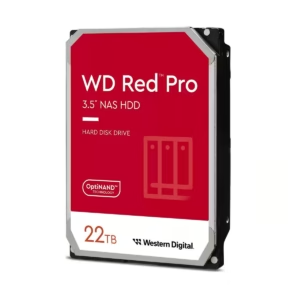 Enterprise Tech & Infrastructure
The Pillars of Data Infrastructure: A Comprehensive Evaluation of the Top Enterprise Hard Drives for 2023
In the modern landscape of digital infrastructure, the demand for robust, high-capacity...






