

A significant portion of this platform evolution is dedicated to the rise of "agents"—autonomous or semi-autonomous AI entities designed to handle complex, multi-step workflows. Spataro notes that an AI agent is not a finished product upon its initial deployment; rather, deployment is merely the starting line. The organizations currently gaining a competitive edge are those that treat AI as a dynamic asset. They define what "good work" looks like, measure the agent’s output against those standards, and implement continuous improvement loops. Over time, these incremental gains compound, allowing the agent to eventually outperform the static specifications that were established at the project’s outset. This focus on "compounding small improvements" is central to Microsoft’s vision of AI as a long-term competitive advantage.
Business model
As AI moves from the periphery of IT departments to the core of business operations, the financial implications of the technology have become a primary concern for executive leadership. Spataro identifies a significant shift in how enterprise software must be priced and managed. For the past two decades, the industry has relied almost exclusively on the User Subscription License (USL)—a flat, predictable monthly fee per employee that granted unlimited access to a software tool.
While the USL remains a staple for general productivity, the arrival of sophisticated AI agents has introduced a new layer of economic complexity. AI operations, particularly those involving long-running tasks or massive data processing, carry variable costs that a flat fee cannot easily absorb. Spataro argues that the most common mistake businesses currently make is attempting to judge these two distinct cost structures by the same logic.
Microsoft’s solution is a hybrid economic framework designed to provide both predictability and flexibility. The first component is the traditional Copilot USL, which provides every employee with a comprehensive suite of AI productivity tools, including chat functions, Copilot integration across Microsoft 365 apps, and ready-made agents such as "Researcher" and "Analyst." This model ensures that as the underlying intelligence of these tools improves, the cost to the business remains stable.
The second component is Usage-Based Billing (UBB), which is tied specifically to the volume of work performed by autonomous agents rather than the number of human users. Spataro recontextualizes this second cost not as traditional IT overhead, but as capital investment. Much like headcount, this investment is directed toward building and maintaining organizational capability.
To simplify this transition, Microsoft has introduced "Copilot Credits," a shared currency that serves as a universal meter for AI operations across the platform. Whether an organization is utilizing "Copilot Cowork" or custom-built agentic capabilities, the spend is aggregated into a single, visible stream. This system is designed to provide leadership with complete transparency, allowing them to monitor expenditures in real-time and set firm limits to prevent "bill shock." By making AI costs manageable and visible, Microsoft hopes to remove one of the primary barriers to large-scale adoption.
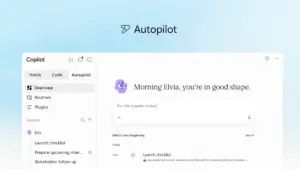 Productivity Software & Office Suites
Microsoft Unveils Reimagined Copilot with Agentic Capabilities and New "Autopilot" Digital Teammate
Microsoft has announced a sweeping overhaul of its Copilot platform, signaling a...
 Productivity Software & Office Suites
Microsoft Announces Global Launch of Copilot Cowork, Introducing Agentic AI to the Modern Enterprise
In a move that signals a significant shift in the landscape of...
 Productivity Software & Office Suites
Microsoft Reimagines Copilot as a Central Hub for AI-Driven Enterprise Productivity
In a significant move to redefine the landscape of modern work, Microsoft...






