
To support this new era of "citizen development," the company is introducing the Microsoft Copilot Managed Runtime. This hosting infrastructure ensures that the code generated by Copilot runs safely within the organization’s Microsoft 365 environment. While it is designed to be easy for non-technical users to share and connect to live data, it remains fully governed by IT departments. This same foundation will eventually support third-party and professional developers, creating a unified environment for AI-driven applications.
The Rise of the Digital Teammate: Autopilot
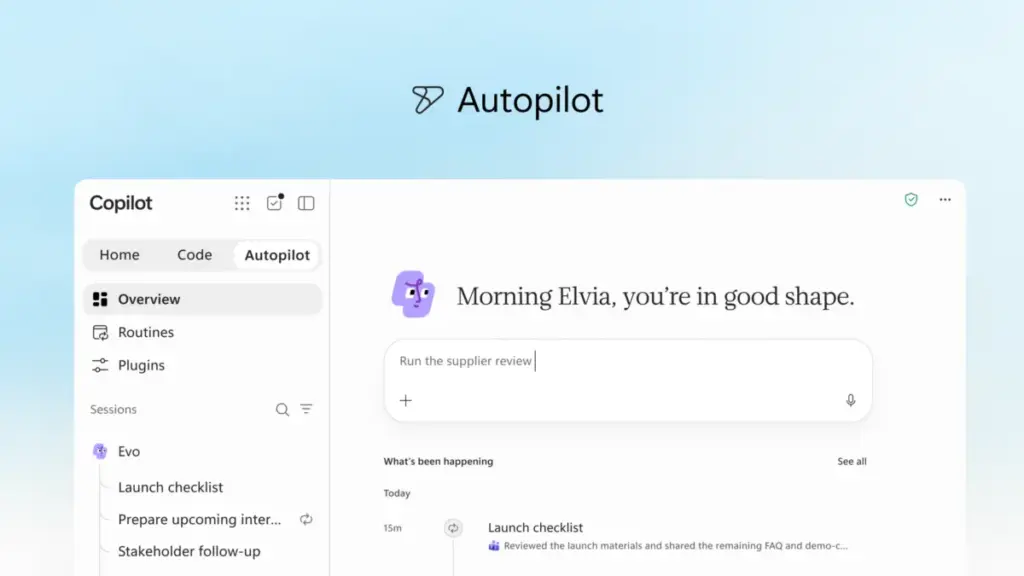
Moving into the realm of "agentic" AI, Microsoft has introduced Autopilot. Formerly known by the internal codename "Scout," Autopilot is described as a persistent, proactive digital teammate. Unlike standard AI assistants that wait for a user prompt, Autopilot is designed to work in the background, even when the user is offline.
By assigning Autopilot a name, a role, and a specific goal, users can delegate recurring or long-running processes. For example, an Autopilot agent could be tasked with managing a full supplier review process. It would independently build a schedule, handle preparation, follow up on threads in Teams or Outlook, and reach out to stakeholders for updates.

Because Autopilot is cloud-hosted and possesses its own identity and memory within the organization’s tenant, it functions more like a human colleague than a software tool. It can be @mentioned in chats or channels, and it operates under the same permissions, audit, and governance structures as any other employee. This allows it to understand the nuances of how an organization operates, ensuring that its proactive actions remain within established boundaries.
Expanding Business Context and Data Grounding
For AI to be effective in a business setting, it must be grounded in the specific data and workflows of that business. Microsoft is addressing this through Microsoft IQ, a unified intelligence platform that connects Copilot to the organization’s knowledge base.
A major expansion of this context comes via Fabric IQ, which integrates over 20 million semantic models from Power BI into Copilot. This ensures that when a user asks a question or delegates a task, the AI is drawing from trusted, real-time data. Furthermore, Copilot is now grounded in data from Dynamics 365 and the Power Platform. This means a salesperson drafting a proposal can have the AI automatically incorporate deal history or support tickets without having to manually look up information in a separate CRM system.
To facilitate external connections, Microsoft is launching a new plugin registry. This unified catalog will house Microsoft-built, partner-built, and custom plugins, allowing IT departments to centrally approve and manage the tools that extend Copilot’s capabilities. Developers can publish a plugin once and have it work across all supported Copilot experiences, simplifying the process of scaling trusted AI capabilities.
 Productivity Software & Office Suites
Microsoft to Headline ESPC 2026 in Amsterdam: A Deep Dive into the Future of AI-Powered Work and Agentic Ecosystems
The landscape of enterprise technology is currently undergoing one of its most...
 Productivity Software & Office Suites
Microsoft to Headline ESPC 2026 in Amsterdam as the European Tech Community Pivots Toward an Agentic AI Future
As the global landscape of work undergoes its most significant transformation since...
 Productivity Software & Office Suites
Microsoft Unveils Strategic Roadmap for Enterprise AI, Emphasizing Agentic Workflows and Hybrid Pricing Models
In an era defined by a relentless cycle of artificial intelligence breakthroughs...







