
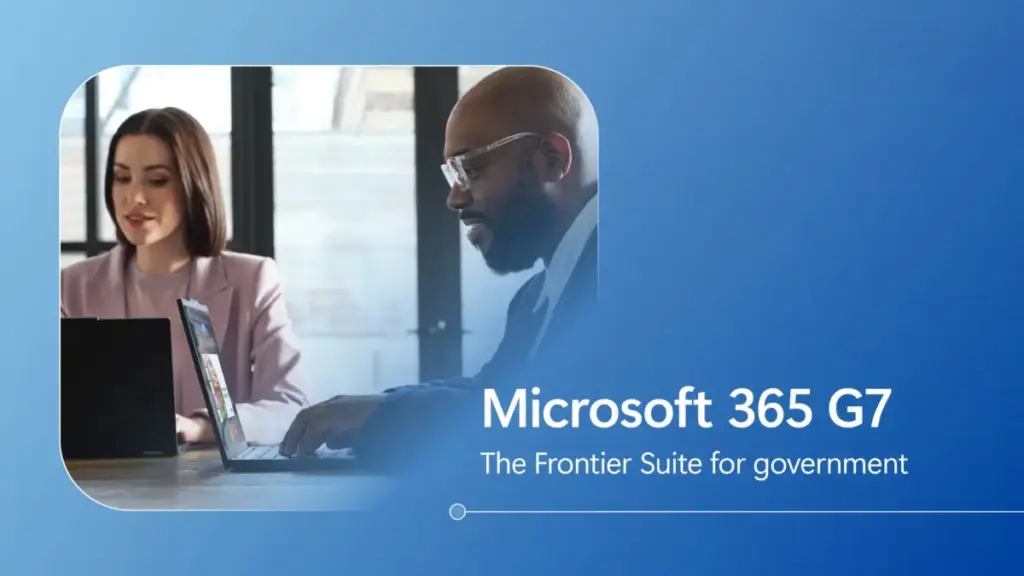
In an era where the public sector faces a dual mandate of rapid digital modernization and heightened cybersecurity vigilance, Microsoft has announced a significant leap forward in its cloud offerings for the United States government. The tech giant is introducing Microsoft 365 G7, designated as the "Frontier Suite" for government, specifically tailored for organizations operating within Government Community Cloud (GCC) environments.
The launch marks a pivotal moment in the evolution of federal, state, and local government technology. As agencies move beyond the initial excitement of generative AI experimentation, the focus is shifting toward practical, governed, and secure implementation at an organizational scale. Microsoft 365 G7 aims to bridge this gap by integrating productivity tools, advanced artificial intelligence, autonomous agents, and comprehensive security protocols into a single, cohesive ecosystem.
The Strategic Shift Toward Intelligence and Trust
The introduction of G7 follows the framework of the "Intelligence + Trust" vision originally established with the commercial Microsoft 365 E7 suite. For government leaders, this vision addresses a critical bottleneck: the need for advanced intelligence that is grounded in the specific, often sensitive, context of agency data, paired with a control plane that ensures strict adherence to compliance and security standards.
Across the public sector, the demand for services is growing while resources often remain static. Microsoft’s strategy with the Frontier Suite is to provide "intelligence grounded in how they work." This means AI that doesn’t just answer general questions but understands the specific missions, workflows, and regulatory environments of a government agency. By bringing together identity, security, and governance under the G7 umbrella, Microsoft is signaling that innovation cannot—and should not—be separated from the trust required to handle public data.
The rollout of these new capabilities is scheduled to begin on October 1, when GCC customers can first purchase Microsoft 365 G7 and the accompanying Agent 365. Additional purchasing avenues will open on November 1. Reflecting the complexity of government IT environments, the deployment will follow a phased approach. This ensures that as new workloads complete the rigorous GCC authorization and FedRAMP-related milestones, they are introduced to the environment with the necessary security clearances in place.
Built on the Trusted Foundation of Microsoft 365 for Government
Microsoft 365 G7 does not replace the existing infrastructure but rather extends the foundation that many agencies have already built using Microsoft 365 G5. For years, G5 has served as the standard for government productivity, offering a robust suite of collaboration tools alongside advanced information protection and compliance features.
The G7 suite elevates this foundation by integrating the Microsoft Entra Suite. This addition is crucial for the modern "Frontier Transformation" of the U.S. public sector, as it introduces sophisticated identity management, access governance, and network security. These features are designed not just for human users but for the burgeoning world of AI agents. In a landscape where "non-human identities" (the agents and bots performing automated tasks) are becoming more common, having a unified security layer to manage who—and what—has access to sensitive data is paramount.
By providing these controls, G7 allows IT and security leaders to move away from isolated, "shadow AI" projects toward a centralized, governed model. It provides the necessary visibility for administrators to manage people, data, and automated processes with the confidence that security policies are being enforced at every touchpoint.
AI Embedded in the Flow of Work
One of the primary goals of the G7 suite is to ensure that AI is not a separate destination for employees but a seamless part of their existing daily routines. Microsoft’s philosophy is that AI should simplify work, not add another layer of complexity or another application to monitor.
To achieve this, G7 embeds Microsoft Copilot and other AI-powered experiences directly into the applications government employees use every day, such as Word, Excel, PowerPoint, and Outlook. Central to this experience is "Work IQ," a capability that grounds AI responses in an agency’s specific organizational data. This ensures that when a user asks for a summary or a draft, the AI is informed by the relevant permissions, internal context, and mission-related data, rather than just general public information.
At launch, G7 will offer a unified Copilot experience designed for the unique needs of government teams. This includes the ability to synthesize vast amounts of organizational knowledge, conduct deep research and analysis, and collaborate on content creation. In the months following the initial release, Microsoft plans to introduce a "surge" of additional capabilities to the US Government clouds. This includes the latest GPT models and features like "Work IQ memory," which allows for a more personalized AI experience over time.
Furthermore, the "Copilot Cowork" feature is expected to assist with longer-running, multi-step projects, effectively acting as a digital assistant that can manage complex tasks across different software applications. These advancements are designed to help public servants navigate the "information overload" that often accompanies modern government work, allowing them to focus on high-priority mission outcomes.
Agents at the Mission’s Edge
While general-purpose AI is useful for drafting emails or summarizing meetings, government work often requires highly specialized expertise. This is where "agents" come into play. Within the G7 framework, agents are specialized AI entities designed to support specific functions such as policy analysis, case management, grant processing, and constituent services.
Microsoft 365 G7 provides what the company calls an "agentic foundation." These agents are grounded in Work IQ and operate within accredited government clouds. This means they are subject to policy-governed access, ensuring they only connect to approved agency systems and data repositories.
Agencies can begin their journey by utilizing pre-built agents like "Researcher" and "Analyst." However, the suite also includes "Agent Builder" and "Microsoft Copilot Studio," which allow teams to create custom agents tailored to their specific mission requirements. For example, an agency could build an agent specifically designed to cross-reference new legislative changes with existing internal policies.
To ensure these agents are truly useful, Microsoft 365 Copilot Connectors allow them to reach into other internal systems, bringing disparate agency knowledge into a single, actionable interface. By utilizing natural-language creation tools, Microsoft is also lowering the barrier to entry, allowing non-technical staff to participate in building the tools they need to succeed, all while maintaining strict organizational oversight.
Agent 365: The Control Plane for AI Adoption
As the use of AI agents expands, government leaders face a new set of management challenges. Without proper oversight, the proliferation of automated agents can lead to security "blind spots," where it becomes unclear which agents are running, what data they are accessing, and who is responsible for their outputs.
To address this, Microsoft is introducing Agent 365 as part of the G7 suite. Agent 365 acts as the "control plane" for AI adoption. It provides administrators with a centralized dashboard to discover, register, and manage every agent within the organization. This unified foundation allows IT leaders to take immediate governance actions—such as deploying an agent to a specific department, blocking an agent that poses a risk, or removing an outdated tool entirely.
At general availability, Agent 365 will focus on these core discovery and identification controls. Over time, Microsoft expects the platform to evolve into a comprehensive lifecycle governance tool, incorporating advanced risk management and security auditing. This ensures that as an agency’s AI ecosystem grows more complex, the tools to manage it remain robust and centralized.
Advancing the Mission with Confidence
The launch of Microsoft 365 G7 and Agent 365 represents a strategic commitment to the digital sovereignty and efficiency of the U.S. public sector. By combining high-level productivity tools with sophisticated AI and a rigorous security framework, the Frontier Suite aims to provide a clear path forward for agencies looking to modernize their operations without compromising their security posture.
Ultimately, the transformation of the public sector is not merely about adopting the newest technology; it is about empowering public servants to better serve their communities. By providing AI that is both intelligent and governed, Microsoft is helping agencies build the capacity and resilience needed to meet the growing demands of the modern world.
As the phased rollout begins this October, the focus will remain on the intersection of innovation and trust. For government organizations, G7 offers a way to embrace the future of work with the controls and confidence required for national missions and public service.
 Productivity Software & Office Suites
Microsoft Set to Headline ESPC 2026 in Amsterdam: A Deep Dive into the Future of AI-Powered Work
The European tech landscape is bracing for a significant milestone in the...
 Productivity Software & Office Suites
Microsoft Reimagines Copilot: New "Autopilot" and "Code" Features Lead a Major Shift Toward Agentic Work
In a significant pivot toward the next era of enterprise productivity, Microsoft...
 Productivity Software & Office Suites
Microsoft Expands Copilot Ecosystem with Natural Language App Building to Democratize Enterprise Software Development
The landscape of software development is undergoing a fundamental transformation as artificial...







