

Managing Archive Retrieval and Early-Exit Exposure
Before committing to any class with a minimum duration, enterprises must model their exposure to "early-exit" fees. If an object is deleted, overwritten, or transitioned to a different class before its minimum duration (30, 90, or 180 days) is met, AWS charges a prorated fee for the remainder of that period. These charges are tracked separately in usage reports and can quickly negate the savings of a lower storage rate if the data is more "churn-heavy" than anticipated.
The overhead associated with Glacier transitions also demands attention. Every object moved to a Glacier tier adds 40 KB of metadata overhead. Specifically, 8 KB is billed at S3 Standard rates, and 32 KB is billed at the destination Glacier rate. For an organization storing large files, this is negligible. For an organization storing millions of tiny files, this overhead can exceed the storage savings of the Glacier tier itself. In such cases, the recommended path is to aggregate small objects into larger archives (such as ZIP or TAR files) before applying Lifecycle rules.
Addressing the Costs Outside the Storage Class
Enterprise storage managers often miss the "peripheral" costs that can dominate a bill. Data transfer is frequently the largest line item that native cost calculators under-emphasize. Cross-Region transfer and internet egress are particularly expensive. When data is routed through Multi-Region Access Points (MRAP) or replicated across different region groups, the costs are reported separately from base storage and can scale rapidly.
Workloads that are request-heavy or metadata-heavy also require a different approach. S3 Batch Operations, Inventory listings, and Metadata update fees are metered separately. In data lake environments or IoT ingestion pipelines where there is high churn and high object counts, these fees can sometimes eclipse the storage-class delta. Additionally, security measures like SSE-KMS encryption introduce their own costs; while the objects remain encrypted through transitions, every KMS request adds a charge that sits entirely outside the S3 billing structure.
Governance and Verification of Cost-Control Actions
Effective governance requires visibility into whether cost-control actions are actually occurring. Activating cost-allocation tags is a primary step, though it comes with a delay; it can take up to 24 hours for a tag to appear on the allocation page and another 24 hours to activate. While tagging itself does not carry an extra charge beyond standard API request rates, it is the only way to ensure that spend is correctly attributed to specific departments or applications.
To verify that Lifecycle actions are running as intended, AWS recommends using S3 Storage Lens dashboards over CloudWatch metrics. Storage Lens provides a more granular, daily view of storage changes resulting from Lifecycle actions. This should be cross-checked with S3 Inventory to verify the actual access tier where objects have landed. Because Lifecycle transitions are asynchronous, there is often a delay between an object becoming "eligible" for a move and the action actually taking place.
Ultimately, the choice of strategy depends on the nature of the workload. If the data has a known aging curve and object sizes are well above 128 KB, Lifecycle rules are the most efficient path. If the workload is new, unpredictable, or consists of mixed object sizes, Intelligent-Tiering serves as an automated safeguard against manual errors. However, for any high-request or high-transfer workload, the storage class is only one piece of the puzzle; the real savings are found in managing the data’s entire journey through the AWS ecosystem.
 Enterprise Tech & Infrastructure
Understanding the Architecture of Modern Storage: Why the Choice Between Flash and SSD Is a Matter of Components, Not Categories
In the rapidly evolving landscape of enterprise data management, the terminology used...
 Enterprise Tech & Infrastructure
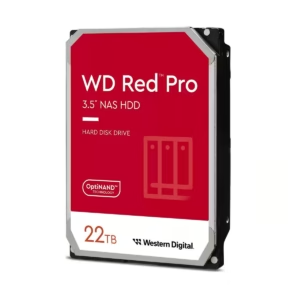
The Pillars of Data Infrastructure: A Comprehensive Evaluation of the Top Enterprise Hard Drives for 2023
In the modern landscape of digital infrastructure, the demand for robust, high-capacity...
 Enterprise Tech & Infrastructure
Navigating the Shift to Software-Defined Storage: Essential Strategies for Modern Enterprise Data Management
The landscape of enterprise data management is undergoing a fundamental transformation as...







