The sudden return of retail crowding occurred despite efforts by Apple management to temper expectations. Internal communications revealed that store personnel had been instructed to explicitly warn walk-in shoppers against standing in line without a reservation, as walk-in stock was severely restricted. Apple subsequently confirmed that physical store availability of the iPhone Duo on launch day would remain extremely limited across most global markets.
Despite the tight inventory constraint, a small percentage of persistent walk-in customers managed to purchase units off the shelf on Friday. To help manage the continuing surge in demand, Apple has begun selectively reopening its online order system for in-store pickup, allowing customers to claim localized store stock as fulfillment centers replenish inventory.

Software Adaptation on the iPhone Duo Form Factor
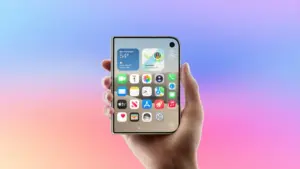
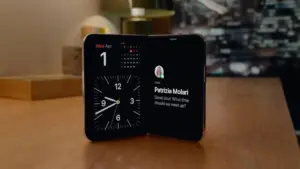
With the physical hardware now in the hands of early adopters and tech reviewers, attention has quickly shifted to how the operating system and applications adapt to the iPhone Duo’s dual-display, foldable canvas. Ahead of Friday’s launch, developer updates to the App Store provided an early look at how Apple redesigned its core system applications to take full advantage of the expanded screen real estate. Stock apps such as Mail, Calendar, Notes, and Files have been reworked to display split-pane layouts, side-by-side multitasking, and contextual controls that trigger based on how far the hinge is opened.
However, early hands-on reviews from technology outlets highlight a split experience between first-party software and third-party software. While Apple’s built-in applications feel natively designed for the unique aspect ratio, many popular third-party applications have yet to release dedicated updates tailored to the device. By default, unoptimized applications launch in a traditional, single-screen iPhone aspect ratio. This leaves significant portions of the display unused, surrounding non-native apps with thick pillarboxes or black borders until developers issue specific patches and adaptive UI updates.
Verizon Details $10 Monthly Charge for iOS 27 ‘iPhone Handoff’
As part of the recent major release of iOS 27, Apple introduced a specialized telecommunications feature known as iPhone Handoff. Designed to simplify multi-device usage, the feature enables two separate physical iPhones to share a single, primary phone number seamlessly. Users can switch actively between two handsets—such as swapping from a standard pocket-sized device to the larger foldable iPhone Duo—without needing to transfer physical SIM cards or manually reconfigure eSIM profiles. Incoming calls, text messages, and cellular data services route dynamically to whichever device is actively in use.
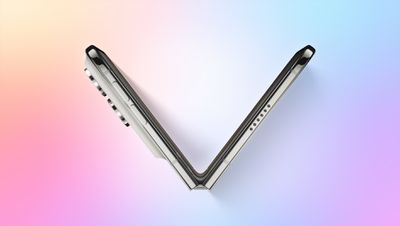
Because iPhone Handoff relies on specialized carrier-side network architecture to manage dual-device line routing, widespread adoption depends heavily on wireless service provider support and pricing structures. Carrier integration remains relatively sparse, and operators are treating the feature as an add-on service.
T-Mobile was the first major U.S. carrier to sign on, setting its pricing for iPhone Handoff at a modest $5 per month per account. This week, Verizon announced its own support rollout for the feature, but confirmed a higher fee structure. Verizon subscribers wishing to link two iPhones to a single phone number via Handoff will be charged a extra $10 per month, doubling the price established by its competitor.
 macOS & Apple IT Support
Apple Prepares Comprehensive iPad Overhaul for First Half of 2027 Featuring OLED iPad Air, Vapor-Cooled M6 iPad Pro, and Upgraded Entry-Level Model
Following the recent announcement of a redesigned iPad mini equipped with an...
 macOS & Apple IT Support
Apple Releases watchOS 27: A Comprehensive Look at New AI Features, Interface Changes, and Health Updates Across Apple Watch Generations
Apple officially launched watchOS 27 on September 14, introducing a sweeping array...
 macOS & Apple IT Support
Apple Retail Staff Advised to Warn Walk-In Customers Against Launch-Day Visits as iPhone Duo Supply Shortages Deepen
Apple retail employees have been instructed to proactively warn customers against visiting...