
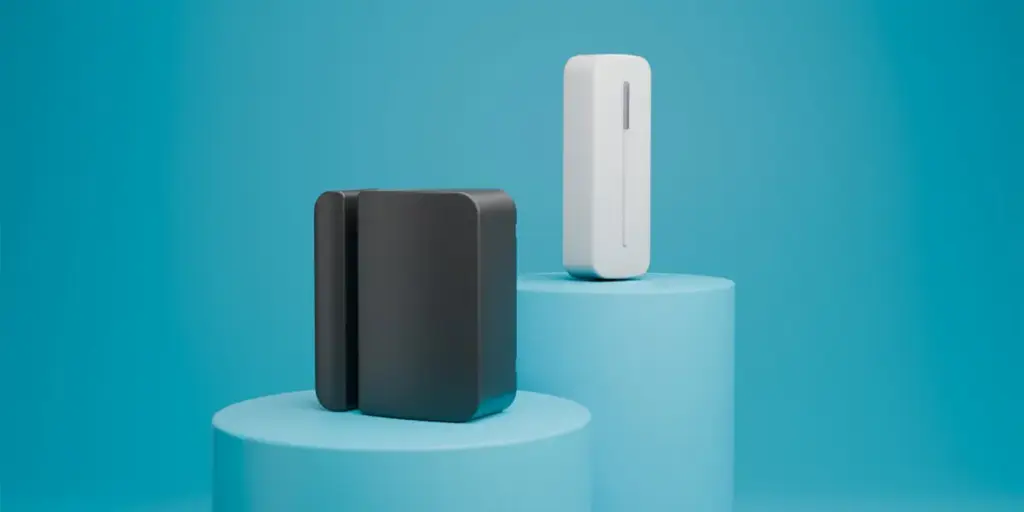
The sensor functions by detecting motion through orientation. Specifically, it senses when a surface changes its angle by more than 45 degrees from its original resting position in either direction. This makes it an ideal solution for up-and-over-style garage doors, tilt-style doors, and even more niche applications like attic hatch doors or basement tilt windows. Because it does not require a secondary magnet to be aligned perfectly—as a standard contact sensor would—it is much more forgiving in environments where doors might vibrate or not sit perfectly flush when closed. Homeowners receive real-time alerts through the Abode app the moment the sensor is triggered, providing an immediate digital breadcrumb of activity at the home’s largest entry point.
Complementing the tilt sensor is the new Abode Outdoor Contact Sensor. While it functions more like a traditional contact sensor using a magnet and a reed switch, it has been significantly "ruggedized" to survive the elements. One of the primary failures of indoor sensors used outdoors is the ingress of moisture or the failure of the wireless signal when mounted on or near large metal objects like fences and sheds.
Abode’s Outdoor Contact Sensor carries an IP66 rating, meaning it is completely dust-tight and can withstand powerful jets of water, making it suitable for installation in areas exposed to heavy rain or snow. Beyond its weatherproofing, the hardware has been optimized for the specific physics of outdoor gates. The company noted:
"The Outdoor Contact Sensor is purpose-built for metal gates, sheds, storage units, mailboxes and detached garages. A stronger magnet and wider activation gap reduce the false alarms that plague indoor sensors used outside. When triggered, the mid-size sensor will immediately notify users through the Abode app, allowing them to respond quickly to unexpected activity."
The "wider activation gap" is a crucial technical detail. Outdoor gates often have more "play" or movement due to wind or loose hinges compared to a tightly sealed indoor front door. By allowing for a larger gap between the sensor and the magnet, Abode prevents the system from triggering a "tamper" or "open" alert every time the wind rattles a gate. Furthermore, the use of a stronger magnet helps overcome the magnetic interference often caused by the heavy steel or aluminum frames found in modern fencing and detached garage doors.
Connectivity is another area where Abode has focused its engineering efforts. Because these sensors are often placed at the far edges of a property—such as on a mailbox at the end of a driveway or a shed at the back of a lot—standard Bluetooth or low-power Wi-Fi often proves insufficient. Abode states that under optimal conditions, the connectivity for both the Garage Tilt Sensor and the Outdoor Contact Sensor can extend up to 500 feet from the Abode hub. To ensure a reliable installation, the company includes setup instructions that guide users through a range test before they permanently mount the hardware, ensuring the signal can penetrate exterior walls and navigate the distance required.
 Smart Home & IoT Solutions
SwitchBot Unveils Lock Vision Series Featuring 3D Facial Recognition and Native Matter Integration
In the rapidly evolving landscape of smart home security, the transition toward...
 Smart Home & IoT Solutions
Why the Apple Home Collection Represents a Watershed Moment for Mainstream Smart Home Adoption
In the fast-paced world of consumer electronics, it is often difficult for...
 Smart Home & IoT Solutions
Apple Poised to Enter Smart Home Display Market with Design Inspired by Iconic iMac G4
In a move that signals a significant shift in its hardware strategy,...







