
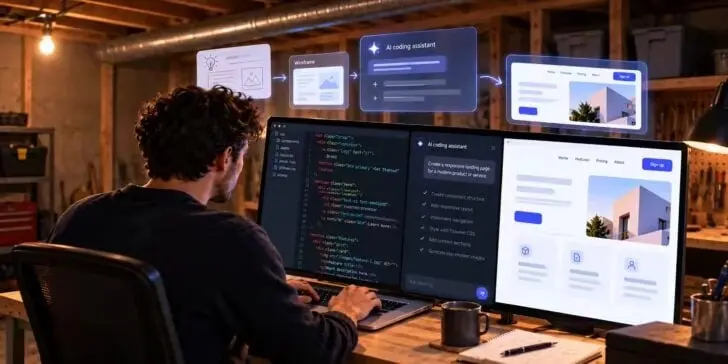
The secondary market for domain names has long been characterized by a certain degree of patience. Traditionally, when an investor or an entrepreneur acquired a premium domain name in the aftermarket, there was an expected lag—often stretching into months or even years—before that digital real estate was transformed into a functional business, a landing page, or a sophisticated web application. However, as the final quarter of 2026 approaches, a startling shift in the velocity of web development is fundamentally altering the landscape of the domain industry.
Recent data suggests that the gap between the purchase of a domain and its deployment as a live project has shrunk to an unprecedented degree. This trend is being driven by the democratization of high-level web development, fueled almost entirely by the rapid evolution and integration of generative artificial intelligence into the building process. What once required a dedicated team of front-end and back-end developers, a graphic designer, and weeks of quality assurance testing can now be accomplished by a single individual in a fraction of the time.
This shift is not merely anecdotal; it is reflected in the sales and development cycles of seasoned industry professionals. Andrew Allemann, a veteran domain investor and the publisher of Domain Name Wire, has observed a significant change in the behavior of his own buyers over the past year. His findings highlight a major transition in the utility of domain names, suggesting that the ease of building web applications is now a primary driver of aftermarket sales.
The Rapid Deployment Phenomenon of 2026
The most compelling evidence of this shift lies in the recent performance of domain portfolios. By mid-September 2026, Allemann reported the sale of 27 domain names from his personal holdings. In previous years, one might expect the majority of those domains to remain parked or display "coming soon" messages for the foreseeable future. Yet, as of October 1, an overwhelming 22 of those 27 domains have already been developed.
This means that roughly 81%, or four out of every five domains sold, have been turned into active websites or forwarded to established, functional projects within just a few weeks or months of the transaction. This level of immediate utility is a departure from historical norms and points to a buyer profile that is more focused on execution than speculative holding.
To understand the magnitude of this change, one only needs to look back at the data from the previous two years. Looking at sales from 2025, fewer than half of the domains sold have become active websites, despite those buyers having had significantly more time to launch their projects. The disparity is even more pronounced when examining sales from 2024, where the development rate also remains below the 50% mark.
The fact that 2026 sales are being developed at a rate nearly double that of previous years—and in a much shorter timeframe—suggests that the technical barriers to entry that once stalled entrepreneurs have largely been dismantled.
The AI Catalyst in Web Development
The primary engine behind this acceleration is the maturation of artificial intelligence in the coding and design sectors. Just a few years ago, launching a complex website or a web-based application was a high-friction endeavor. An entrepreneur with a great idea but no technical background faced a difficult choice: they could spend months learning to code, or they could spend thousands of dollars hiring professional developers. For many, this friction resulted in "project stall," where a domain was purchased with grand intentions but eventually sat idle as the realities of development set in.
By 2026, the paradigm has shifted. AI-powered development tools have reached a level of sophistication where they can generate entire codebases, manage database integrations, and design user interfaces based on simple natural language prompts. This has effectively turned the "solopreneur" into a full-stack development team.
The ability to build a complex, functional site quickly means that the ROI on a domain purchase is realized much sooner. When the "build" phase of a business is reduced from six months to six days, the urgency to acquire the right brand name increases. This is likely why the aftermarket is seeing not just more sales, but sales that result in immediate digital construction. Buyers are no longer just buying a name; they are buying the starting point for an AI-assisted sprint to market.

A Shift in Buyer Intent and Market Dynamics
The data from the 2026 sales cycle suggests a fundamental change in who is buying domains and why. In the past, a significant portion of aftermarket activity was driven by other investors or businesses that were "warehousing" names for future use. While that still exists, the current trend indicates a surge in "end-user" activity—buyers who have a specific application in mind and the tools ready to build it the moment the domain hits their registrar account.
This "just-in-time" development model is beneficial for the health of the domain ecosystem. When domains are put to use immediately, it increases the overall value of the internet’s real estate. Active sites generate traffic, commerce, and SEO value, which in turn validates the pricing models of the aftermarket.
Furthermore, the ease of development is mitigating the risk associated with high-value domain acquisitions. In the past, the high cost of a domain combined with the high cost of development made starting a new web venture a risky proposition. Today, with development costs plummeting thanks to AI, entrepreneurs can afford to spend more on the "perfect" domain name because they know the rest of the launch process will be efficient and cost-effective.
The Comparison to Previous Years
The contrast between 2024, 2025, and 2026 serves as a timeline for the "AI Revolution" in web accessibility. In 2024, AI tools were beginning to assist with content and basic layout, but building a "complex" site still required significant manual intervention. Consequently, less than half of the domains sold that year have reached a state of active development.
In 2025, the tools improved, but the workflow was still being established. Many buyers were still operating under the old mindset of slow-roll development. However, 2026 appears to be the tipping point. The integration of AI into every step of the web lifecycle—from naming and branding to coding and deployment—has reached a state of ubiquity.
The fact that 22 out of 27 domains sold in 2026 are already active is a testament to this new reality. It suggests that the "shelf life" of an unused domain in the hands of a buyer is shrinking. If a buyer doesn’t have the site up within a month, they are now the exception rather than the rule.
Implications for the Future of the Industry
As we move toward 2027, the trend of rapid development is expected to continue, if not accelerate. This creates a more vibrant and liquid aftermarket. Domain investors may find that their "quality" names are more attractive than ever, as the pool of people capable of building a professional-grade website has expanded to include almost anyone with a computer and an AI subscription.
This evolution also places a premium on "brandable" and "functional" domain names. Since the technical side of the business is becoming a commodity, the value of the brand—the domain name itself—becomes the primary differentiator. If everyone can build a great app, the winner is often the one with the most memorable and authoritative address.
The observations made by Allemann provide a crucial snapshot of this transition. The domain market is no longer just a place for speculation; it has become a high-velocity launchpad for the next generation of web applications. The ease of building is not just a convenience for developers—it is a powerful economic driver that is currently reshaping the domain aftermarket, one rapid-fire launch at least.
While the long-term effects of this AI-driven development surge remain to be seen, the immediate impact is clear: the path from a "For Sale" sign to a fully functional web application has never been shorter. For the domain industry, this represents a new era of utility, where the value of a name is tied directly to the speed at which it can be brought to life.
 Web Hosting & Domain Management
The Long Road to .web: Chris Ambler Reflects on Decades of Domain History and a New Path Forward with .epic
The landscape of the internet is on the verge of a significant...
 Web Hosting & Domain Management
D3 Unveils Frontier: A New Pre-Order Ecosystem Designed to Gauge Demand and Streamline Next-Generation TLD Launches
In a strategic move to reshape how new top-level domains (TLDs) are...
 Web Hosting & Domain Management
Domain Registrants Face Looming Deadline as Verisign Prepares to Increase .Com Pricing on November 1
The global market for .com domain names is approaching a significant financial...







