
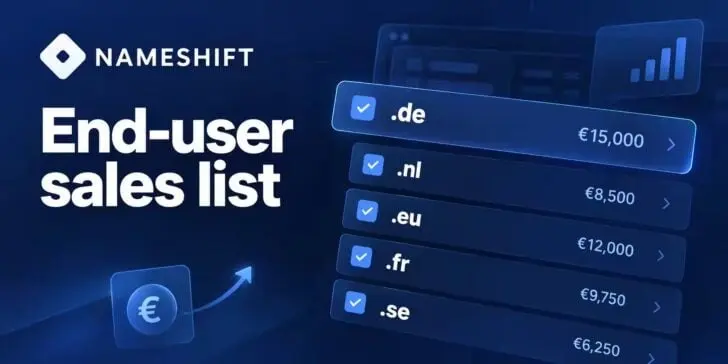
The secondary market for domain names remains a critical indicator of corporate strategy, brand expansion, and the shifting digital landscape. Recent data released by Nameshift, a prominent domain sales platform boasting an inventory of approximately 1.5 million assets, offers a revealing glimpse into the purchasing habits of European businesses. By analyzing a curated list of twenty-eight recent transactions involving end users—ranging from established luxury fashion houses to niche agricultural firms—we can see a clear trend: companies are increasingly willing to invest in country-code top-level domains (ccTLDs) to solidify their local presence and streamline their digital identities.
Nameshift’s portfolio is heavily weighted toward European ccTLDs, making its sales data particularly valuable for understanding regional market dynamics. The following analysis covers a variety of disclosed sales up to the €15,000 mark, highlighting how businesses across the continent are utilizing these digital assets to drive growth, protect their intellectual property, and improve user accessibility.
High-Value Strategic Upgrades and Market Entry
At the top of the recent sales list is Butchery.de, which commanded a price of €15,000. The acquisition appears to have been made by the operators of Butchery.nl, a Dutch meat specialist. This transaction is a textbook example of cross-border expansion within the European Union. For a successful business in the Netherlands, acquiring the corresponding .de extension is a logical step when entering the German market. In Germany, the .de extension is not merely a technical preference but a symbol of trust and localization. By securing the category-killer "Butchery" in the German namespace, the company positions itself as a primary authority in its field before even launching a full-scale regional campaign.
Similarly, the sale of MotorPartsDirect.co.uk for €8,743 represents a significant brand consolidation for the buyer. The company, Motor Parts Direct, has historically operated using the domain MPDonline.co.uk. While functional, the previous domain required customers to remember an acronym and an additional "online" suffix. By acquiring the exact-match domain that mirrors their full corporate name, the company eliminates friction in the customer journey. This type of "upgrade" is a common trend among established brick-and-mortar businesses that are looking to professionalize their online presence and improve their search engine optimization (SEO) performance.
The Value of Short-Form and Acronym Domains
The demand for three-letter domains remains high due to their memorability and versatility. KBW.nl sold for €7,500 to Kompas Begeleiding & Wonen, an organization that provides essential guidance and support for individuals navigating challenges such as addiction and probation. The organization currently utilizes the longer, more descriptive domain kompaszorgverlening.nl, but the acquisition of KBW.nl allows for a much cleaner corporate identity. Short domains are particularly effective for email addresses and physical marketing materials like business cards or vehicle wraps, where brevity is a premium.
In a similar vein, HVS.eu was acquired for €7,500 by HVS International. The company, which specializes in the trade of herbs, vegetables, and spices, found a perfect acronymic match in this domain. The .eu extension serves as an ideal platform for a company involved in international trade across the continent, signaling a pan-European reach rather than a focus on a single nation.
The Swedish market also saw activity in the three-letter space with the sale of ONC.se for €2,350 to ONC AB, an investment firm, and CJC.se for €2,000 to C.C. Jensen. C.C. Jensen, a company specializing in oil filtration and purification systems, likely viewed the acquisition as a necessary defensive and branding move to prevent confusion and provide a direct shortcut for their Swedish clientele.
Artificial Intelligence and the Tech Sector
The ongoing boom in artificial intelligence continues to influence domain acquisitions. Harbour.de was sold for €3,995 to a German AI consulting firm. As "Harbour" evokes a sense of safety and stability, it is an attractive brand name for a consultancy helping businesses navigate the often-turbulent waters of AI integration.
Furthermore, PlanetAI.de sold for €2,000 to Planet AI, a company that provides advanced AI-driven document solutions. This purchase is a classic example of a company securing its local ccTLD to complement its global presence; the firm primarily operates on planet-ai.com but recognizes the necessity of owning the .de variant to cater to its home market in Germany.
In the cryptocurrency space, Send.fi was acquired for €5,000. The Finnish .fi extension is highly regulated and regarded as one of the more secure ccTLDs in the world. For a crypto platform where trust is the primary currency, a clean, four-letter "call-to-action" domain like Send.fi provides an immediate sense of purpose and reliability.
Localization and Global Brand Protection
Global brands often find themselves needing to "mop up" various ccTLDs to protect their trademarks and ensure that local customers reach the correct destination. This month, the fashion giant Valentino secured Valentino.de for €2,000. While the company operates globally on a .com, owning the .de extension prevents bad actors from engaging in typosquatting or phishing and provides a seamless redirect for German shoppers who might instinctively type the brand name followed by their national extension.
Andis, a well-known American manufacturer of hair clippers and grooming tools, followed a similar strategy by purchasing Andis.de for €2,500. By securing the .de domain, Andis ensures its brand consistency remains intact as it serves the German market, mirroring the ownership of its primary .com asset.
Niche Markets and Keyword-Rich Domains
The data from Nameshift also highlights the importance of keyword domains for specific service industries. Aesthetics.nl was purchased for €2,500 by a skincare and beauty business in the Netherlands. For a service-based industry, owning the generic keyword for the entire sector can be a massive advantage in capturing organic search traffic.
In France, the domain Reiki.fr sold for €2,000. Interestingly, this domain currently forwards to a .eu version of the site for a reiki training center based in Geneva. This suggests that the buyer is looking to capture the French-speaking market across borders, using the .fr domain as a lead-generation tool to funnel traffic to their primary educational platform.
The German market saw a notable transaction with ReifenNotdienst.de, which sold for €1,995. The domain, which translates to "tire emergency service," was acquired by Ottomobile Mobiler Reifenservice, a mobile tire repair company. In an emergency, customers are likely to type exactly what they need into a search engine; having a domain that is an exact match for a high-intent search query is an invaluable asset for a service provider that relies on urgent, local calls.
Cultural Nuance and Diverse Business Interests
The sale of FOL.fr for €3,800 offers an interesting look at branding. In French, "fol" is an archaic or poetic form of "fou," meaning "crazy." The buyer is reportedly a luxury agriculture firm. This choice of branding suggests a move toward "boutique" or avant-garde marketing within the agricultural sector, using a short, punchy, and culturally resonant word to stand out in a traditional industry.
Other notable sales include:
- Vivar.ch (€1,995): Acquired by a Swiss e-commerce entity with a broad product range.
- BlueScale.co.uk (€1,751): Purchased by a financial consultancy firm, reinforcing the professional standard of the .co.uk extension for UK-based B2B services.
- VitaHealth.nl (€1,500): Bought by a biomarker testing company, highlighting the growth of the digital health sector.
- Joan.nl (€1,500): Acquired by the Joan Gallery in Amsterdam, a move that secures a short, personal, and memorable digital home for an arts institution.
Defensive Acquisitions and Redirects
Several sales in the Nameshift report involve companies purchasing domains that are not their primary web address, but rather tools for redirection. RenTree.nl (€3,500) now forwards to rentree.nu, serving as a portal for tenants of the landlord Rentree. This ensures that tenants who mistakenly use the .nl extension instead of the .nu extension still reach the correct login page.
Similarly, Meine-Auskunft.de (€1,790) forwards to Auskunft.de, a business directory. By owning various iterations of "Auskunft" (information/directory), the parent company Alpha Neun GmbH & Co. KG can capture a wider net of search traffic and protect its market share from competitors.
Some acquisitions remain slightly more mysterious. Ecotree SAS, a firm known for selling carbon credits and environmental solutions, purchased Respond.de for €1,790. While the immediate connection isn’t clear, it likely signals a new project or a specific marketing campaign focused on "responding" to the climate crisis. Similarly, the clothing brand LERROS Moden GmbH acquired Monograph.de for €1,790, possibly for a new sub-brand or a specific editorial line of fashion content.
Conclusion of the Current Market Cycle
The diverse range of sales at Nameshift underscores the enduring vitality of the European ccTLD market. Whether it is a youth travel agency securing JongerenTravel.nl (€1,500) or an investigative news outlet like Follow The Money acquiring FollowTheMoney.eu (€1,500) to protect its brand, the motivation remains consistent: a domain is more than just an address; it is a strategic business asset. As the digital economy in Europe continues to mature, the premium on clear, concise, and localized domain names is only expected to grow, providing companies with the necessary tools to establish trust and authority in their respective markets.
 Web Hosting & Domain Management
Identity Digital spins out agentic effort, now called Known
The transition marks a significant milestone for the project previously known as...
 Web Hosting & Domain Management
WIPO Panel Rebukes Temperley Holdings in Attempted Takeover of Founder’s Personal Domain Name
In a significant ruling that underscores the complexities of personal branding and...
 Web Hosting & Domain Management
Cloudflare Continues Upward Trajectory as GoDaddy and Namecheap Maintain Lead in Latest .com Registrar Report
The landscape of the .com domain namespace continues to undergo significant shifts...







